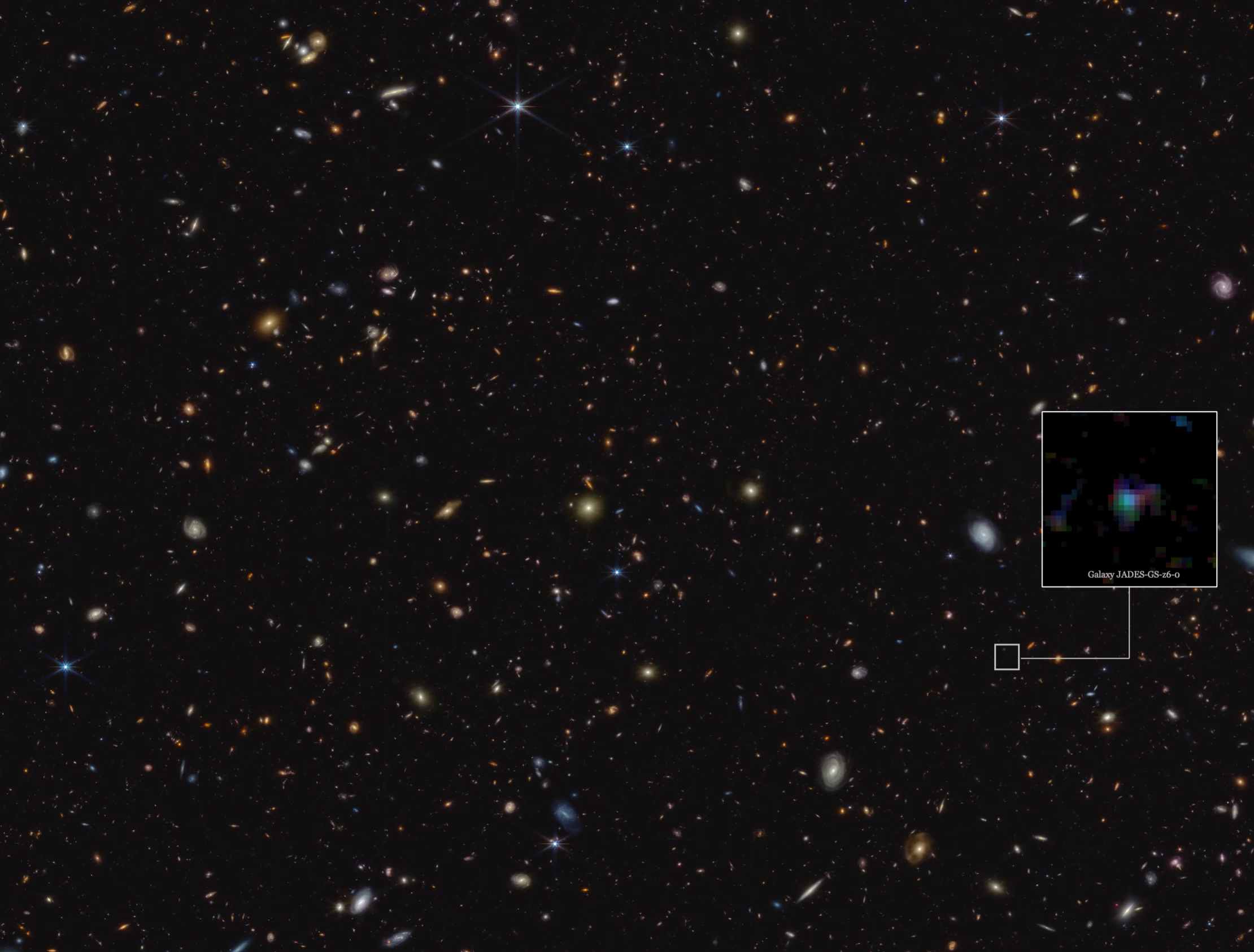
Nearly 800,000 galaxies captured by JWST's NIRCam, overlaid with a dark matter distribution map shown in blue
AI × astronomy

An AI that taught itself what noise looks like found three times more galaxies in JWST data

A team at Tsinghua University built a neural network called ASTERIS that strips structured noise from telescope images, without ever seeing a clean reference frame. Applied to JWST deep-field data, it recovered galaxies one full apparent magnitude fainter than previous pipelines could detect, and tripled the number of galaxy candidates at redshifts above 9. The paper landed in Science in April 2026, and the code is on GitHub. One magnitude sounds modest until you remember the scale is logarithmic. A gain of 1.0 mag means detecting objects 2.5× dimmer. That’s roughly equivalent to doubling the mirror area of the telescope that took the data. ASTERIS achieves it with software alone. ...

June 16, 2026 · 6 min · Andreas Ioannou
Artemis I, Crew-4, & Starlink Rockets on the Pad
Space news

SpaceX went public at $1.77 trillion — what that means for the night sky

On June 12, SpaceX raised $75 billion in the largest initial public offering in history. The company listed on the Nasdaq at $135 per share, valuing the business at approximately $1.77 trillion — putting it among the ten most valuable public companies on Earth. Within hours of the listing, a Falcon 9 carrying 29 Starlink satellites lifted off from Cape Canaveral. The symbolism wasn’t accidental. The reason SpaceX commands that valuation isn’t Starship, and it isn’t the Artemis HLS contract. It’s 10,400 satellites already in orbit, beaming internet to paying subscribers in 75+ countries. Starlink generates an estimated 58% of SpaceX’s total revenue. When public investors bought SpaceX stock this week, they bought a satellite internet company that also happens to build rockets. ...

June 14, 2026 · 6 min · Andreas Ioannou
Total solar eclipse showing the Sun's corona radiating outward from behind the Moon's dark silhouette
Celestial event

Europe's first total solar eclipse in 27 years arrives on August 12 — at sunset

On August 12, 2026, at 18:28 UT, the Moon’s shadow will touch down on the coast of Galicia in northwestern Spain. For about 1 minute 50 seconds in Oviedo — less in Bilbao, more in León — the Sun will disappear behind the Moon while sitting roughly 10° above the western horizon. It will be the first total solar eclipse visible from mainland Europe since August 11, 1999. Totality happens at sunset, during the Perseid meteor shower peak, under a new moon. For anyone in the path, the sequence is: watch the Sun vanish near the horizon, turn east, and count Perseids across a moonless sky all night. ...

June 13, 2026 · 7 min · Andreas Ioannou
Infrared image of the Vela Molecular Ridge captured by NASA's SPHEREx, showing glowing interstellar dust and gas
Space science

Astronomers detected a true sugar in interstellar space for the first time

A Spanish-led team has detected erythrulose, a four-carbon ketose and the first true monosaccharide ever confirmed in interstellar space, inside a molecular cloud near the Galactic Center roughly 26,000 light-years from Earth. The preprint, posted to arXiv on June 2, draws a line from a specific interstellar molecule to the chemistry of TNA (Threose Nucleic Acid), a simpler genetic polymer that may have preceded RNA on early Earth. Not the first “sugar in space” headline, but the first actual sugar You may remember headlines from 2012 about sugar molecules found near a young star. Those referred to glycolaldehyde, a two-carbon hydroxyaldehyde with the formula C₂H₄O₂. It’s the simplest molecule that participates in sugar chemistry, and it can react with other molecules to eventually form ribose. But glycolaldehyde isn’t a sugar. It has two carbon atoms; the smallest molecule that counts as a monosaccharide needs at least three. ...

June 11, 2026 · 6 min · Andreas Ioannou
Artist's rendering of the star Vega, a blue-tinged white main-sequence star in the constellation Lyra
Beginner stargazing

How to find the Summer Triangle: three stars, no gear, one June evening

If you step outside tonight around 22:00 local time and face east, you’ll see a bright blue-white star roughly a third of the way up from the horizon. That’s Vega — the fifth-brightest star in the entire sky, magnitude +0.03, and your entry point to the largest asterism of the summer. Vega belongs to a pattern called the Summer Triangle: three stars in three separate constellations that together frame one of the richest stretches of sky visible from northern latitudes. You don’t need a telescope. You don’t need an app, though one helps. All you need is a clear evening and a rough sense of east. ...

June 9, 2026 · 7 min · Andreas Ioannou
A person gazing at the Milky Way from a mountain lake under a dark sky
Astrotourism

Kefalonia's Mount Aenos: stargazing from Greece's first and only dark sky park

Greece has one certified dark sky park. It’s on Kefalonia, on top of Mount Aenos, inside a national park that was established in 1962 to protect a fir tree found almost nowhere else. The fir is still there. So are skies dark enough to earn DarkSky International certification in 2023 — the first site in Greece to manage it. If you’re planning a Greek island trip this summer and you own a pair of binoculars, Aenos deserves a night. ...

June 7, 2026 · 7 min · Andreas Ioannou
JWST near-infrared image of the Cosmic Cliffs in the Carina Nebula, showing towering pillars of gas and dust backlit by young stars
Gear

Light pollution filters from a Bortle 7 balcony: what actually helps and what doesn't

I shoot from a fourth-floor balcony in Nicosia. Bortle 7 on a clear night, Bortle 8 when the football pitch lights are on. Every spring, someone in the astrophotography forums asks: “Which filter should I buy for light-polluted skies?” The answers range from “get an L-Pro” to “move to the countryside.” Neither is particularly useful if you’re standing on a balcony with a one-shot colour camera and two hours before the neighbour’s security light comes on. ...

June 6, 2026 · 8 min · Andreas Ioannou
A deep-field view of the sky captured by NASA's Spitzer Space Telescope showing hundreds of faint distant galaxies scattered across the frame
AI × astronomy

Rubin Observatory sends millions of alerts per night. Nine ML brokers sort them.

On February 25, 2026, the Vera C. Rubin Observatory in Chile sent its first batch of real-time alerts — 800,000 of them in a single night. Each one flagged something that changed in the sky: a new point of light, a brightening star, a moving dot that might be an asteroid. The Legacy Survey of Space and Time (LSST) had officially started talking. That was the gentle version. At full survey depth, Rubin will generate up to 10 million difference-image alerts every night. No research group, no observatory control room, no grad student with a caffeine problem can review that by hand. The only reason the alerts are useful at all is a network of nine community software platforms — called alert brokers — that run machine-learning classifiers on every packet before the Sun comes up. ...

June 4, 2026 · 6 min · Andreas Ioannou
Venus, Moon, and Jupiter in conjunction above the horizon
Celestial event

Venus–Jupiter conjunction on June 9: both planets fit in one binocular view

On the evening of June 9, Venus and Jupiter close to within roughly 1.5° of each other, about three full-moon widths, low in the western twilight. Venus, near magnitude −4, is the brighter of the two. Jupiter sits at about magnitude −2, dimmer but impossible to miss. Both planets fit comfortably inside a standard binocular field of view, and you don’t need anything more than your eyes to enjoy the pairing. The show runs for the better part of a week on either side of the closest approach, so one cloudy night won’t ruin it. ...

June 2, 2026 · 7 min · Andreas Ioannou
NASA Administrator Jared Isaacman views Blue Origin's Blue Moon Mark 1 lunar lander Endurance at the company's facility in Florida
Space news

NASA named it Moon Base, and the first lander launches this fall

On May 26, NASA Administrator Jared Isaacman stood at agency headquarters in Washington and gave the lunar program something it hasn’t had before: a name with “base” in it. The program is called Moon Base. Three uncrewed landers are targeting the lunar south pole before the end of 2026. Behind them, $440 million in contracts for two crewed rovers. Behind that, a phased timeline stretching into the 2030s for power grids, hopping drones, and eventually semi-permanent crew presence. ...

May 31, 2026 · 6 min · Andreas Ioannou