Saturn Atmosphere
Space science

JWST found methane on a Saturn-sized world with Earth-like temperatures

TOI-199b sits about 330 light-years from Earth, orbits a Sun-like star every 105 days, and holds an equilibrium temperature of roughly 352 K (79°C). That’s warm by terrestrial standards but downright mild for an exoplanet, where “hot Jupiter” atmospheres regularly top 1,500 K. A team led by Aaron Bello-Arufe at Penn State pointed JWST at a single transit of this world and pulled methane out of its atmosphere, making TOI-199b the first temperate giant exoplanet whose atmospheric composition has been directly measured. ...

May 30, 2026 · 6 min · Andreas Ioannou
Four planets aligned above the horizon in the predawn sky, photographed from Brisbane, Australia
Beginner stargazing

Five planets you can see without a telescope this June

All five naked-eye planets are out this June, split between the evening and morning sky. The headline act: Venus and Jupiter converge to within 1°38’ of each other on June 9, the two brightest objects in the night sky after the Moon, close enough to cover both with your thumb at arm’s length. You don’t need a telescope, a dark sky, or any experience. Here’s where and when to look. ...

May 28, 2026 · 6 min · Andreas Ioannou
Milky Way Untangled
Gear

How to choose a star tracker for Milky Way season

The Milky Way core is above the horizon from the northern hemisphere between roughly May and September. From my latitude in Nicosia (35°N), the galactic center tops out at about 26° above the southern horizon. Low enough that Troodos at 1,700 m is worth the midnight drive, but high enough to image from anywhere with a clear southern view. If you own a camera and a lens wider than 50 mm, a star tracker is the cheapest single upgrade that turns a noisy 15-second snapshot into a clean, deep wide-field frame. I’ve spent the past few months researching them before committing to one. Here’s what the specs mean and which three models are worth comparing. ...

May 26, 2026 · 7 min · Andreas Ioannou
The Telescopio Nazionale Galileo at Roque de los Muchachos Observatory on La Palma, with the Andromeda galaxy visible in the night sky
Astrotourism

La Palma: the island that wrote dark skies into law

La Palma has something no other island in the world can match: a national law — Ley 31/1988, the Ley del Cielo — that controls every streetlight, bans upward-pointing fixtures, and dims the grid after midnight. The law exists to protect the sky above the Roque de los Muchachos Observatory, where the 10.4 m Gran Telescopio Canarias sits at 2,396 m altitude. The side effect for visitors is an island with some of the darkest measured skies in Europe, over 300 clear nights per year, and 16 purpose-built astronomical viewpoints. ...

May 24, 2026 · 7 min · Andreas Ioannou
Image of Sun from NASA's Solar Dynamics Observatory
AI × astronomy

Machine learning is learning to hear inside the Sun

The Sun is a bell. Not a metaphor — the entire solar interior resonates with acoustic waves, trapped pressure oscillations that bounce between the surface and the core roughly every five minutes. The field that studies these oscillations is called helioseismology, and for three decades a network of ground stations has been recording every pulse. A team at the University of Sheffield and the National Solar Observatory just ran 30 years of those oscillations through three different machine learning architectures. All three converge on the same prediction: Solar Cycle 25 peaked in early 2025, and the next minimum falls around 2030–2031. The paper, published this month in Solar Physics, is one of the first to treat the Sun’s acoustic frequency shifts as a forecasting signal for the solar cycle — not just a diagnostic one. ...

May 21, 2026 · 6 min · Andreas Ioannou
Full disc of the Moon showing maria and craters, imaged by NASA Goddard Space Flight Center
Celestial event

May 31 brings a Blue Micromoon — the smallest full moon of 2026

On May 31 at 08:45 UTC, the Moon reaches full phase for the second time this month. That second-in-a-month qualifier makes it a Blue Moon by the modern calendar definition. It also happens to sit near apogee — 406,135 km from Earth — making it a Micromoon: roughly 5.5% smaller in angular diameter and about 10% dimmer than an average full moon. It’s the most distant full moon of 2026. And if you walk outside that night expecting something visibly unusual, you’ll be disappointed. ...

May 20, 2026 · 6 min · Andreas Ioannou
STS-47 view of the Aurora Australis
Space news

SMILE is in orbit: what happens between now and the first X-ray image of Earth's magnetosphere

At 03:52 UTC this morning, a Vega-C rocket lifted off from Kourou carrying SMILE — the Solar wind Magnetosphere Ionosphere Link Explorer — into a 707 km circular parking orbit. ESA’s New Norcia ground station in Western Australia picked up the spacecraft’s first signal at 04:48 UTC. Solar panels deployed one minute later. The first mission designed to X-ray Earth’s entire magnetosphere in real time is alive and drawing power. I covered the science in detail two weeks ago, before the launch window opened. Now that the spacecraft is actually flying, here’s what happens between today and the first X-ray image of Earth’s magnetic shield — and when the data starts mattering for aurora forecasts. ...

May 19, 2026 · 6 min · Andreas Ioannou
Thousands of galaxies in the Hubble Frontier Fields parallel observation near Abell 2744, showing the deep universe in the constellation Sculptor
Space science

JWST's largest survey mapped the cosmic web across 13 billion years

When you look at galaxies through a telescope — scattered across the field like grains on dark cloth — it’s tempting to think they’re placed at random. They aren’t. Galaxies live on a structure so vast that the only metaphor that survives at scale is a web: long filaments of matter, hundreds of millions of light-years across, connecting dense knots of galaxy clusters and skirting nearly empty voids. This month, the largest survey JWST has carried out gave us the clearest map of that web to date, tracing it back to a time when the universe was barely a billion years old. ...

May 17, 2026 · 7 min · Andreas Ioannou
The Big Dipper asterism above trees at night, with thin clouds, over Brastad, Sweden
Beginner stargazing

Five star-hops from the Big Dipper: a beginner's map to the May sky

You don’t need an app tonight. You need one pattern. The Big Dipper sits almost directly overhead on May evenings from mid-northern latitudes, and its seven stars — all between magnitude +1.8 and +3.3, easy to spot even under suburban light pollution — form the single best starting point for learning the rest of the sky. Five hops, no telescope, about ten minutes. What star-hopping is Star-hopping is the oldest navigation trick in observational astronomy: use a pattern you already recognise to find something you don’t. Point your eyes at a known bright star, move a known angular distance in a known direction, and land on the next target. ...

May 14, 2026 · 6 min · Andreas Ioannou
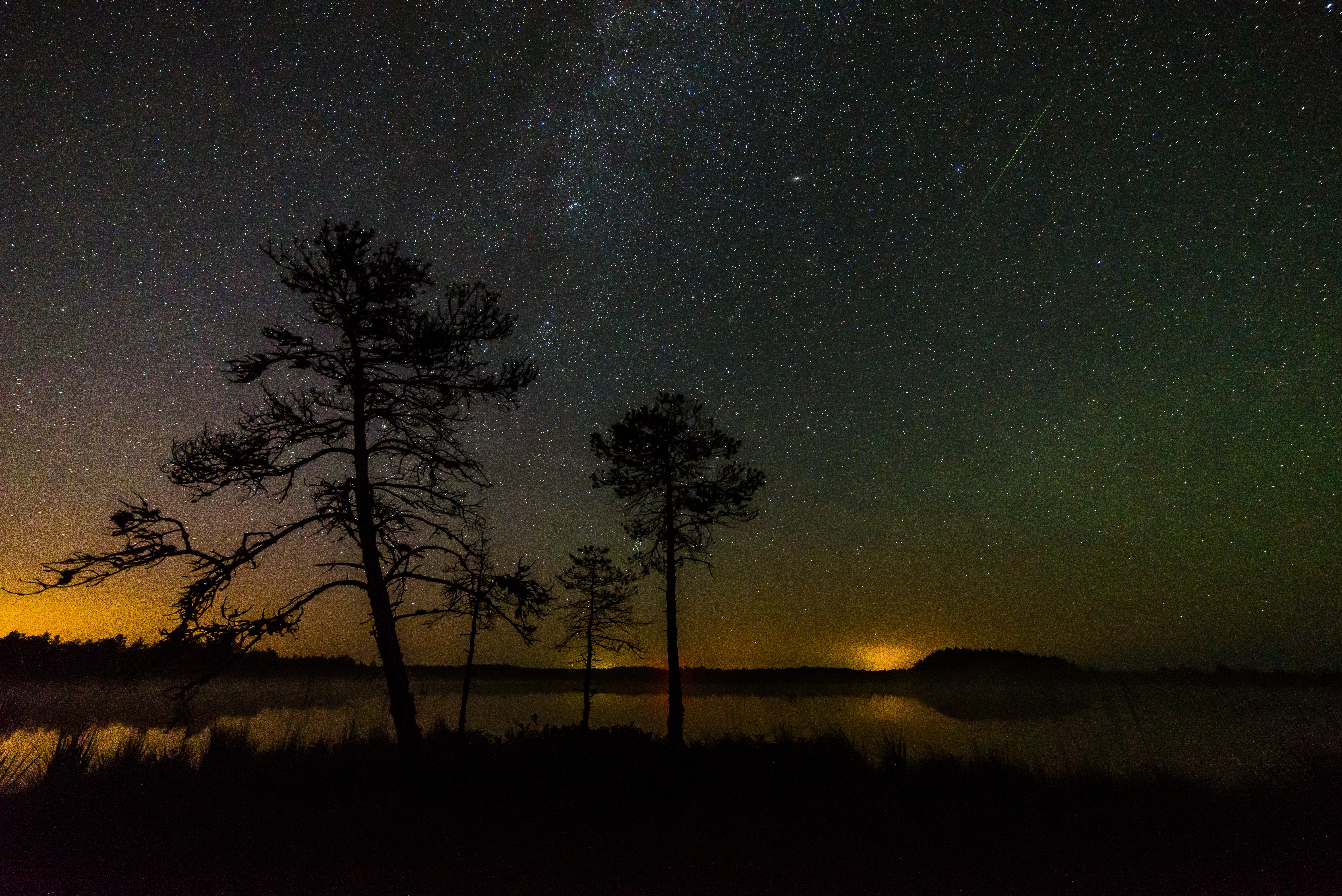
Milky Way panorama over a lake at night
Astrotourism

Alqueva Dark Sky Reserve: 10,000 km² of protected night sky in Portugal's Alentejo

Southern Portugal’s Alentejo region is flat, dry, and almost empty. The largest artificial lake in Western Europe — Alqueva — sits at its center, surrounded by cork oak plains, whitewashed villages, and roughly zero urban light domes. In 2011, the Starlight Foundation (supported by UNESCO, the IAU, and UNWTO) certified a 10,000 km² zone around the lake as the world’s first Starlight Tourism Destination. Fourteen years later, the reserve is still one of the darkest accessible skies in Europe, and one of the easiest to reach. ...

May 13, 2026 · 7 min · Andreas Ioannou