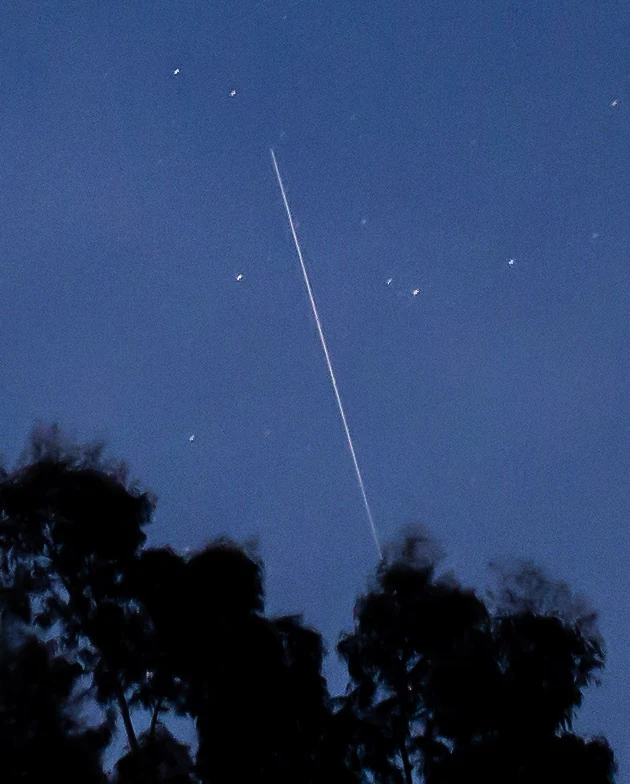
The Lyrids peaked around 19:40 UT on April 22 — essentially yesterday evening for anyone in Europe. Conditions were as good as this shower gets: a new moon on April 17 meant only a thin crescent in the sky, and it set before 10 pm local, leaving the prime post-midnight hours properly dark. Under a clean dark site the International Meteor Organization expected 18–20 meteors per hour at the peak. From a light-polluted backyard, Space.com put realistic rates closer to 8–12/hour.
If you caught them from Troodos or any 4-Bortle-or-better site, that’s probably what you saw: a meteor every three or four minutes once the radiant climbed above the Nicosia rooftops, brighter ones visible through thin altitude haze. If you were in the suburbs, maybe one every ten. That’s the Lyrids being themselves. They’re not a display shower; they’re a scheduled reminder that Earth is moving, and once a year we plow through the trail of comet C/1861 G1 Thatcher, which last visited the inner solar system in 1861 and won’t be back until around 2283.
The shower tapers fast. You can still catch the occasional Lyrid tonight and tomorrow — the IMO lists residual activity running through April 25 — but the rate drops sharply after the peak. What actually matters now is what’s coming in two weeks.
The Eta Aquariids: better shower, worse year
The Eta Aquariid meteor shower peaks on the morning of May 5–6, 2026. Under ideal conditions, EarthSky lists up to 50 meteors per hour. That’s roughly three times the Lyrid rate. And the parent is Halley’s Comet — yes, that Halley, visiting every 76 years. Every May and (again in October, as the Orionids) we drift through the debris it sheds each time it swings through.
Two things work against Cyprus observers this year.
Geometry. The radiant is in Aquarius, around the star η Aquarii. At Cyprus’s latitude (34–35° N) that radiant barely clears the horizon before dawn. Roughly the last hour of dark sky is all you get, and even then the radiant sits low in the southeast. The Southern Hemisphere is where this shower rewards observers; from the Mediterranean we see maybe a third of what New Zealand gets.
The moon. Last night’s Lyrids had near-new skies. The Eta Aquariids this year will not. The moon on May 5–6 is waning gibbous — roughly 75 % illuminated, rising late evening and still hanging in the sky when the radiant finally comes up. Royal Museums Greenwich flagged this as the dominant problem for 2026: bright moonlight during the exact pre-dawn window you’d otherwise use. It won’t kill the shower. It will wash out anything fainter than magnitude +2, which is most of them.
How to plan a compromised peak
I’ve worked through a few strategies for a low-radiant-plus-bright-moon scenario. None of them recover a clean peak. All of them save something.
Observe a couple of nights early. The Eta Aquariids have a broad, flat peak — activity is roughly 50 % of peak for three or four nights on either side of May 5. On May 2 and 3, the moon rises several hours later than on peak night. You sacrifice meteor rate but get darker sky before moonrise.
Use terrain to block the moon. This works better than it sounds. On Troodos, find a ridge or building edge you can sit behind, with the moon blocked and the southeast horizon clear. The main-road parking spots on the north side of Olympos work; the Amiantos area has more open horizons.
Face away from the radiant. Standard meteor-observing advice anyway, but it matters more here. Meteors appear from the radiant, but you want them crossing a dark field of view, not streaking near a bright moon. Face 90° away — northeast toward Cassiopeia, say — and catch them on their tracks across dark sky.
Accept fewer, brighter meteors. The moon kills the faint ones. Anything that survives moonlight will be a +1 or +2 magnitude fireball. You’ll see fewer but they’ll be worth seeing.
Cape Greco as an alternative. Down on the southeast coast, Cape Greco at Paralimni has open sea to the south — the radiant rises over water, which means no terrain cutoff on the horizon. Light pollution is higher than Troodos (Bortle 5 vs. 3–4), but the geometry advantage partly compensates. If you can only do one site, pick Troodos for the Lyrids/Perseids/Geminids and Cape Greco for the Eta Aquariids.
Reading a meteor forecast without getting burned
Every source you’ll check quotes a ZHR (Zenithal Hourly Rate). It’s worth knowing what that number means so you don’t show up expecting 50/hr and feel cheated.
ZHR is the theoretical rate if three things are simultaneously true: the radiant is directly overhead, the sky is perfectly dark (magnitude 6.5 limiting), and your eyes can cover the full sky. None of those are ever true. A rough approximation for what you’ll actually see:
observed rate ≈ ZHR × sin(radiant altitude) × dark-sky factor
The dark-sky factor is roughly 1.0 at a real Bortle-3 site, 0.5 in suburbia, 0.2 in a city. For the Eta Aquariids from Cyprus at 04:30 local, with the radiant maybe 25° up and a Troodos dark site factor of ~0.7, you multiply 50 × sin(25°) × 0.7 ≈ 15/hour, then knock off another third for moon. So realistically you’re looking at 8–10 meteors/hour from the best Cyprus site, during the one hour before the sky starts to turn.
That’s still several times better than a normal suburban shower. It’s also far from the 50/hr the headlines quote. Both numbers are real. They just describe different universes.
The gear question (still: none)
Meteor showers remain the one kind of astronomy where a telescope is actively wrong — it narrows your field of view to a postage stamp and meteors will cross everywhere else. Binoculars have the same problem.
What actually helps:
- A red-light headlamp. Any “astronomy mode” phone light works. White light ruins dark adaptation for 20 minutes each time.
- Layered warm clothing. Troodos at 4 am in May is often single-digit Celsius. Sea-level southern Cyprus is mild but damp — bring more than you think.
- A reclining camping chair or closed-cell foam pad. You’ll be looking straight up for an hour. Your neck will thank you.
- Stellarium or Sky Safari on a phone, in red-light night mode, to find the radiant. Not strictly needed for meteor watching, but helpful when you want to name the constellation you’ve been staring at.
That’s it. Every other “essential” you’ll see on gear-affiliate posts is trying to sell you something for an event that requires your eyes and a dark patch of sky.
FAQ
Do I need a telescope to see the Eta Aquariids?
No. A telescope actively hurts. Meteor observing uses the widest possible field of view, which is your unaided eye.
Why are the Eta Aquariids named after a star?
The shower’s radiant — the point meteors appear to stream from — sits close to the star η (eta) Aquarii in the constellation Aquarius. The radiant is a perspective effect; meteors are actually moving parallel through Earth’s atmosphere, but we see them diverge from a common direction on the sky.
Can I see any meteors from central Nicosia?
A few of the brightest ones per hour, yes. The Lyrids last night produced the occasional fireball visible even through streetlight glare. For the Eta Aquariids with a bright moon, expect maybe 2–4/hour from a city sky.
Is the 2022 Lyrid outburst going to repeat?
No prediction for 2026. Historical outbursts (1803, 1982, 2022) are unevenly spaced and not currently understood well enough to forecast. The shower’s normal baseline is 18–20 ZHR; treat anything beyond that as a bonus.
What’s next
After the Eta Aquariids, the calendar goes quiet until summer. The next big event for Europe is a double header on August 12, 2026: the Perseid meteor shower peak — a real 100/hr shower — coinciding with the total solar eclipse over northern Spain, Iceland, and western Ireland. Same night. New moon. Both are going to earn their own dedicated posts starting around mid-June.
For now, set a calendar reminder for the early hours of May 5, find a site with a clear southeast horizon and a ridge to block the moon, and accept that this year you’re observing the Eta Aquariids in hard mode.