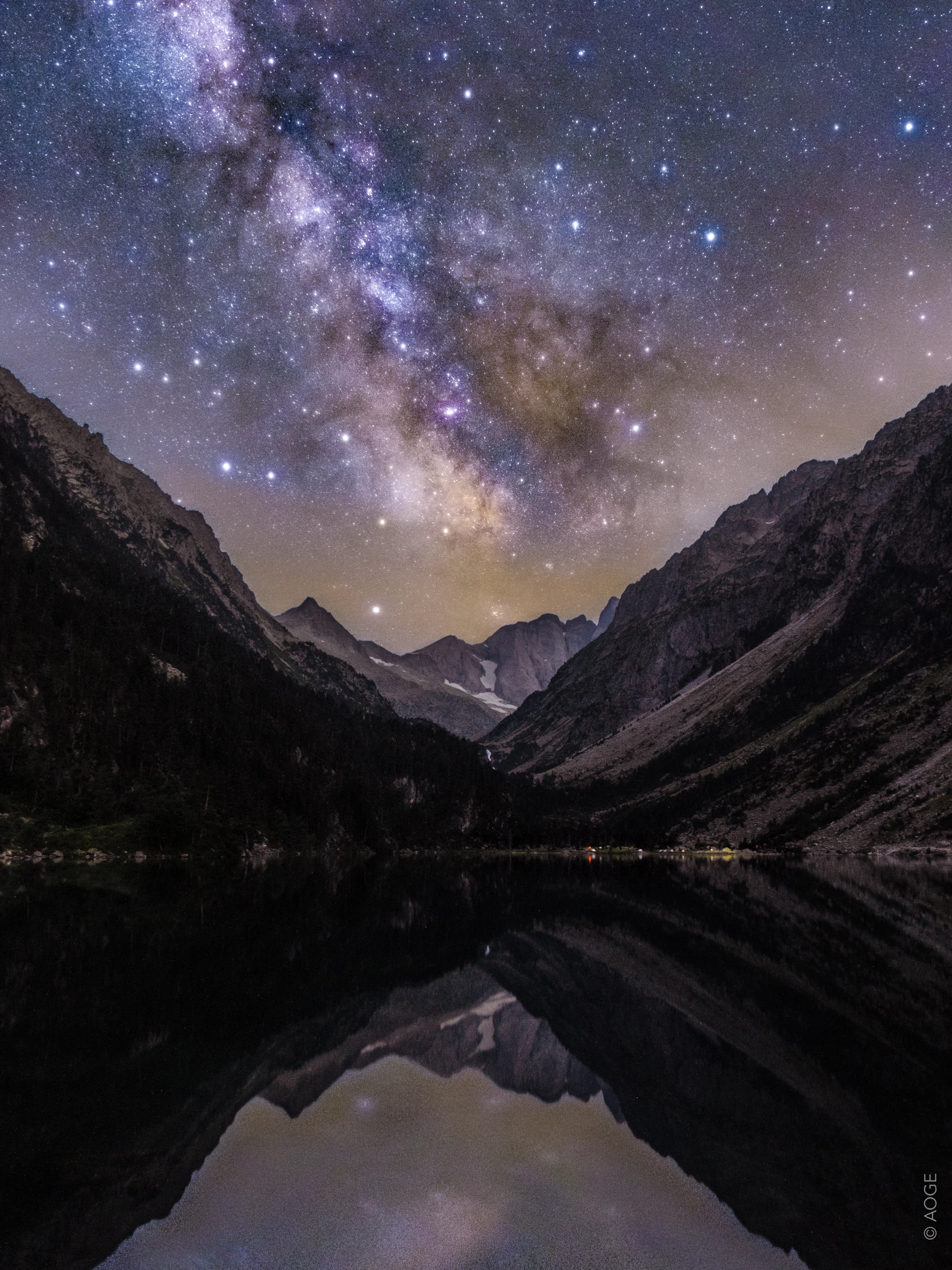
If you live anywhere on Cyprus, you can be under SQM 21.3 skies in 90 minutes. The Troodos massif covers the central third of the island, peaks at 1,952 m on Mount Olympus, and is the only place on Cyprus with both real darkness and paved roads to it. From my balcony in Nicosia (Bortle 7, SQM around 19.0 on a good night), the difference is roughly two visual magnitudes. The Milky Way goes from “you can almost see it” to “you can read your watch by it.”
This is the practical guide I wish someone had handed me when I started driving up there. What you’ll see, where to set up, what’s working against you, and how to plan a night.
How dark is it, really?
The central Troodos region, meaning the area within ~10 km of Mount Olympus, measures around SQM 21.3–21.4 at zenith. That’s reported by Italian astrophotographer Emmanuele Sordini, and it lines up with my own Sky Quality Meter readings on moonless nights. In Bortle terms, that’s the dark end of class 4, brushing into class 3 on the cleanest nights. The Paphos Forest section in the northwest is darker still, with SQM around 21.65 at zenith, but the trade is real. Winding mountain roads, dense pine cover with few open viewing spots, and the Kykkos Monastery throws a noticeable light dome including some bright green floodlights that you’ll curse if you’re trying to image to the south.
Most readers won’t drive to Paphos Forest on a weeknight. The real question is what the central Troodos sites deliver, since they’re accessible from any major Cypriot city in under two hours and have parking and paved roads. They’re dark enough that the Milky Way’s structure is naked-eye obvious from horizon to horizon, dark enough that the limiting magnitude is around 6.5 on a good night, and dark enough that M31 (Andromeda) is direct-vision naked-eye without averted vision tricks.
What you’ll see on a moonless night
Numbers don’t translate directly into experience, so here’s what I see on a typical moonless August night from a clearing near Troodos village (1,725 m):
- The Milky Way’s dark rift through Cygnus is plain naked-eye. The extension of that rift down through Aquila is visible too.
- The unresolved star fields around Sagittarius are bright enough to cast a faint glow on a sheet of paper. The first time I noticed this from Troodos, I thought the Moon was rising.
- M31 (Andromeda) sits in the eyepiece of nothing. You can just look at it. Its companion M33, the Triangulum galaxy, is on the edge of naked-eye visibility — averted vision and dark adaptation help.
- M13, the Hercules cluster, is a faint patch with averted vision. A pair of 7×50 binoculars makes it obviously not a star.
- The Pleiades show six or seven stars without optical aid. From central Nicosia, four is a stretch.
- The zodiacal light is present before dawn in late summer and early autumn. A faint cone of light running up the ecliptic, easier to see than the Milky Way once you know where to look.
The southern horizon is partly obstructed by the massif itself, depending on where you set up. This costs several degrees of altitude on objects that culminate south. Sagittarius and the galactic center never get as high as they should by purely terrestrial geometry. The Mount Olympus summit does better but is closed to the public at night because of the radar dome up there. From Troodos village proper, you compromise.
Three sites worth driving to
I’ve tried five or six observing sites in the central Troodos region. Three are worth bothering with for someone driving up from one of the coastal cities.
1. The clearing west of Troodos village
A 5-minute drive uphill from Troodos village, past the Troodos National Forest Park visitor center, on the road toward Mount Olympus’s lower flanks. There’s an unmarked grassy clearing on the northern side of the road around 1,700 m elevation. Decent zenith view, OK to the north and west. Limassol’s light dome cuts the bottom 10–15° to the south.
2. The Prodromos plateau
Prodromos is the highest village on Cyprus at around 1,400 m. There’s open ground on the western edge of the village, away from the streetlights, with a panoramic view of the western and northern sky. SQM is similar to the Troodos village clearing, call it 21.2–21.3, but the western horizon is genuinely flat. Best site I’ve found for low-altitude western targets.
3. The road up to the Throni / Kykkos junction
Driving from Pedoulas toward Kykkos, there’s a series of pull-offs around the 1,200 m mark before you reach the Kykkos light dome. Not as dark as the higher sites but more open, and you avoid the southern obstruction problem. Stop before the monastery. Past it, you’re in the dome.
I’ve stopped recommending the actual Mount Olympus summit area. The access road is closed at night, and the radar dome’s red lights are visible from the saddle.
When to go
Best months: September and October. Cyprus summers are dry but the seeing is often awful. Heat shimmer rises off the limestone all day, which translates to high atmospheric turbulence well into the night. By September, daytime temperatures drop, the upper atmosphere stabilizes, and you get reliably transparent dark nights. October adds the bonus of the Orionid meteor shower and the early winter constellations rising before midnight.
Avoid December through February at the higher sites. Troodos gets snow. There’s actually a small ski resort on Mount Olympus, and the access roads close intermittently. Even when they’re open, condensation forms fast on telescope optics at near-freezing temperatures and most of the guesthouses shut for the season.
Lunar timing matters more here than at a darker site. With this kind of sky, the Moon’s contribution dominates as soon as it’s a thin crescent. A waxing gibbous moon turns Troodos into the equivalent of suburban Limassol for deep-sky purposes. Plan around new moon ± 5 days.
Weather forecasting: Meteoblue’s astronomy seeing forecast is the single most useful resource I’ve found. It accounts for jet stream position, atmospheric turbulence, and cloud cover, and is more reliable for Cyprus than the generic stargazing forecasts.
Light pollution: what you’re up against
Troodos’s main light-dome problems, in rough order of how much they cost an observer:
- Nicosia, ~50 km northeast. The light dome cuts about 20° into the sky in that direction. Polaris sits in that quadrant from anywhere on Cyprus, so polar alignment is harder than it should be from a true dark site.
- Limassol, ~40 km south. Smaller dome but uncomfortably positioned. The southern Milky Way passes through it, and most of the deep-sky targets you actually want to image at Cypriot latitudes are to the south.
- Paphos, ~50 km west. More distant, lower dome of about 10–15° vertical extent on a clear night.
- Larnaca, ~75 km southeast. Minor contributor.
For visual observation, none of these are deal-breakers above ~25° altitude. For astrophotography, the southern dome from Limassol is the real cost. You’ll lose perhaps 0.5 magnitudes of contrast on M8, M16, and the galactic center region versus a true sea-horizon site at the same SQM.
Getting there
Drive times to Troodos village from the major cities, no traffic, late evening:
- Nicosia to Troodos: ~75 min via the B9 through Astromeritis and Kakopetria. Good road.
- Limassol to Troodos: ~50 min. Shortest drive, climbs steeply.
- Larnaca to Troodos: ~95 min via the A1/B22.
- Paphos to Troodos: ~75 min via the B7 through Pano Panagia.
There is no public transport that works for night observing here. You need a car. Roads are paved and well-maintained but include a lot of switchbacks above 1,200 m. Drive slower than you think on the way up, much slower on the way down.
Practical setup
A few things I’ve learned the slow way:
- Bring layers. Even in July, the temperature at 1,700 m drops to around 12 °C by 3 AM. In October it’s closer to 5 °C. The dew point is higher than you’d expect for an island. Pine forests hold humidity.
- Park considerately. Most of the clearings I described are unofficial pull-offs. Nobody will bother you if you set up quietly, but blocking the road or running a generator will draw attention.
- No artificial light. This includes phone screens. Apps like SkySafari or Stellarium on red-screen mode are fine. Checking Instagram with full brightness will end your dark adaptation in two minutes and your neighbor’s in twenty.
- Bring a star atlas or planisphere as backup. Cell coverage in central Troodos is patchy and there are dead zones around Mount Olympus.
- For overnight stays, the villages of Pedoulas, Platres, and Kakopetria all have small guesthouses and tavernas. Nothing fancy. Pedoulas is closest to Prodromos and the Kykkos road sites. Platres puts you closer to the Troodos village viewpoint.
What I bring up
A typical session for me: a Seestar S50 (the smart telescope that reawakened my hobby), 8×42 binoculars, a Sky-Watcher Heritage 130p when I want a more traditional dob session, and a thermos. The Seestar handles deep-sky imaging without polar alignment, which is lifesaving when you’re setting up after a 90-minute drive at 11 PM. The dob handles visual on planets and the brighter Messiers. You don’t need an EQ mount and an autoguider for Troodos to be worth the trip.
If you’re a beginner with no gear, bring your eyes and a reclining chair. A sky like this deserves a deck chair more than it deserves a mediocre 8" Newtonian. I’ve had some of my best Troodos nights doing nothing but lying back and tracking satellites, ISS passes, and the slow rotation of the summer Milky Way overhead. The naked-eye experience is the actual gift here. The hardware just lets you look at one specific corner of it for longer.
What Troodos isn’t
It isn’t La Palma’s Roque de los Muchachos. It isn’t the Atacama. The seeing is mediocre by professional-observatory standards because Cyprus sits in the path of dust transport from the Sahara, and the eastern Mediterranean climate doesn’t deliver Antofagasta’s transparency. The southern horizon is partly compromised by the massif’s own geometry. There’s no on-site infrastructure for visiting astronomers. No observing pads, no observatories open to the public, no formal dark-sky reserve designation.
What it is: a working dark site in the eastern Mediterranean basin that you can drive to from any major Cypriot city in an evening. For Cyprus residents, that’s the only such site on the island. For visitors who care about the sky, it’s worth a night in Pedoulas or Platres if your itinerary brings you anywhere near the central mountains. Bring a thermos, a planisphere, and a chair. The rest takes care of itself.