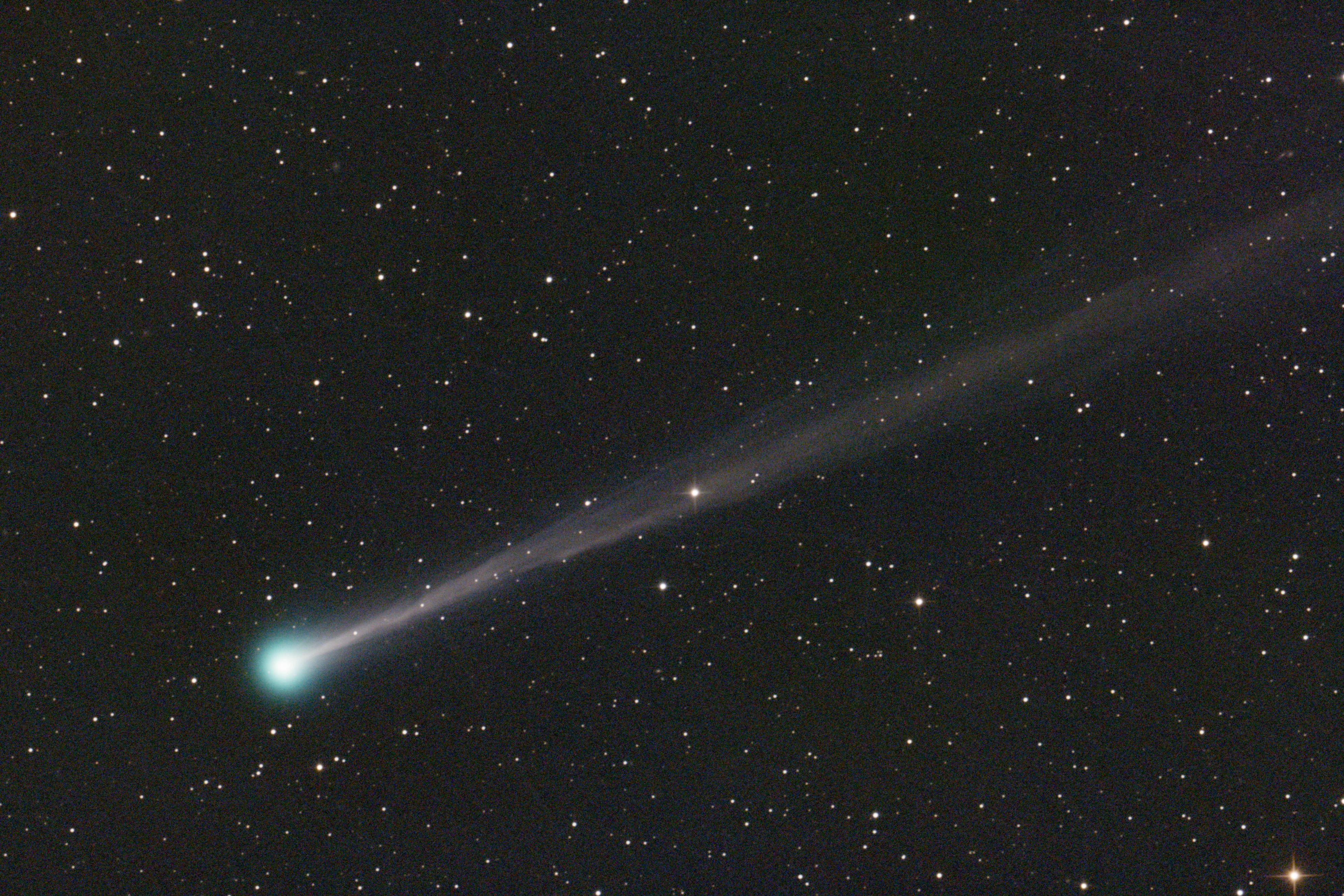
Comet C/2025 R3 (PanSTARRS) passed perihelion on April 19, 2026 at 0.499 AU from the Sun, then made its closest pass of Earth on April 26 at 0.489 AU (about 73 million km). For a few days around peak it pulled to roughly magnitude +3 to +5, depending on whose visual estimate you trust on the COBS database. Bright enough to spot in dark-sky binoculars, faint enough that nobody from the Northern Mediterranean was going to call it a naked-eye showpiece.
That’s the headline. The interesting part is everything around it: the comet was hyped for months as the candidate “great comet of 2026”, the brightness predictions disagreed by ten magnitudes, and the geometry that delivered the brightest nights also pinned the comet within a handful of degrees of the Sun. From Nicosia (Bortle 7, 35°N) the realistic verdict is: if you didn’t catch it before April 17 in the pre-dawn sky, you missed your window. The good news is the Southern Hemisphere is just opening theirs.
Where the comet is right now
As of tonight (April 28 UT), C/2025 R3 sits in Pisces, dropping fast toward the southern constellations Cetus and Eridanus. Two days past closest approach to Earth, it’s still less than 10° from the Sun in the sky. From any latitude north of about +20° that’s an unusable elongation: the comet rises in twilight and sets before the sky is dark. From Cyprus the geometry is brutal: the comet is buried in dawn glare and won’t pull clear for northern observers.
The cover image at the top of this post tells you what was possible before the geometry collapsed. It’s Dimitrios Katevainis’s frame from eastern Crete on April 8, 2026, thirty 30-second exposures stacked on a 203 mm reflector. The ion tail has real structure (kinks and disconnections from solar-wind interaction), and the dust coma is a fat, asymmetric bullet shape pointing away from the Sun. That was a Bortle-3 dark site, an experienced imager, and twenty days before perihelion. It’s roughly the best a 200 mm scope at our latitude was going to do.

Why northern observers basically missed it
Not every comet plays well with every hemisphere. C/2025 R3’s orbit hands its post-perihelion track to the south.
The geometry is straightforward once you draw it. Perihelion happened inside Earth’s orbit at 0.499 AU. The comet then crossed between Earth and the Sun, which produced the dramatic “forward scattering” brightness spike around April 18–22, where dust grains in the coma scattered sunlight back toward us at small phase angles, briefly inflating the apparent magnitude by a magnitude or more. But the same geometry parked the comet at a tiny solar elongation. By Starwalk’s reckoning, the elongation at closest approach (April 26) was about 4.9°, or six lunar diameters from the Sun. There’s no observing technique that gets you that close to the limb on a comet that faint.
The comet’s southerly motion after perihelion finishes the story. It’s now tracking south through Pisces → Cetus → Eridanus → Orion → Monoceros over the next several weeks. Each day southward steals a degree of accessible altitude from a Mediterranean observer; by mid-May the comet is below my horizon at any reasonable hour.
So if you weren’t out at a dark site before April 17 with binoculars or a small wide-field scope pointed at the Great Square of Pegasus an hour before sunrise, you didn’t catch this one from Cyprus. I managed two pre-dawn sessions in the second week of April. The first from a balcony in Nicosia where I picked up a fuzzy spot at the right place but couldn’t honestly call it a tail; the second from Troodos where the binocular view at ~5° altitude showed a small bright coma with a hint of an asymmetric brush trailing northwest. Nothing photo-worthy at my gear level. That was the window.
The “great comet of 2026” question
This is the part of the story where I want to be careful, because the headline-driven coverage got out ahead of the data and then quietly walked it back.
In the months after PanSTARRS first picked up the comet on September 8, 2025, brightness predictions from various model fits ran from magnitude 7–8 (binocular object, no fuss) to magnitude –2.5 (rivals Venus, naked-eye showpiece for weeks). Space.com framed the question fairly: “will it be the great comet of 2026?” with no answer. IFLScience went a touch further. The hopeful end of the range relied on the comet being a “fresh” Oort cloud visitor with high volatile content, exactly the population that historically over-promises and under-delivers because surface ices burn off in a frenzy on the way in and there’s nothing left for the inner-orbit fireworks. (Comet Kohoutek in 1973 is the canonical case study; ISON in 2013 disintegrated outright.)
What actually happened: C/2025 R3 brightened roughly on the central forecast track, hit perhaps magnitude +3 to +4 around perihelion (the COBS visual estimates from the past two weeks cluster in that range, with the bright end coming from southern observers under genuinely dark skies during the forward-scattering window), and is now fading. By late May it’s expected to be around magnitude 9–10, back in the dedicated-observer range.
Was it a great comet? No. Was it a notable one? Yes. It produced a properly photographable tail in late March and early April, it gave us another data point on Oort-cloud visitors, and it didn’t disintegrate. The lesson, again, is that comet brightness predictions before perihelion carry uncertainties of several magnitudes. If you read a forecast that says “could reach magnitude X”, silently translate it as “could reach anywhere from X – 4 to X + 3” and plan accordingly.
What the Southern Hemisphere is about to get
The next few weeks belong to observers south of about –10° latitude. As C/2025 R3 climbs out of solar conjunction in their evening sky, southern observers get reasonable elongation, a darkening sky, and a comet that’s still around magnitude 5–7, squarely binocular and small-scope territory.
Starwalk’s southern forecast sketches the path:
- Late April – early May: comet visible after sunset in the western evening sky, working through Cetus and into Eridanus.
- Mid-May: passes through Eridanus toward Orion. By now around magnitude 7–8, small scopes only.
- Late May: faded to magnitude 9–10. Photographic-only for most.
For Australian, Chilean, South African, or New Zealand observers, the next two weeks are the realistic last chance for a visual comet. Wide-field binoculars (10×50 or larger), a transparent western horizon, and a willingness to start observing within an hour of sunset are the basic recipe. The comet’s tail will be short by then. The dust geometry that gave us the impressive April 8 frame above isn’t repeating, but the coma should still be obvious as a soft, condensed glow.
What’s left for the rest of us
A short list, ordered by realism:
Process whatever you shot in early April. If you fired off a few subs in the pre-dawn sky between April 5 and April 15, that’s your data. Stack it, stretch it, see what the ion-tail structure looks like in your own frames. Comets are personal records. Nobody else got that exact rotational state of the coma from your latitude on your night.
Follow the southern imagers. The Comet OBServation database and the daily uploads from southern-hemisphere astrophotographers on Astrobin and the relevant subreddits will keep producing new images through May. The post-perihelion ion tail can do interesting things: disconnections, ribbons, kinks tied to coronal mass ejections. The 2007 break-up of Comet 17P/Holmes is the dramatic version of this; even quieter comets show CME-driven tail disturbances if you image often enough.
Wait for the next one. This is the unromantic truth about Oort-cloud comets: they show up roughly when they show up, and there’s no way to schedule a great comet. C/2023 A3 (Tsuchinshan-ATLAS) was excellent in autumn 2024. C/2025 R3 turned out to be a modest one. The next genuinely-bright Oort visitor will probably come from a discovery we haven’t logged yet. (PanSTARRS, ATLAS, and the Vera Rubin Observatory’s first full survey year are all going to keep finding them.)
Mark the next observing window in the calendar. For Mediterranean observers the next non-trivial event is the Eta Aquariids on May 5–6, a Halley’s-Comet-debris shower that the moon is going to ruin this year, but the geometry is at least predictable. I wrote a planning piece on it last week.
What this comet was, in one paragraph
C/2025 R3 (PanSTARRS) is a hyperbolic Oort-cloud comet on its first and last visit through the inner solar system. Eccentricity is essentially 1.0, meaning the Sun’s gravity isn’t going to recapture it. After this passage the comet leaves on an open trajectory and won’t return. Discovered by the Pan-STARRS survey at Haleakala on September 8, 2025, peaked around magnitude +3 to +5 in mid-April 2026, photographable from southern dark sites for roughly six weeks bracketing perihelion, and now fading on its way out. Not a great comet. A perfectly respectable one. The kind that justifies keeping the binoculars next to the door for whatever the next discovery email brings.