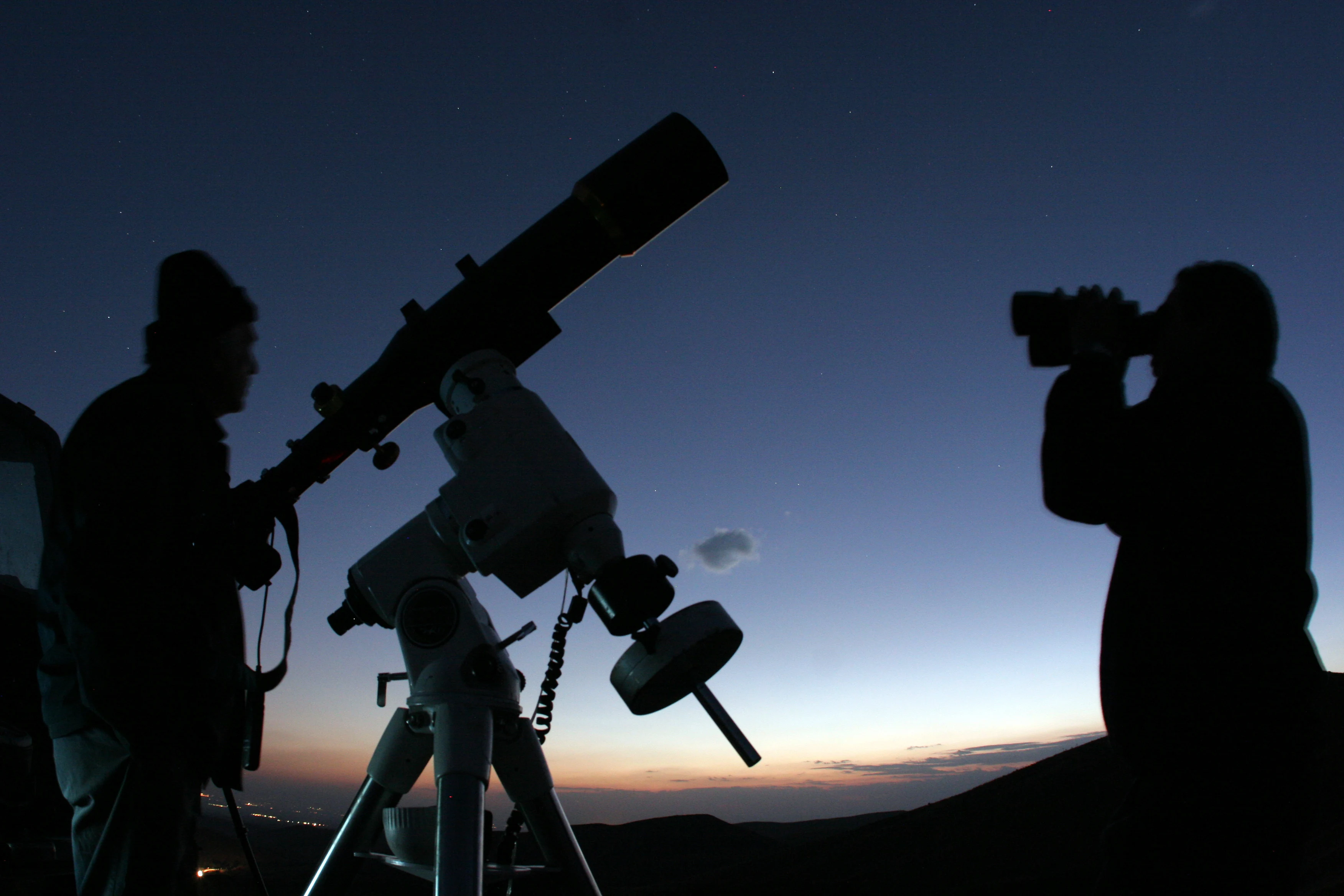
The first time I drove from Nicosia up to Troodos for a moonless night, I got out of the car, looked up, and was disappointed. I could see the Milky Way, but it was a thin grey smear, not the structured river I’d been promised. So I sat down on the camping chair, put my phone away, and waited. About twenty minutes later I looked up again. The same patch of sky now had texture: a dark rift through Cygnus, the unresolved haze around Sagittarius, individual dust lanes I hadn’t seen at all on the first look.
Nothing changed in the sky. My eyes changed. That process — dark adaptation — is the single most underestimated piece of equipment in amateur astronomy, and it’s free. Here’s how it works, why it takes about half an hour, and why the white screen of a phone undoes it in roughly two seconds.
Two kinds of photoreceptor
Your retina has two types of light-sensing cell, and they’re built for different jobs.
Cones sit densely in the central few degrees of your retina (the fovea) and handle daylight and colour vision. There are about 6 million per eye, in three flavours sensitive to roughly red, green, and blue. They’re fast, high-resolution, and they need a lot of light to fire. In the dark, they’re useless.
Rods are spread across the rest of the retina, peaking in density about 18° off-centre. There are roughly 120 million per eye. They’re monochromatic, with one pigment (rhodopsin, sensitive to blue-green light around 500 nm), slower than cones and lower-resolution, but enormously more sensitive. A fully dark-adapted rod can fire on a single photon.
When the lights go out, both systems start adapting at different rates. Cones reach their dark-adapted threshold in about 5–7 minutes. Rods take much longer, somewhere between 20 and 45 minutes depending on your age and how bright your previous environment was. The full curve is called the Pulfrich-Hecht-Schlaer curve in the literature, after the experimenters who measured it in the 1930s, and the shape has been replicated thousands of times since. The two-stage descent is sometimes called the rod-cone break: there’s a visible kink in the curve where the rods overtake the cones in sensitivity, usually around the 7-minute mark.
The number that matters: between full daylight and full dark adaptation, your retinal sensitivity increases by a factor of roughly 100,000. That’s five orders of magnitude. The Milky Way doesn’t get brighter when you wait; you just stop being a daylight animal.
What’s actually happening in the retina
The biochemistry is the part that explains why bright light wrecks dark adaptation so fast.
Rhodopsin is a protein with a small molecule attached: 11-cis-retinal, a derivative of vitamin A. When a photon hits it, the retinal isomerises (twists) into the all-trans form. That structural change kicks off a signalling cascade ending in a nerve impulse to the brain. So far, so straightforward.
The catch is the recovery. Once the retinal has flipped to all-trans, it has to be enzymatically returned to 11-cis before it can detect another photon. That regeneration takes time. In bright light, vast numbers of rhodopsin molecules are continuously bleached, and the regeneration machinery can’t keep up. So in a brightly lit room, the fraction of usable rhodopsin in your rods is very low; most of it is sitting in the bleached state.
When you turn off the light, the bleached rhodopsin starts regenerating. The full pool refills with a time constant of around 5–10 minutes per molecule, but the system is large, so the aggregate sensitivity keeps rising for 30+ minutes. This is why the curve is gradual rather than a step function.
It’s also why the “phone screen for two seconds” problem is so brutal: even a brief flash of bright light bleaches a meaningful fraction of your rhodopsin, and you have to wait for it to regenerate again. The damage is asymmetric. You spent 30 minutes building it up; you can lose half of it in less than a second.
Age, oxygen, hydration
Three factors I wish someone had told me about earlier:
Age. Dark adaptation slows down significantly with age. A 60-year-old typically needs 50% longer to reach full sensitivity than a 25-year-old, and reaches a lower final ceiling. There’s nothing you can do about this except plan for it. If you’re observing with someone twice your age, give them more time before dimming your red light.
Oxygen. The retina is a high-metabolism tissue. At altitude, even moderate altitude, dark adaptation is measurably slower and the final sensitivity is lower. The Air Force has known this since World War II; pilots flying above ~1,500 m were given supplemental oxygen partly for this reason. From Troodos at 1,700 m, I won’t claim a dramatic effect, but I do notice my eyes feel “tireder” toward 3 AM than they would at sea level. La Palma’s professional observatories are at 2,400 m and astronomers there report the same thing. If you’re observing from genuinely high altitude (Mauna Kea, Atacama, the Bolivian altiplano), the effect is real.
Hydration and blood sugar. Vitamin A is the substrate for rhodopsin regeneration, but if you’re well-fed in general you have plenty in liver storage. What matters more for a single observing night is overall metabolic state. Severe dehydration or low blood sugar can slow dark adaptation. The fix is a thermos and a snack. This is one of the few “tips” in astronomy that’s actually grounded.
What ruins dark adaptation, in order
The wavelengths your rods care about are blue and green, peaking at about 500 nm. Red light, 600 nm and above, is much less effective at bleaching rhodopsin. Hence the universal red-light convention.
In rough order of how much damage each does to a fully dark-adapted observer:
- A car headlight or phone flashlight at full brightness, even briefly. Wipes you out completely. Reset the timer.
- A full-screen white phone display held near your face for five seconds. Costs you the bulk of your adaptation. You’ll be back to roughly cone-vision-only and have to rebuild.
- A nearby observer’s screen at default brightness, even if you’re not looking directly at it. Peripheral exposure still bleaches rod pigment. This is why observing groups have unwritten “screens off or red-only” rules.
- An LED headlamp on white mode for any length of time. Same problem, plus the wide beam reaches everyone around you.
- A campfire or lantern visible at the observing site. Slow drain rather than instant kill. You won’t reach full adaptation if there’s a fire 20 m away.
- Light pollution from a distant city. The diffuse sky glow itself bleaches rhodopsin at a steady, low rate. From Bortle 7 Nicosia, my rods never get to do their best work; the sky itself is too bright. From Bortle 4 Troodos, they do.
- Looking at the Moon when it’s gibbous or full. The Moon at magnitude –12 is genuinely bright. Even a glance through a telescope will reset you. This is why “dark of the Moon” matters for deep-sky observing.
The first three are the ones that ruin most beginners’ first night out. They go to a dark site, set up the telescope by phone-flashlight, check the time on their unfiltered phone every few minutes, and wonder why they can’t see what the guide promised.
What to actually do
The protocol that works for me, refined over a few years of trying to outsmart my own retina:
Before driving up. Set your phone to the lowest screen brightness, switch to dark-mode everything, and install a red-screen filter app. On Android I use Twilight, on iOS the built-in Color Filters accessibility setting can be set to a strong red tint and assigned to the triple-click side button. Whichever app, test it before you leave. Half the apps on the market drop the red intensity if a notification arrives and the lock screen takes over.
At the site, before sunset. Set up the telescope, mount, eyepieces, and chair while you can still see normally. Trying to assemble a Dobsonian after dark with a red headlamp is character-building but unnecessary.
During astronomical twilight (the 30 minutes after sunset where the sun is between –12° and –18° below the horizon). Sit. Drink water. Eat something. Don’t look at the brightest part of the sky. Your rods will be doing roughly half their work by the end of this period, enough to see the brighter constellations forming.
The first 30 minutes of full darkness. This is the hard part. No phone, even with a red filter, unless you absolutely need it for plate-solving or polar alignment. Talk to your observing companion if you have one, but face away from any nearby cars or buildings. Look around. The averted vision technique, where you stare slightly off the object you want to see, uses the rod-rich peripheral retina rather than the cone-dominated fovea. You’ll start to notice things move from “nothing” to “barely there.”
Once adapted. A dim, dim red light is fine for star charts. The rule of thumb: if a red headlamp lets you see your own hand, it’s too bright. You want enough red light to read a planisphere held 30 cm from your eyes, no more. Most commercial astronomy red headlamps are still too bright on their lowest setting; a piece of Rubylith over a regular LED, or a custom build, often does better.
If something has to ruin your adaptation. Close one eye. Use the wrecked eye for the bright thing (looking at a phone, checking a chart, glancing at headlights), then go back to using the still-adapted eye. You’ll lose the bad eye for another 20 minutes, but the good one is still working. This is why pirates used eye patches — probably, though that’s traditional folklore rather than confirmed history.
What’s changed since 1996
Two reasons. First, the night sky has gotten brighter. Globally, sky brightness is increasing by about 9.6% per year as measured by citizen-science data (Kyba et al., 2023, Science). That’s roughly a doubling every 8 years. If you’re observing from a moderately light-polluted location, your rods are working harder against ambient sky glow than your parents’ rods did at the same site. You need them at peak performance.
Second, screens are everywhere. The amateur astronomer of 1996 had a torch wrapped in red film and a printed star atlas. The amateur astronomer of 2026 has a phone running Stellarium, SkySafari, or Sky Tonight, a smart telescope’s app, a satellite tracker, and possibly a livestream from another telescope across the world. Every one of those is, by default, a high-brightness rectangle of white-blue light eight inches from your face.
The hardware has improved. The eyes are the same eyes. Rhodopsin doesn’t care that it’s 2026.
A small experiment
Next clear night, try this. Go outside, somewhere reasonably dark. Look up. Note how many stars you can count in your favourite constellation — say, the Plough/Big Dipper, or Orion if it’s the right season. Don’t move for 30 minutes. Don’t look at your phone. Then count again.
If you’ve done it right, the count goes up by a factor of two or three. You haven’t moved. The stars haven’t moved. You just gave your retina half an hour to do what it’s been doing for several hundred million years of vertebrate evolution. There’s no other piece of astronomy gear that delivers a 100,000× sensitivity gain for free.
Bring a thermos.