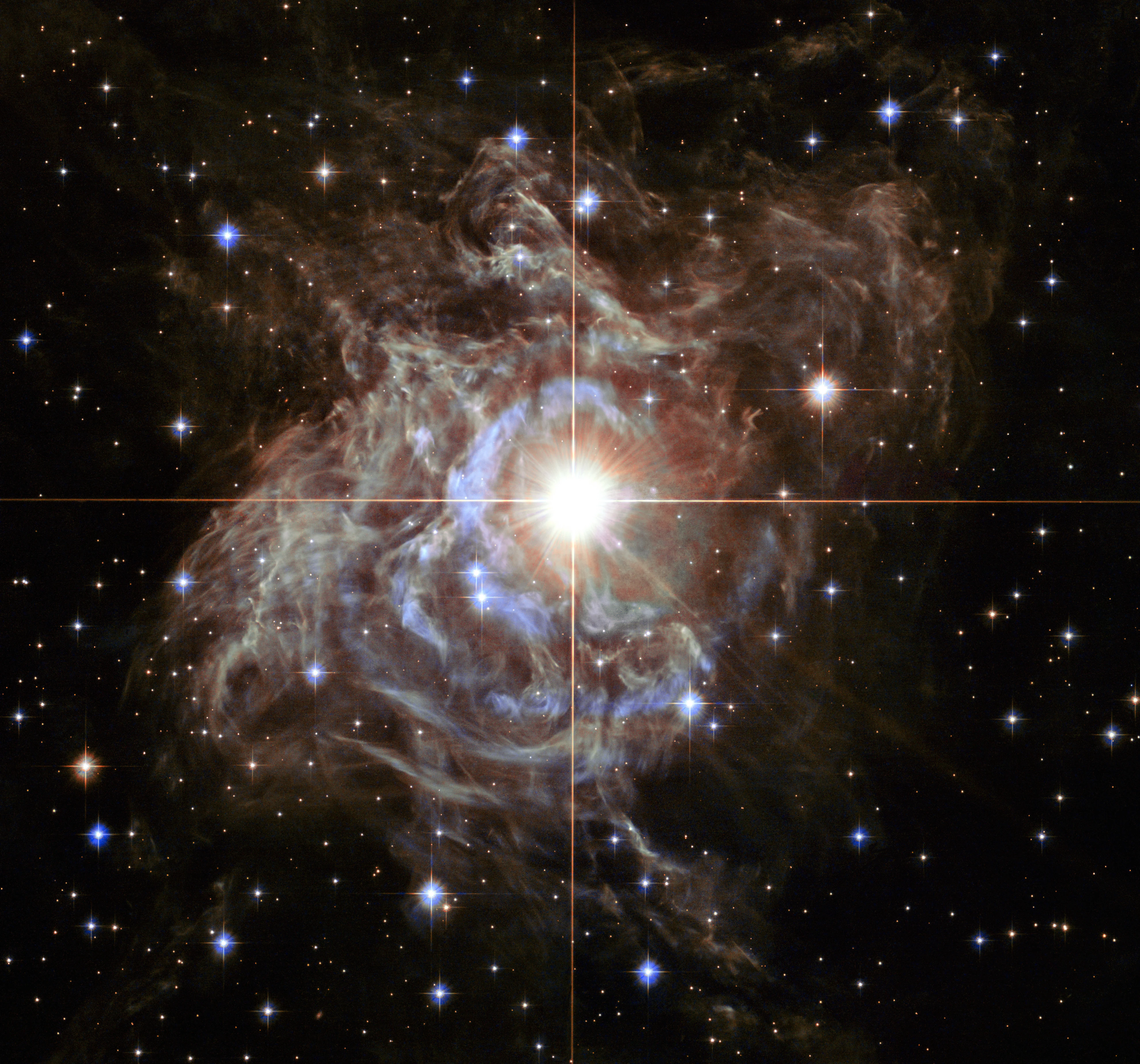
When I tell people the Andromeda galaxy is 2.5 million light-years away, the next question is almost always: how do you know? It’s a fair question. We’ve never sent anything past the outer edge of the Kuiper belt. The fastest probe humanity has ever launched would still take roughly 70,000 years to reach the nearest star. So how does anyone get from “I’m staring at a smudge above the rooftops of Nicosia” to “that smudge is around 24 quintillion kilometres away”?
The honest answer is that no single technique works. There’s no cosmic tape measure. Astronomers chain five different methods together, each one calibrating the next and extending the reach of the last. We call it the cosmic distance ladder, and it climbs from a few hundred metres at the bottom rung to the observable edge of the universe at the top. Each rung has its own physics, its own precision floor, and its own ways of going wrong. And right now, two of the upper rungs are quietly disagreeing with each other in a way that may end up rewriting cosmology.
This is a tour of the ladder from the bottom up.
Rung 1: bouncing things off the solar system
The lowest rung is the easiest. Send a signal, wait, time how long it takes to come back.
For the Moon, that signal is laser light. Apollo 11, 14, and 15 each left a retroreflector on the lunar surface (a passive corner-cube prism that sends any incoming photon straight back the way it came). Two Soviet Lunokhod rovers carried French-built reflectors of their own. All five are still in use today; the APOLLO project at Apache Point routinely measures the Earth–Moon round-trip to about 1 millimetre, on a distance that averages 384,400 km. That’s roughly one part in a trillion. China made the first daytime Earth–Moon laser-ranging measurement in 2024.
For the inner planets, it’s radar. Same physics, longer round-trip. Bouncing radar off Venus in the early 1960s gave us the first real value for the astronomical unit, the average Earth–Sun distance. The AU is now defined exactly as 149,597,870,700 metres, fixed by IAU resolution in 2012, which means every other distance in the solar system is anchored to a measurement we make to centimetre precision.
This rung is solid. It also gets us absolutely nowhere outside the solar system.
Rung 2: parallax, the only direct method
Hold a finger out at arm’s length. Close one eye, then the other. The finger jumps against the background. The closer the finger, the bigger the jump. That’s parallax, and it’s the only way we directly measure a distance to anything outside the solar system.
The “two eyes” version for stars is Earth’s orbit. Between January and July, our viewpoint shifts by 2 AU (about 300 million km). Nearby stars appear to wobble back and forth against the more distant background; that wobble angle, combined with the known size of Earth’s orbit, gives the distance. A star one parsec away (3.26 light-years) shifts by 2 arcseconds across the year. Hence the name: parallax-second.
Stellar parallax sounds simple. It is also tiny. The nearest single star, Proxima Centauri, has a parallax of 0.77 arcseconds. That’s roughly the angular size of a coin held at the distance from Cyprus to Athens. Friedrich Bessel pulled off the first reliable stellar parallax in 1838, on the star 61 Cygni, after several others had tried and failed for two centuries. Until we got telescopes into space, we could only manage a few thousand stars within about 100 parsecs.
Then came Gaia. ESA’s astrometric satellite has been parked at the Sun–Earth L2 point since January 2014, scanning the sky over and over, watching every star tremble against the cosmic background. The most recent public release, Gaia DR3 (June 2022), measured parallaxes for about 1.46 billion stars. For stars brighter than G ≈ 15, the median parallax uncertainty is 20 to 30 microarcseconds, the angle subtended by a human hair seen from 600 km away.
That precision pushes accurate parallax distances out to roughly 10 kpc, or 33,000 light-years. Far enough to map the structure of the Milky Way’s disc directly. Not even close to far enough to measure another galaxy.
Rung 3: standard candles, and the woman who built them
Past Gaia’s reach, we need an indirect trick. The trick is to find an object whose intrinsic brightness we already know. Light dims as the inverse square of distance, so if you know how bright a thing actually is and how bright it looks, the distance falls out of one equation. Anything whose intrinsic brightness is predictable is called a standard candle, and the entire upper ladder rests on finding good ones.
The first standard candle came from Henrietta Leavitt at Harvard College Observatory. She was paid 30 cents an hour to catalogue stars on photographic plates of the Magellanic Clouds, taken with a telescope in Arequipa, Peru. In a 1908 paper she noted in passing that the brighter variable stars in the Small Magellanic Cloud seemed to have longer pulsation periods. In a 1912 follow-up, she made it formal, plotting magnitude against the logarithm of period for 25 Cepheid variables and showing the relationship was a clean straight line.
This is the move. Because all 25 Cepheids were in the same galaxy, they were all at essentially the same distance. Any difference in apparent brightness was therefore a difference in intrinsic brightness. The pattern was real. Period predicts luminosity. Leavitt’s Law.
After that, the chain assembles itself. Find a Cepheid in the Milky Way, measure its parallax with Gaia, calibrate Leavitt’s law in absolute terms. Then find a Cepheid in another galaxy. The Hubble Space Telescope can resolve them out to about 30 megaparsecs, JWST somewhat further. Measure its period, read off its true luminosity from Leavitt’s law, compare to its apparent brightness, get a distance to the host galaxy.
Cepheids are how Edwin Hubble in 1923 proved that the “Andromeda nebula” was a galaxy of its own, not a cloud inside the Milky Way. The plate where he marked the variable star “VAR!” in red ink is one of the most consequential photographs in the history of astronomy.
There are other Population II candles in this regime too: RR Lyrae stars (older, fainter, useful for globular clusters) and the tip of the red giant branch (TRGB), which is currently a competitive alternative to Cepheids. Each gives a slightly different answer. That disagreement comes back two rungs up.
Rung 4: Type Ia supernovae
Cepheids run out of reach somewhere around 100 megaparsecs even for JWST. To get to billions of light-years, we need brighter candles. We use exploding stars.
A Type Ia supernova happens when a white dwarf in a binary system gains enough mass to cross the Chandrasekhar limit (about 1.4 solar masses) and triggers runaway thermonuclear fusion. Because the trigger mass is the same every time, the explosion’s intrinsic peak brightness is also (almost) the same: about 5 billion times the Sun’s luminosity. Bright enough to be seen halfway across the observable universe.
In practice, no two Type Ia supernovae are perfectly identical. A correction discovered by Mark Phillips in 1993 fixes most of the scatter: brighter Type Ia supernovae fade more slowly. Apply the Phillips relation, and you get a calibrated luminosity good to about 5%, distances good to about 7%.
This is the rung that earned a Nobel Prize. In 1998, Adam Riess, Saul Perlmutter, and Brian Schmidt used distant Type Ia supernovae to measure how the universe’s expansion rate was changing. The supernovae came in fainter than expected, meaning they were further away than a steadily-expanding universe would put them. The expansion was accelerating. The 2011 Nobel went to all three. We now call the cause “dark energy”, and we still don’t know what it is.
Rung 5: Hubble’s law and the edge of the visible universe
The top rung is redshift. Light from distant galaxies is stretched to longer wavelengths in proportion to how fast the galaxy is moving away from us, which (in the Hubble flow regime, beyond roughly 70 megaparsecs) is in proportion to its distance.
The constant of proportionality is the Hubble constant, H₀, in km/s per megaparsec. Plug a galaxy’s redshift into Hubble’s law and you have a distance, anchored all the way back through Type Ia supernovae, Cepheids, and parallax to a laser bouncing off the Moon.
Out to z ≈ 1, this works cleanly. At higher redshift, things get more complicated: light from a z = 6 quasar was emitted when the universe was a billion years old, and the relationship between distance, age, and redshift becomes a question of cosmology rather than direct measurement. JWST routinely sees galaxies at z > 10, light that has been travelling for over 13 billion years.
The Hubble tension: when two rungs disagree
Two completely different methods now give different values for H₀. The “local” path I just walked through (laser ranging, then Gaia parallax, then Cepheids, then Type Ia supernovae) was refined to roughly 1% precision by the SH0ES team using Gaia and Hubble photometry of 75 Milky Way Cepheids. Their answer is around 73.0 km/s/Mpc.
The “early-universe” path measures the same constant from the cosmic microwave background, the leftover radiation from 380,000 years after the Big Bang, mapped to high precision by ESA’s Planck satellite. That answer is about 67.4 km/s/Mpc.
The two values disagree at about 5σ, roughly a one-in-3.5-million chance of being a statistical fluke. JWST observations of Cepheids in 2024–2025 confirmed the local distance ladder isn’t broken: the Cepheids are where SH0ES says they are. TRGB-based ladders sit somewhere in the middle, around 69–72 km/s/Mpc, but as of late 2025, nothing has actually closed the gap.
Either there is a systematic error nobody has spotted in either path, or the standard cosmological model is incomplete and there is new physics waiting to be found. The Hubble tension is the most important open problem in observational cosmology right now, and it lives at the seam between the third and fifth rungs of the ladder.
You can almost touch the bottom rung yourself
You can’t measure parallax from a balcony. The angles are far too small for amateur gear. But you can do something close.
On a moonless night, point a tracked camera and a 200 mm lens at Barnard’s Star, which at 5.96 light-years is the closest single-star system to the Sun. It’s a magnitude 9.5 red dwarf in Ophiuchus, easy in any 80 mm refractor. Photograph it on the same night every year for three or four years, register the images carefully against background reference stars, and you’ll see it move. Barnard’s Star has the largest proper motion of any known star: 10.4 arcseconds per year. Over a decade, that’s about double the angular diameter of Jupiter at opposition. That’s not parallax exactly; it’s the star’s transverse velocity through space. But the experiment is the one Bessel was doing in 1838 to make the first stellar distance measurement in history, with marginally better gear.
The whole ladder, all five rungs, exists because someone once noticed something move and refused to let it go.