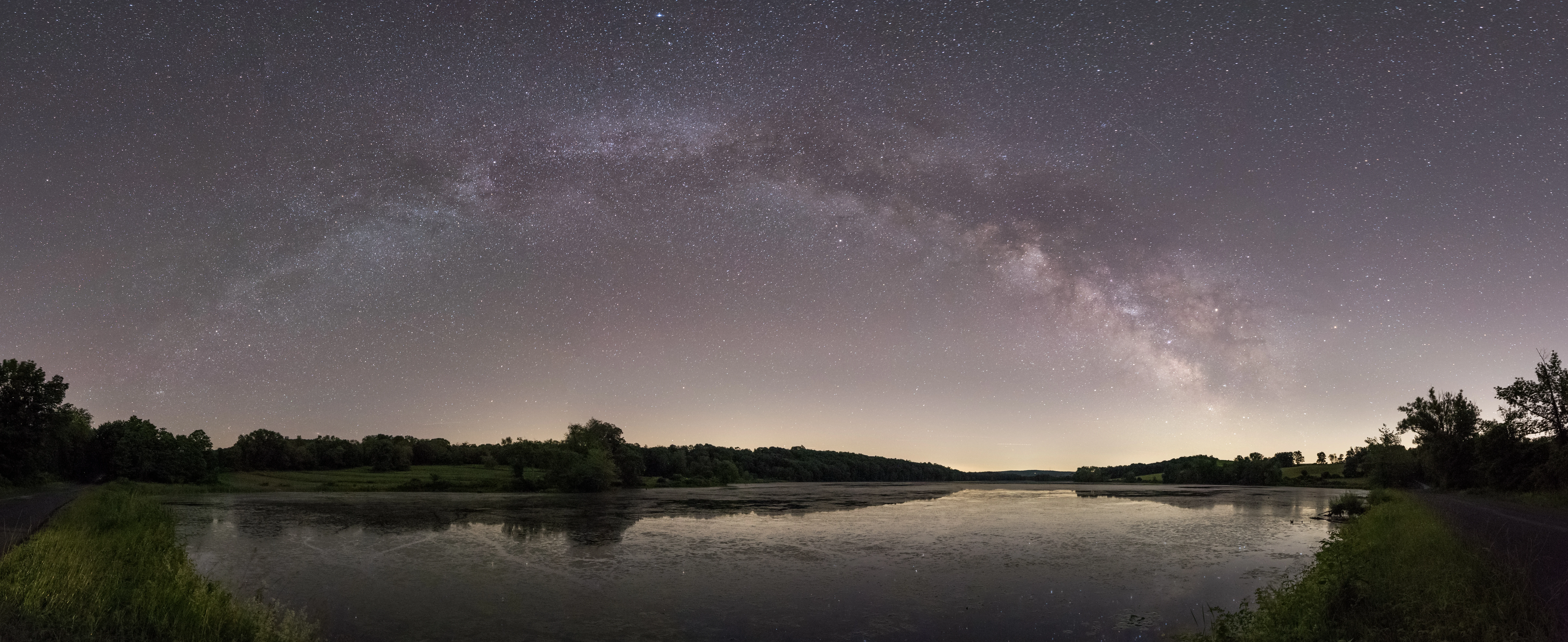
Southern Portugal’s Alentejo region is flat, dry, and almost empty. The largest artificial lake in Western Europe — Alqueva — sits at its center, surrounded by cork oak plains, whitewashed villages, and roughly zero urban light domes. In 2011, the Starlight Foundation (supported by UNESCO, the IAU, and UNWTO) certified a 10,000 km² zone around the lake as the world’s first Starlight Tourism Destination. Fourteen years later, the reserve is still one of the darkest accessible skies in Europe, and one of the easiest to reach.
I’ve been watching Alqueva from a distance since I started shooting from Troodos. Cyprus has patches of real dark sky — the upper slopes around Xyliatos or Chandria can surprise you — but the Mediterranean basin is narrow, and North African light domes bleed into the southern horizon. The Alentejo doesn’t have that problem. The nearest city of any size is Évora (population around 57,000), about 60 km northwest. The Atlantic buffer means zero light pollution from the west. The result is a horizon-to-horizon dark dome that’s hard to match this side of La Palma.
What the sky looks like
On a moonless summer night from the lakeshore near Monsaraz, the Milky Way is bright enough to reflect off the water. The zodiacal band — that faint wedge of sunlight scattered by interplanetary dust — is obvious from dusk through midnight during spring and summer. From Troodos I can pick up the zodiacal light if I’m above 1,500 m and the humidity cooperates. In the Alentejo, observers report it from ground level without effort.
The Starlight Foundation requires measured sky brightness above 21.0 mag/arcsec² (SQM) for certification. The Alqueva Observatory area meets that bar. For context, my better Troodos sessions land in roughly the same territory, but the Alentejo wins on consistency: more clear nights per year by a wide margin.
When to go
The Alentejo is semi-arid. The region averages over 280 cloudless nights per year, putting it near the top in Europe for observing reliability.
April through October is Milky Way season. The galactic center clears the horizon by midnight in late April and is well up at dusk by July. For the core overhead, aim for June through early September.
Summer (June through August) is the driest stretch. Daytime highs hit 35–40°C, dropping to 18–22°C by midnight. Warm enough that dew on optics isn’t a concern.
Spring and autumn offer the best balance: dark skies, comfortable temperatures, and lower hotel prices. Note that the Perseids peak on August 12 this year — the same night as the total solar eclipse over Spain — so August accommodation across southern Portugal will book early. Portugal gets a deep partial eclipse (around 95% from Lisbon), which alone is worth a trip if you pair it with a Perseid night from the reserve.
Winter is colder (5–10°C overnight) and wetter, but still clearer than anything in northern Europe. Geminids in December and Quadrantids in early January are both viable from here.
Two observatories, one reserve
The reserve has two public facilities.
The Official Dark Sky Alqueva Observatory sits in Cumeada, in the reserve’s core. Sessions run about 75 minutes: a guided naked-eye tour (constellation identification, finding Polaris, binocular sweeps) followed by eyepiece time on their main scope. They cover planets, star clusters, and a deep-sky target or two depending on the season. Small groups, advance booking required.
The Alqueva Lake Observatory (OLA) is the larger facility, positioned on the lakeshore with views toward Monsaraz Castle. It runs a broader program: interpretation panels, multiple telescope setups, and daytime solar observation alongside the evening sessions. The lakeside location makes it easy to combine an afternoon kayak or boat trip with a night session.
Entry to the reserve itself — the 10,000 km² of protected dark sky — is free. You can set up your own rig on any public land, and several accommodations along the Dark Sky Route offer rooftop terraces and loaner binoculars for guests who’d rather observe informally.
Where to stay
Accommodation in the reserve follows a “Dark Sky Route”: a network of certified guesthouses and rural hotels that control outdoor lighting, provide dark-adapted spaces, and often stock optics for guest use.
Monte de Santa Catarina is a rural guesthouse near the observatory with a 12-inch Dobsonian on-site. At that aperture, you’re resolving globular clusters into individual stars and picking up spiral structure in galaxies like M51. Rates sit around €70 for bed and breakfast.
Monte Alerta runs €70–120 per night and keeps a Meade ETX-125 for planetary viewing, a swimming pool, and genuinely good Alentejo cooking.
São Lourenço do Barrocal is the upscale pick. A restored 19th-century estate with guided astrophotography sessions and a designated dark-sky terrace. Boutique-hotel pricing, but the program is well-run.
For budget travelers, Monsaraz itself has small guesthouses, and the campsite near Amieira Marina works for anyone bringing their own scope.
Getting there
Alqueva is about two hours by car from Lisbon, or two and a half from Faro (the Algarve gateway). Lisbon is the natural hub — budget carriers like Wizz Air, Ryanair, and TAP connect it to most EU capitals. From Larnaca, direct seasonal routes to Lisbon pop up in summer, or you’ll connect through Athens or Rome for under €150 round-trip if you book a few weeks out.
A rental car is non-negotiable. Public transport in the Alentejo barely exists outside Évora. The drive from Lisbon is flat and fast: the A6 motorway to Évora, then secondary roads south through cork oak hills. The last 30 km to Monsaraz is single-lane, unlit road. That’s not a warning. That’s the point.
What to do during the day
You won’t spend 14 hours staring at the Sun waiting for dark. The OLA observatory runs solar sessions, but the Alentejo has strong daytime draws of its own.
Monsaraz is a walled medieval village on a ridge above the lake. Narrow cobblestone streets, a castle with views across the reservoir to Spain, and a handful of cafés. Small enough to walk in 30 minutes, old enough to photograph for three hours.
The region is wine country. The Alentejo DOC produces some of Portugal’s best reds, and several estates within driving distance of the reserve offer tastings. Pair a vineyard afternoon with a 22:00 observing session and you’ve built a day that justifies a multi-night stay to anyone who isn’t already sold on the stargazing alone.
Lake Alqueva supports kayaking, paddle-boarding, and boat tours. A few operators run full-moon kayak sessions — not great for observing, but a different kind of night on the water.
How it stacks up
For dark-sky travel from the Mediterranean or southern Europe, the main alternatives are:
La Palma (Canary Islands) has darker skies, full stop. The island is small, high (2,400 m at the Roque de los Muchachos), and has enforced strict lighting laws since the 1980s. But it’s more expensive to reach, accommodation near the observatory is limited, and the access road to the summit is a two-hour series of switchbacks you’ll drive in the dark. La Palma is the pilgrimage. Alqueva is the trip you take three or four times before you need to level up.
Troodos (Cyprus) is my home dark-sky site. Comparable sky quality on the best nights, and I can be on-site in 90 minutes from Nicosia. But the genuinely dark window is narrow (only the upper slopes above about 1,500 m), summer humidity limits transparency, and there’s no infrastructure — no observatory, no dark-sky-certified lodges, just you and your gear at the end of a forest road. I wrote a full guide to Troodos observing last month.
Pic du Midi (French Pyrenees) sits at 2,877 m with world-class seeing. But it’s cold, the cable car limits what you can bring up, and overnight stays in the summit dome book out months ahead.
Alqueva’s edge is the combination: genuinely dark sky, warm climate, affordable accommodation, two staffed observatories, and a two-hour drive from a major European airport. No single factor is the best in class. The package is.
Planning a trip
If you’re flying from the eastern Mediterranean, Alqueva is a 4–5 hour door-to-door commitment (flight plus drive). That’s comparable to reaching La Palma but with cheaper flights, simpler logistics, and a region that works as a proper holiday rather than a pure astronomy mission. I’m planning a September visit this year: the galactic center will be low but still up in the early evening, the tourist crush will have thinned, and off-season rates at the Dark Sky Route guesthouses drop to something reasonable for a four-night stay.
For EU-based stargazers who’ve been meaning to get to a properly dark site: Alqueva is the simplest first step. Book a certified guesthouse, bring binoculars at minimum (a small refractor if you have one), and give yourself two or three clear nights. The Alentejo’s 280 clear nights per year mean the odds are heavily in your favor.