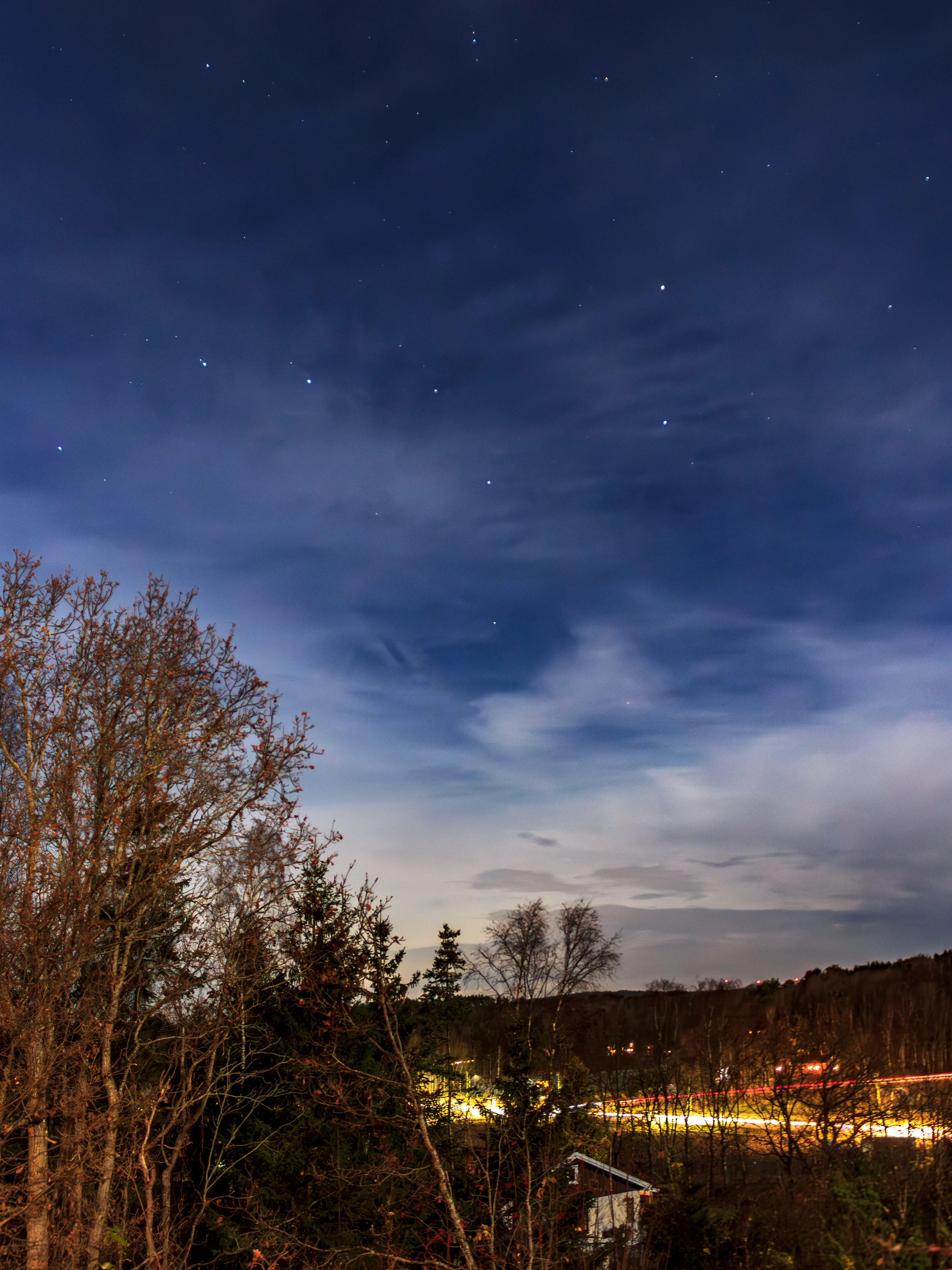
You don’t need an app tonight. You need one pattern. The Big Dipper sits almost directly overhead on May evenings from mid-northern latitudes, and its seven stars — all between magnitude +1.8 and +3.3, easy to spot even under suburban light pollution — form the single best starting point for learning the rest of the sky. Five hops, no telescope, about ten minutes.
What star-hopping is
Star-hopping is the oldest navigation trick in observational astronomy: use a pattern you already recognise to find something you don’t. Point your eyes at a known bright star, move a known angular distance in a known direction, and land on the next target.
The Big Dipper (the ladle-shaped asterism inside Ursa Major) works so well because it’s circumpolar above about 40°N and stays visible all night even from my latitude at 35°N in Nicosia. Its shape is unmistakable, and different parts of it point toward different regions of the sky. Every hop below starts from its stars.
One tip for estimating angular distances: a closed fist held at arm’s length covers roughly 10°. Three fingers held together cover about 5°. The Big Dipper’s bowl spans about 10° from corner to corner, and the full ladle from Dubhe to Alkaid stretches about 25°.
Hop 1: The pointer stars to Polaris
Find the two stars forming the outer edge of the bowl — Merak at the bottom, Dubhe at the top. These are the Pointer Stars. Draw a line from Merak through Dubhe and extend it about five times the Merak–Dubhe distance (roughly 28°, or just under three fist-widths). You’ll hit Polaris, the North Star.
Polaris isn’t especially bright at magnitude +2.0 — about the same as the Big Dipper’s own stars. But it sits within 0.7° of the north celestial pole, so everything else in the sky appears to rotate around it through the night. From 35°N here in Nicosia, Polaris hangs at 35° above the northern horizon. That’s not a coincidence — your geographic latitude always equals Polaris’s altitude. At 51°N in London, it’s at 51°. At 45°N in Milan, 45°. Quick sanity check whenever you’re at a new observing site.
Knowing where Polaris is orients the entire sky for every hop that follows.
Hop 2: Arc to Arcturus
Follow the curve of the Big Dipper’s handle — Alioth, Mizar, Alkaid — and keep arcing in the same gentle curve for about 30° (three fist-widths). You’ll land on Arcturus, a bright orange star at magnitude −0.05. It’s the fourth-brightest star in the entire sky and the brightest in the northern celestial hemisphere. You can’t miss it.
Arcturus is the luminary of Boötes, the Herdsman, though the rest of that constellation is faint and harder to trace. The star itself is a red giant roughly 25 times the Sun’s diameter, about 37 light-years from Earth. It’s moving through the galaxy on an unusual orbit that carries it well above and below the galactic plane, which is partly why it stands out — it’s a visitor from a different stellar population passing through the Sun’s neighbourhood.
If you’ve found it, you’ve learned the most famous mnemonic in star-hopping: “arc to Arcturus.”
While you’re on the handle, look at Mizar, the middle star. Can you see a faint companion just to its northeast? That’s Alcor, at magnitude +4.0, separated from Mizar by about 12 arcminutes (roughly a fifth of the Moon’s width). Splitting the pair with the naked eye was historically used as a casual vision test. Under clean skies it’s easy; under Bortle 7+ light pollution it gets harder. From my balcony, I can usually see Alcor but I have to look slightly away — averted vision, a trick my dark adaptation article explains.
Hop 3: Spike to Spica
From Arcturus, continue the same arc another 30° south. You’ll reach Spica, magnitude +1.0, a blue-white star and the brightest in Virgo. The mnemonic: “spike to Spica” (some say “speed on to Spica” — either works).
Spica is actually a close binary system whose two components orbit each other every four days, so close together that their mutual gravity distorts them into egg-like shapes. You won’t resolve the pair visually — even the best ground-based telescopes can’t — but knowing that the single point of light you see is two massive stars whipping around each other at close range adds a layer to what might otherwise look like just another dot.
With Arcturus and Spica found, you’ve traced the Spring Arc, the backbone of the spring sky’s geography.
Hop 4: Through the bowl to Leo
Go back to the Big Dipper’s bowl. Find Megrez (where the handle meets the bowl) and Phecda (the bottom corner opposite Dubhe). Draw a line from Megrez through Phecda and extend it roughly 35° — about 3.5 fist-widths. You’ll end up in the vicinity of Leo.
The line is approximate, not razor-sharp, so confirm with the constellation’s shape: look for a pattern resembling a backward question mark. That’s the Sickle, one of the sky’s most recognizable asterisms, forming the lion’s head and mane. The bright star at the base of the Sickle is Regulus, magnitude +1.4, Leo’s heart.
In May, Leo is already in the western half of the sky by 22:00 local time, so catch it before it sinks too low. The rest of Leo’s body extends east of the Sickle — a triangle of stars marks the hindquarters, with Denebola at the tip of the tail. Denebola also belongs to a larger pattern: the Spring Triangle (Arcturus, Spica, Denebola), so now your mental map has overlapping landmarks, exactly the way navigating a city works.
Hop 5: Off the handle to the Whirlpool Galaxy
This one needs binoculars (7×50 or 10×50) or a small telescope. Find Alkaid, the star at the very end of the Big Dipper’s handle. Move about 3.5° southwest — roughly one binocular field — and look for a faint, soft glow. That’s M51, the Whirlpool Galaxy.
M51 is about 23 million light-years away, a face-on spiral interacting with a smaller companion galaxy (NGC 5195). In binoculars under dark skies — Bortle 4 or better — the core shows as a diffuse smudge. A 4-inch telescope starts revealing the elongated shape. The full spiral structure needs darker skies and more aperture, but the fact that a galaxy 23 million light-years away sits just one binocular hop from the most familiar pattern in the sky makes it one of the most satisfying first deep-sky targets you can find.
From my balcony in Nicosia (Bortle 7), M51 is invisible in binoculars. I have to drive up to Troodos — at 1,700 m the sky drops to about Bortle 4 and the smudge appears. If you’re in a suburban area, M51 doubles as a sky-quality test: if you can see it in 10×50s, your sky is genuinely dark.
Try it tonight
All five hops work from late April through mid-July, and May is the sweet spot: the Big Dipper reaches its highest point in the evening sky, putting every starting star in a comfortable position. Head out around 22:00 local time — 21:00 if you want Leo before it gets too low — and give your eyes about 20 minutes to adapt.
No app required, though if you want to double-check your identifications, Stellarium (free on both iOS and Android) has a red-light night mode that won’t wreck your dark adaptation. Point it at a star and confirm you’ve landed on Arcturus, not something else.
One evening, five hops, and you’ll have a mental map of the spring sky you can use for the rest of your life.