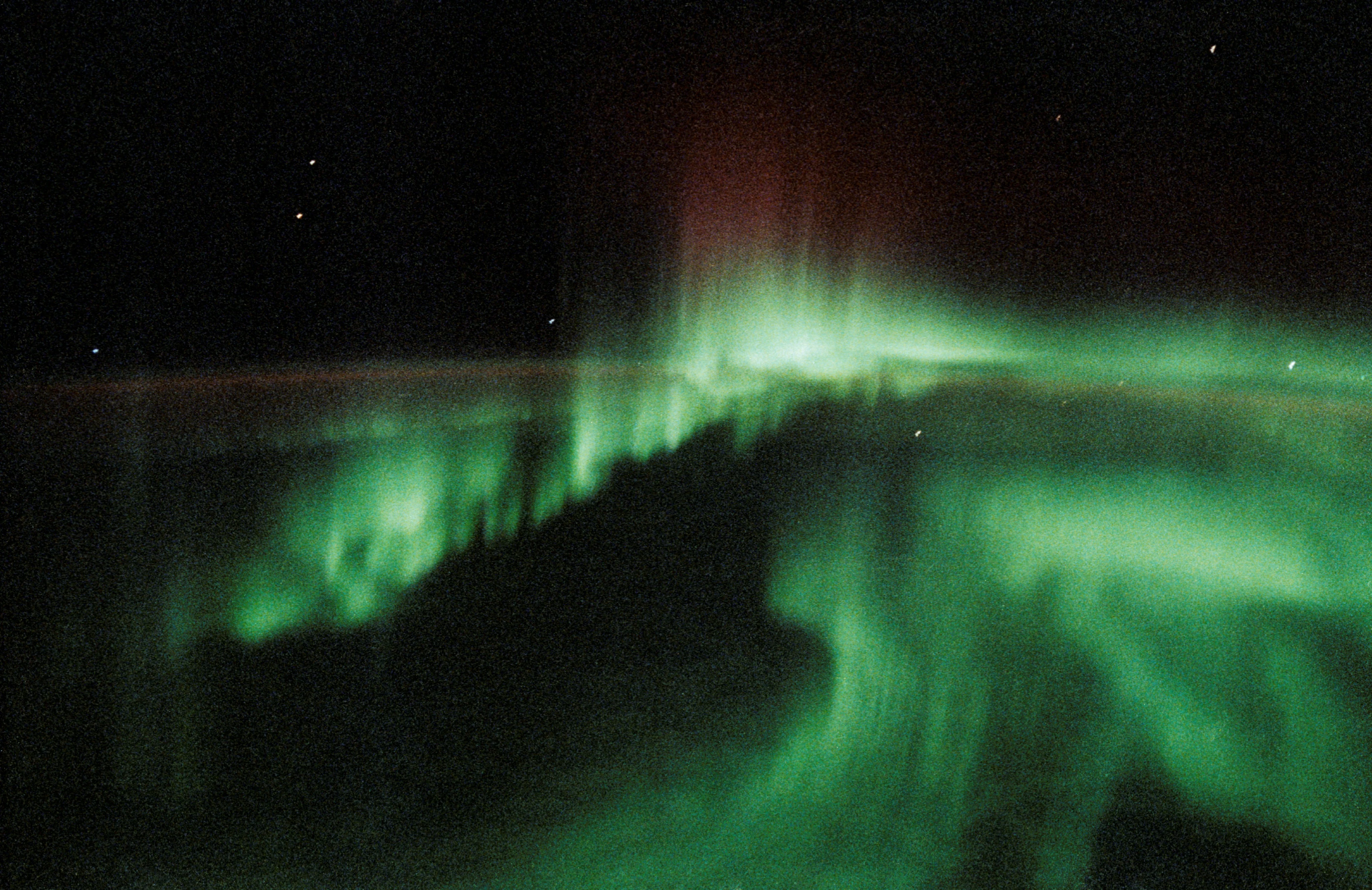
At 03:52 UTC this morning, a Vega-C rocket lifted off from Kourou carrying SMILE — the Solar wind Magnetosphere Ionosphere Link Explorer — into a 707 km circular parking orbit. ESA’s New Norcia ground station in Western Australia picked up the spacecraft’s first signal at 04:48 UTC. Solar panels deployed one minute later. The first mission designed to X-ray Earth’s entire magnetosphere in real time is alive and drawing power.
I covered the science in detail two weeks ago, before the launch window opened. Now that the spacecraft is actually flying, here’s what happens between today and the first X-ray image of Earth’s magnetic shield — and when the data starts mattering for aurora forecasts.
From 707 km to 121,000 km
SMILE is parked in a low circular orbit at 707 km altitude, inclined 73°. That isn’t its science orbit. The final trajectory is a highly elliptical loop: 5,000 km above the South Pole at perigee, 121,182 km above the North Pole at apogee, completing one revolution every 51 hours.
Reaching that orbit takes 11 engine burns over the next month, each one raising the apogee step by step. The spacecraft carries 1,520 litres of hydrazine — a hefty fuel budget for a ~2,200 kg vehicle — because the climb from 707 km to 121,000 km is almost entirely self-propelled. Vega-C’s job was to deliver SMILE to LEO and release it cleanly. Everything after separation is on the spacecraft.
Once the orbit-raising campaign wraps up around late June, SMILE enters a three-month commissioning phase. That means instrument checkout, calibration of the lobster-eye X-ray optics, validation of the UV imager against known auroral patterns, and end-to-end data pipeline tests with the O’Higgins Antarctic ground station that handles downlinks during the fast, low-altitude perigee passes. First science data is expected around September 2026.
The Vega-C story
This morning’s flight, designated VV29, was Vega-C’s seventh launch overall and the first one operated by Avio, the rocket’s manufacturer, after Arianespace previously handled launch services. It was also the first Vega-C flight of 2026.
The launch was originally set for April 9. Avio postponed it after identifying a production-line issue while the vehicle was already stacked with its payload. SMILE spent nearly eight weeks sitting inside the fairing at Kourou, fully fuelled with hydrazine, waiting for clearance. The investigation concluded, the fix was verified, and the rescheduled date of May 19 held.
For European launch autonomy, the outcome matters more than the delay. Vega-C’s return to regular service after its troubled early history — including the VV22 failure in December 2022 that grounded the vehicle for over a year — is concrete progress toward independent medium-lift access for ESA.
The largest ESA-China collaboration to date
SMILE is the first time ESA and the Chinese Academy of Sciences have jointly selected, designed, built, launched, and will operate a science mission from start to finish. More than 250 scientists from 14 European countries and China contributed.
The split: ESA delivered the payload module (including the Soft X-ray Imager, built by the University of Leicester with UK Space Agency and ESA funding), supplied the launch vehicle, and runs part of the science operations. CAS built the spacecraft platform, contributed three of the four instruments — the ultraviolet imager, the light ion analyser, and the magnetometer — and shares mission control.
This collaboration exists against the backdrop of the Wolf Amendment, the U.S. law renewed annually since 2011 that bars NASA from bilateral cooperation with Chinese government entities unless Congress and the FBI explicitly authorise it. NASA can’t join a mission structured the way SMILE is structured. The science SMILE targets — magnetospheric dynamics, solar-wind coupling, heliophysics — overlaps heavily with NASA’s own portfolio. The agency that built the Magnetospheric Multiscale Mission and the Van Allen Probes is, by statute, on the outside of this one.
ESA’s position is pragmatic: export controls, technology safeguards, and case-by-case governance can manage the risk for selected non-classified science. Whether that model extends beyond SMILE is an open question, but the spacecraft launched today is the working proof-of-concept.
For amateur astronomers and aurora watchers, the geopolitics is background. What matters is whether the data gets published. ESA has committed to open data access for SMILE’s science archive, the same policy that made Gaia and JWST data available to anyone with an internet connection. If that holds, the Wolf Amendment limits who built the instruments, not who benefits from the results.
When aurora watchers will notice
Not this summer. SMILE’s instruments won’t be fully calibrated until roughly September, and even then the first year focuses on science validation — proving that solar wind charge exchange X-ray imaging of the magnetopause works as predicted, and assembling the baseline dataset that future forecasting tools will need.
What “validation” means in practice: the SXI needs to demonstrate that it can resolve the magnetopause boundary in X-rays at a cadence useful for tracking storm-time compressions. The UV imager needs to be cross-calibrated against ground-based all-sky cameras that have been filming the aurora for decades. And the light ion analyser needs to produce reliable solar wind plasma measurements that line up with what L1 monitors (DSCOVR, ACE) report upstream. Only after all four instruments are producing consistent, correlated data does the real science campaign start.
The practical payoff begins in 2027 and beyond. Once SMILE is returning continuous X-ray movies of the magnetopause, correlated orbit after orbit with simultaneous UV auroral imaging, the data feeds into next-generation geomagnetic storm models at both ESA’s Space Weather Service Network and NOAA’s Space Weather Prediction Center. The target: extending reliable Kp forecasts from the current 15–45 minute L1-based warning window to multi-hour lead times. The three-year planned mission lifetime gives enough storm seasons to build statistically meaningful models — assuming we get a few decent coronal mass ejections during that window, which, given that we’re heading toward solar maximum, is a reasonable bet.
From my balcony in Nicosia at 35°N, where aurora needs at least Kp 7 to climb above the northern horizon, every extra hour of warning is the margin between stepping outside in time and scrolling through other people’s photos the next morning.
Where things stand
SMILE is in orbit, drawing power, and talking to ground stations. The 11-burn climb to 121,000 km starts in the coming days. Commissioning runs through the summer. First science operations begin around September, if calibration goes to plan. The mission’s planned lifetime is three years — long enough to capture multiple geomagnetic storm seasons and build the first real library of X-ray magnetosphere movies.
If you want the full science background — the charge-exchange physics, the four-instrument suite, the orbit geometry, and why real-time X-ray magnetosphere imaging matters for aurora prediction — I laid it out in the preview article from two weeks ago. Today’s update is simpler: the rocket worked, the spacecraft works, and the long climb has begun.