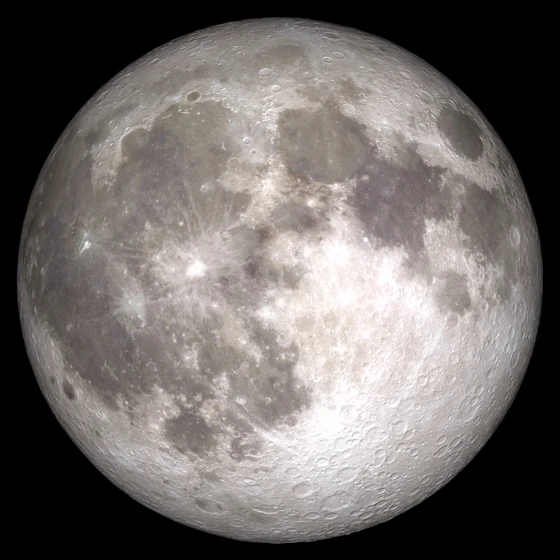
On May 31 at 08:45 UTC, the Moon reaches full phase for the second time this month. That second-in-a-month qualifier makes it a Blue Moon by the modern calendar definition. It also happens to sit near apogee — 406,135 km from Earth — making it a Micromoon: roughly 5.5% smaller in angular diameter and about 10% dimmer than an average full moon. It’s the most distant full moon of 2026. And if you walk outside that night expecting something visibly unusual, you’ll be disappointed.
What “Blue Moon” actually means
The Moon won’t look blue. It never does, barring volcanic aerosols or wildfire smoke scattering red wavelengths out of the beam — the kind of atmospheric oddity that has nothing to do with the calendar.
The term has two definitions. The older, seasonal one labels the third full moon in an astronomical season that contains four (instead of the usual three). The newer, more popular definition — the one most outlets use — is simpler: a Blue Moon is the second full moon in a single calendar month.
May 2026 qualifies because the first full moon landed on May 1 (the Flower Moon), and the synodic month is 29.53 days, so the next full phase fits inside the same 31-day window. It’s arithmetic, not astronomy. If May had 29 days, there’d be no Blue Moon.
Blue Moons by this calendar rule occur roughly every 2.5 years. The last one was August 2023. After this one, the next falls in December 2028. The phrase “once in a blue moon” predates the astronomical definition entirely — it meant “absurdly rare” in 16th-century English, long before anyone tried to pin it to a specific lunation. The frequency works out to about 7 per 19 years, or once every 2.7 years on average. Not quite as rare as the idiom implies.
What a Micromoon is — and why both May full moons qualify
The Moon’s orbit isn’t a circle. It’s an ellipse with an eccentricity of about 0.055, which means perigee (closest approach) sits around 356,500 km and apogee (farthest point) around 406,700 km. The difference between those extremes is about 50,200 km — roughly 13% of the mean distance.
When a full moon falls near perigee, the press calls it a Supermoon. When it falls near apogee, it’s a Micromoon. There’s no official IAU definition for either term; the cutoffs are informal. Most sources use a threshold of roughly 360,000 km for supermoons and 405,000 km for micromoons.
The May 31 full moon peaks at 406,135 km — well past the micromoon threshold and close to the orbital maximum. But it’s not alone: the May 1 Flower Moon was also near apogee. Both May full moons are micromoons, a consequence of where the Moon happened to be in its elliptical track when the calendar lined up.
The numbers: how different does a Micromoon look?
Here’s the comparison that matters. On May 31, the full moon’s angular diameter will be about 29.4 arcminutes. The average full moon is about 31.1 arcminutes. On December 24 — when the closest full moon of 2026 arrives at 356,740 km — the disc will span roughly 33.4 arcminutes.
That’s a 12% difference in apparent diameter between the year’s smallest and largest full moons. In area, it’s about 23%. In brightness, the supermoon will deliver roughly 30% more light.
Side by side in photographs, the difference is obvious. In the sky, on any given night? I’ve tried. I’ve photographed full moons at perigee and apogee with the same lens and held the prints next to each other — the size gap jumps out. But standing on my balcony in Nicosia looking up at a lone disc with no reference frame, I can’t honestly say I’ve ever noticed. The brain doesn’t carry a calibrated ruler for the Moon.
The brightness difference is even harder to detect. A 10% flux drop against a black sky, with no comparison source at the same angular scale, doesn’t register. The Moon looks bright. Full stop.
A photography project that actually proves it
If you want to see the Micromoon for what it is, here’s the project: photograph it on the night of May 30 (when it rises full and round for European observers) or May 31 (for those farther west). Then photograph the December 24 supermoon with the same gear at the same focal length. Overlay the two frames. The size difference will be immediate and satisfying.
Setup notes:
- Use a telephoto lens at 300 mm or longer, or a telescope with a camera adapter. A phone through the eyepiece works too, but keep the setup identical both nights.
- Expose for the bright disc, not the sky: around 1/125 s at f/8, ISO 100 on a clear night. Bracket if you’re unsure.
- Shoot when the Moon is high enough that atmospheric distortion isn’t smearing the limb — at least 25° altitude.
- The Seestar S50 can do this in planetary mode. A single short-exposure stack gives a sharp disc. I’ve done it for lunar phase sequences; it works.
Label both frames with the date and distance. Post the pair. It’s the kind of comparison that teaches more than any article can.
When and where to look
The exact full phase at 08:45 UTC on May 31 falls during morning hours for Europe and overnight for the Americas — but this is academic. The Moon looks indistinguishable from full for about three days centred on the peak. You won’t tell the difference between “12 hours before full” and “full.”
From the Mediterranean at 35°N, the late-May full moon rises in the southeast around sunset and reaches a maximum altitude of about 30-35°. It’s not as high as a December full moon (which climbs past 70° from the same latitude), so the atmospheric path is longer and the colour skews slightly warmer. From my balcony, May full moons have a persistent amber cast in the first hour after rising that fades to white as they gain altitude.
Northern-hemisphere observers get a similar geometry. Southern-hemisphere viewers see it higher and brighter — the full moon’s declination in late May is around -22°, which puts it nearly overhead from southern latitudes.
One practical note: the full moon washes out most deep-sky objects. Don’t plan a galaxy hunt for the nights around May 31. But the Moon itself is the target here, and a bright full disc against a washed-out sky is actually ideal for lunar photography — no competing detail to distract the exposure. If you own a polarising filter for your camera, try it on the Moon at various angles. It won’t cut glare the way it does in daylight, but it can suppress scattered moonlight in the surrounding sky and pull out subtle albedo differences on the disc. Results vary, but it’s a free experiment.
Bottom line
The May 31 Blue Micromoon is two calendar coincidences stacked: a second-of-the-month full moon landing near the far end of an elliptical orbit. It won’t look blue. It won’t look small. It won’t look dim. But the numbers behind it — 406,135 km, 29.4 arcminutes, 10% less flux — describe something real about the geometry of a system most people take for granted.
Photograph it. Write down the distance. Do the same on December 24. Then compare. That’s where the Micromoon stops being trivia and starts being geometry you can hold in your hands.