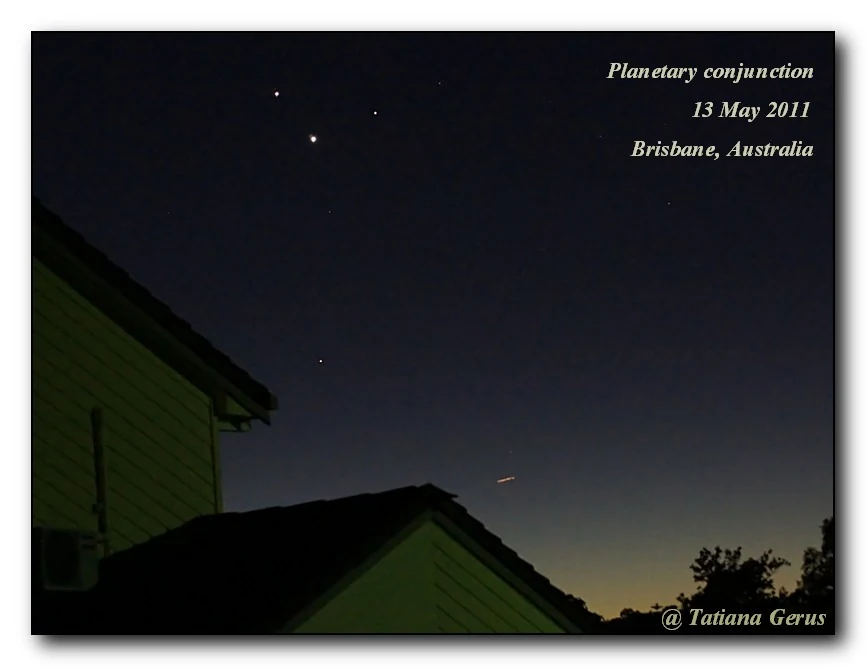
All five naked-eye planets are out this June, split between the evening and morning sky. The headline act: Venus and Jupiter converge to within 1°38’ of each other on June 9, the two brightest objects in the night sky after the Moon, close enough to cover both with your thumb at arm’s length. You don’t need a telescope, a dark sky, or any experience. Here’s where and when to look.
How to tell a planet from a star
Planets don’t twinkle the way stars do. A star is a point source: its light passes through turbulent pockets of atmosphere and flickers. A planet is close enough to show a tiny disc, even if your eye can’t resolve it, so the flickering averages out. The light looks steadier, calmer.
There are three other giveaways:
- Planets stick to the ecliptic, the strip of sky the Sun, Moon, and zodiac constellations travel along. If something bright sits well off that band, it’s probably a star.
- Over days and weeks, planets drift against the background stars. The word “planet” comes from the Greek planētēs, wanderer. Stars hold their patterns for a human lifetime; planets don’t.
- Colour helps. Venus is white-brilliant. Mars is orange-red. Saturn is a muted yellow. Jupiter is white but slightly warmer than Venus. Mercury looks pinkish near the horizon because you’re always viewing it through thick atmosphere.
If you’re unsure, open a free app like Stellarium Mobile or Sky Tonight, point your phone at the bright object, and let the app label it.
Evening sky: Venus, Jupiter, and Mercury
Venus and Jupiter
Go outside any clear evening in early June, face west-northwest, and look about 15–20° above the horizon roughly 30–45 minutes after sunset. You’ll see two objects brighter than anything else in the sky. The brighter one is Venus, at around magnitude −4, so bright it’s visible before the sky fully darkens. The other is Jupiter, around magnitude −2, which still outshines every star in the sky.
Through the first week of June, the gap between them shrinks night by night. On June 9, they reach conjunction: a separation of about 1°38’, roughly three Moon-widths. From June 5 through June 12 they sit within a single binocular field of view, so that whole week is worth watching.
If you have binoculars — even a cheap 8×42 pair — point them at Venus that evening. It’s near dichotomy, about 49% illuminated: a clean half-disc, like a tiny half-moon. Jupiter will show its four Galilean moons as pinpricks in a line. All of this from your front door, no mount, no tracking, no setup.
The pair sets roughly an hour after the Sun, so don’t wait too long after sunset. By the time the sky is fully dark, they’ll be gone below the horizon.
Mercury
Mercury is the trickiest naked-eye planet because it never strays far from the Sun. In mid-June it makes its best evening appearance of the year, reaching greatest eastern elongation — its widest apparent angle from the Sun — on June 15 at 24.5°.
Look low in the west-northwest about 30 minutes after sunset, below where Venus and Jupiter were earlier in the month. Mercury will be a faint, pinkish point close to the horizon. On June 16, a thin crescent Moon sits nearby, and that’s your best locator. Find the Moon, then scan just to its right.
From Nicosia at 35°N, Mercury is always a challenge. The ecliptic hits the horizon at a shallow angle in early summer, which keeps Mercury low in thick air. A rooftop or a west-facing beach with a flat horizon helps. If you catch it, you’ve seen something plenty of amateur astronomers go years without deliberately spotting.
Morning sky: Saturn and Mars
You’ll need to set an alarm for these two. Both are in the eastern sky before sunrise.
Saturn
Saturn is the easier morning target. By early June it’s about 20° above the east-southeast horizon at the start of morning twilight, roughly 90 minutes before sunrise, depending on your latitude. It sits in front of Pisces, a dim constellation that won’t compete for your attention. Saturn’s light is steady and muted yellow, around magnitude +0.9.
On the mornings of June 10 and 11, a waning crescent Moon passes close to Saturn. Find the Moon, and Saturn is the brightest thing nearby.
Mars
Mars is lower and fainter, sitting in the eastern twilight shortly before sunrise. In the first half of June, it’s buried in bright sky and hard to catch. In the second half, it climbs higher and drifts near the Pleiades star cluster, which makes for a nice wide-field view in binoculars even if Mars itself is small and distant right now.
Mars isn’t at its best in June 2026. It’s far from Earth and relatively dim. But it’s there, and its orange-red colour is distinct once you find it. If you’re checking off all five planets in one month, Mars is the hardest box to tick.
The five-planet schedule
Here’s the month compressed into two viewing windows:
Evening, 30–45 min after sunset, face west-northwest: Venus and Jupiter all month (conjunction June 9). Mercury from mid-June, best around June 15–16 with the crescent Moon as a guide.
Morning, 60–90 min before sunrise, face east-southeast: Saturn all month (Moon nearby June 10–11). Mars in the second half of June, near the Pleiades.
If you’re in the northern hemisphere and have a clear horizon in both directions, you can see all five in a single 24-hour window: Saturn and Mars before dawn, Venus, Jupiter, and Mercury after sunset. The planets aren’t bunched in the same part of the sky, but having all five above the horizon and visible within one calendar day is a good month for planet-watching.
What you need (almost nothing)
Your eyes. A phone with a sky app to confirm identifications. That’s the complete gear list.
Binoculars (8×42 or 10×50) are a luxury that turn Venus into a half-disc and Jupiter into a system of moons, but they’re not required. A telescope is overkill for this kind of observing. The whole point is scanning the sky with just your vision and knowing what you’re looking at.
The one thing that does matter: a clear view to the horizon. Evening planets in early June are all low in the west. Trees, buildings, and hills at 10° altitude will block them. Pick a spot with an unobstructed western view for the evening, an eastern view for the morning.
If you’re in a city, planets are still easy. I observe from Nicosia, solidly Bortle 7. Light pollution washes out faint stars and the Milky Way, but a magnitude −4 Venus doesn’t care about streetlights.
What I’m planning
I’ll be on my balcony most evenings the first week of June, tracking Venus and Jupiter with the Seestar S50 to catch the conjunction in a wide stack. The real goal is a photo with both planets and some foreground, maybe the Pentadaktylos ridge to the north if the geometry works. But the naked-eye view will be better than any photo. It always is with conjunctions: two planets that have nothing to do with each other, separated by hundreds of millions of kilometres, happening to line up from exactly where you’re standing.
Go outside on June 9. Look west. You can’t miss it.