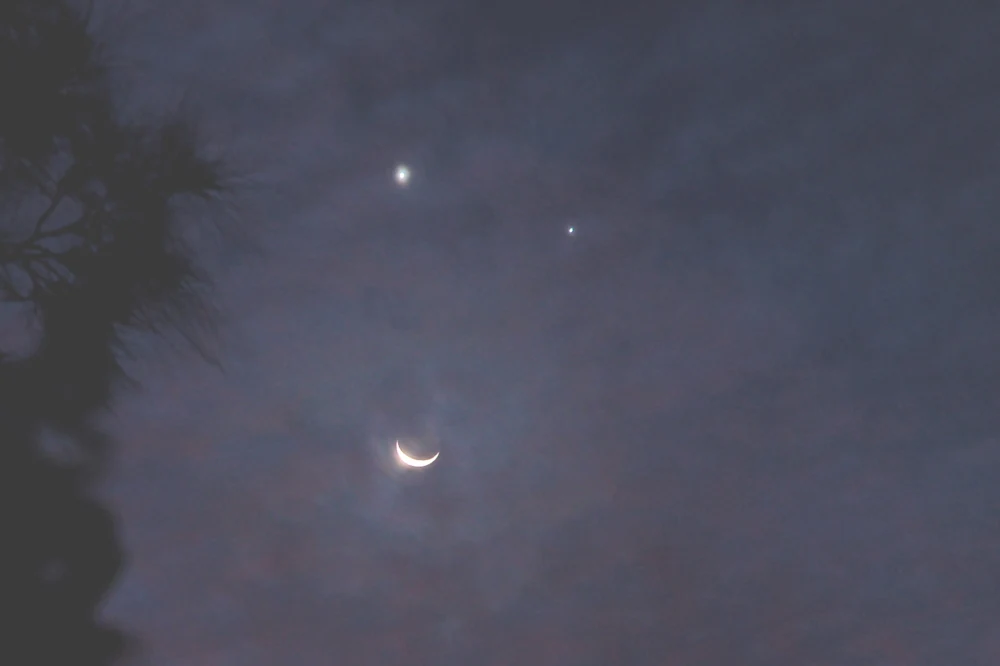
On the evening of June 9, Venus and Jupiter close to within roughly 1.5° of each other, about three full-moon widths, low in the western twilight. Venus, near magnitude −4, is the brighter of the two. Jupiter sits at about magnitude −2, dimmer but impossible to miss. Both planets fit comfortably inside a standard binocular field of view, and you don’t need anything more than your eyes to enjoy the pairing. The show runs for the better part of a week on either side of the closest approach, so one cloudy night won’t ruin it.
Why they appear close
Venus is roughly 0.5 AU from Earth in early June (about 80 million km). Jupiter is over 6 AU away, closer to 900 million km. They aren’t remotely close to each other in space. What’s happening is geometric: our line of sight to both planets crosses at nearly the same angle against the background sky, placing them in the same narrow patch of twilight.
Venus reached greatest eastern elongation around June 5, which means it’s at its widest angular distance from the Sun as seen from Earth. Jupiter, meanwhile, is on the far side of its orbit heading toward opposition in October. The two approach each other in the WNW evening sky as Venus begins its slow fall back toward the Sun and Jupiter climbs away from it. The timing produces one of the year’s most photogenic naked-eye planetary pairings.
When and where to look
Face west-northwest about 30 to 45 minutes after local sunset. For the eastern Mediterranean (Nicosia, Athens, Beirut) that puts you outside around 20:15 to 20:40 EEST (UTC+3) in the first week of June. Western Europe is roughly 21:30–22:00 local time; the US East Coast about 21:00–21:30 EDT. The pair sits low, maybe 15° to 20° above the horizon, so you need a reasonably unobstructed view to the west. Trees, apartment blocks, or a hillside in the wrong direction will cut you off.
The window between “sky dark enough to spot Jupiter” and “planets too low and sinking into haze” is around 45 to 60 minutes. Don’t be late. If you arrive after the pair drops below 10° altitude, atmospheric extinction eats into Jupiter’s brightness fast.
Naked-eye view
Two brilliant points of light, tight together, against the deepening blue of nautical twilight. Venus is the unmistakable one, the third-brightest object in the sky after the Sun and Moon. Jupiter is the fainter companion to its upper left (from northern latitudes). Even from a Bortle 8 city centre the pair punches through light pollution without difficulty.
If you’ve been watching the western sky after sunset for the past few weeks, you’ve already noticed them converging night after night. The motion is surprisingly fast — they close roughly half a degree per day in the final approach. On the evenings of June 7 and 8 they’re already within about 2.5° and 2° respectively. By June 10 and 11 they’re separating again but still a striking pair.
Binoculars: the right tool for this event
A standard pair of 10×50 binoculars gives you a true field of view of about 5° to 7°. At 1.5° separation, both planets sit comfortably in the middle of the frame with plenty of sky around them. The colour contrast is the first thing you’ll notice. Venus is a hard, blue-white blaze; Jupiter is slightly warmer, a touch more golden.
At 10× magnification, Jupiter’s Galilean moons (Io, Europa, Ganymede, and Callisto) resolve as tiny pinpricks in a rough line beside the planet’s disc. Which ones are visible and where they sit changes night to night depending on their orbits. Some nights you’ll see three on one side and one on the other; occasionally one is hidden behind Jupiter or lost in its glare.
Venus through binoculars is a point source — brilliant, almost painfully bright, but you won’t make out the phase. For that you need a telescope.
No tripod required at 10×. If you have a heavier pair (15×70 or 20×80), a tripod adapter helps, but for 10×50s, handheld is fine. Brace your elbows against a railing or wall to cut vibration.
Through a telescope
A telescope adds two details binoculars can’t touch: Venus’s phase and Jupiter’s cloud belts.
Venus passed greatest elongation around June 5, so it shows a nearly half-lit phase, roughly 49% illuminated. Telescopic observers call this dichotomy. Through a refractor at 60× to 80×, the terminator (the line between lit and dark) is a clean, sharp boundary. It’s a satisfying view and a useful reminder that Venus is closer to the Sun than we are.
Jupiter at this time of year is far from opposition and appears relatively small, around 33 arcseconds across. Two dark equatorial cloud belts are visible at 80× to 100× in steady seeing, and the Galilean moons are obvious even at low power.
The catch: most telescopes at the magnification you need for surface detail on either planet can’t fit both in the same field of view. A 2,000 mm Schmidt-Cassegrain at 100× gives a true field of about 0.3°, enough for one planet at a time. To frame both simultaneously you’d need a short-focal-length refractor (400 to 500 mm) with a wide-angle eyepiece at 20× to 30×. The view is lower magnification, but the novelty of seeing two resolved planetary discs side by side is worth the trade-off.
Smartphone and camera tips
The conjunction is wide and bright enough that a smartphone can capture it. Set the phone to night mode if available, or tap to focus on Venus and let the exposure handle itself. The pair against the twilight gradient, deep blue fading to orange near the horizon, makes for a good frame.
For a DSLR or mirrorless camera, a lens in the 85 mm to 200 mm range at f/4 to f/5.6, ISO 400 to 800, 1 to 4 seconds on a fixed tripod. You won’t trail the planets at these exposures. A telephoto at 200 mm on an APS-C sensor frames the pair with some sky context. Tighter crops need tracking.
If you want to get creative, try shooting the same framing every evening from June 5 to June 12 and stacking the results into a composite that shows the two planets approaching and separating. Fixed tripod, same time each night, same lens and composition. The diagonal paths trace out the conjunction geometry.
The full week: don’t wait for June 9
The conjunction isn’t a single-evening event. Venus and Jupiter are visibly converging from June 5 onward and still make a tight pair through June 12. That’s eight evenings of opportunity. If June 9 is overcast at your location, any of the surrounding nights looks nearly identical to the naked eye.
From my balcony in Nicosia, the western horizon is partially blocked by the apartment across the street. For this one I’ll probably head up to the roof or drive 15 minutes to a spot with a cleaner sightline toward the sea. The altitude won’t be the problem — even from 35°N the pair should clear 15° easily. Horizon clutter in a city can still steal those last few degrees when the planets are sinking, though.
What comes next
If you catch the conjunction bug and keep watching Venus through mid-June, mark June 17. The Moon passes in front of Venus in a lunar occultation, a rare event visible in daylight from parts of Europe and the Middle East. Observing it requires a telescope and care to keep the Sun well out of the field. More on that as the date approaches.
For now, set a reminder for 30 minutes after sunset, grab binoculars if you have them, and find a clear western horizon. The pair is already closing in.