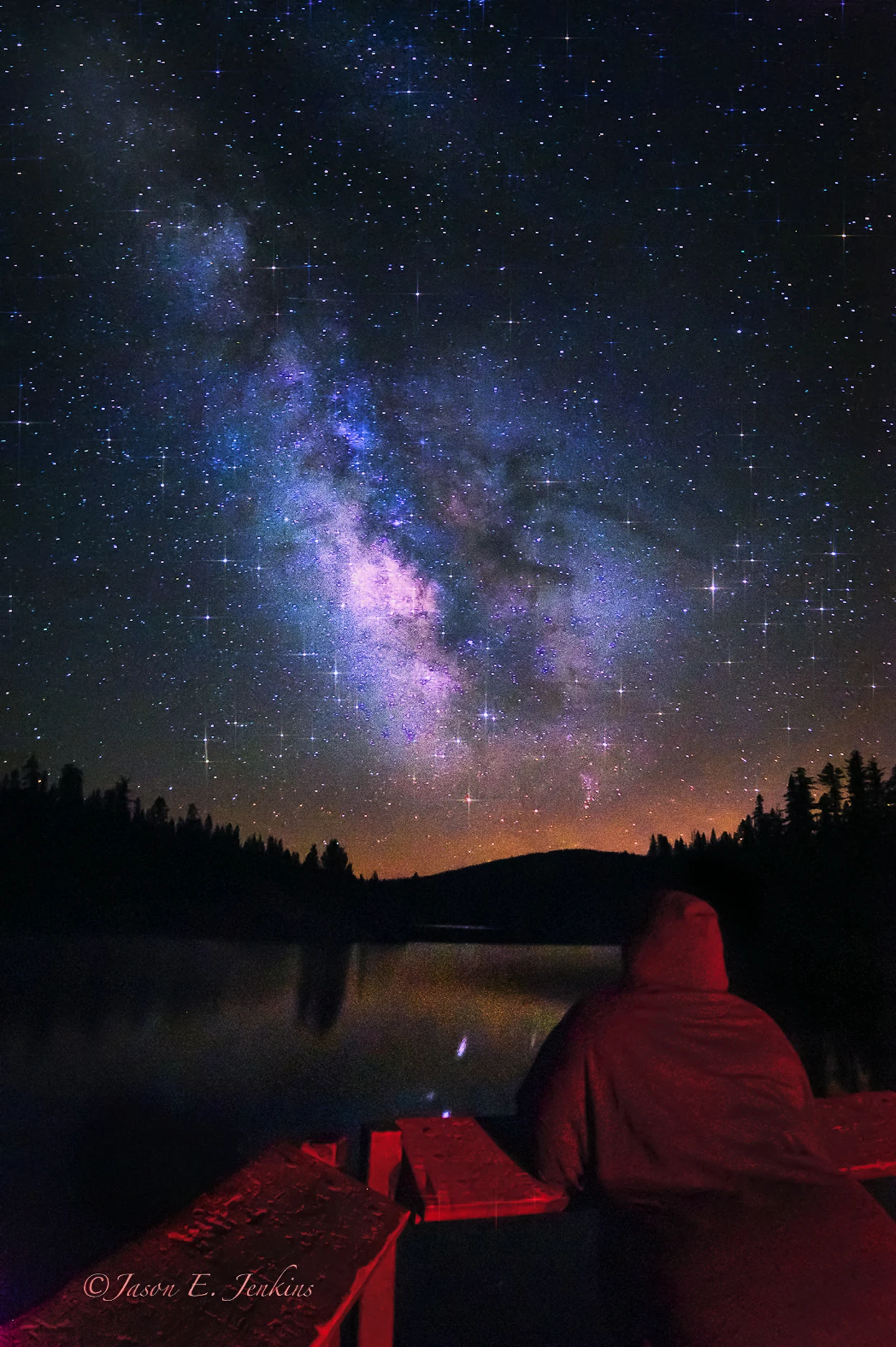
Greece has one certified dark sky park. It’s on Kefalonia, on top of Mount Aenos, inside a national park that was established in 1962 to protect a fir tree found almost nowhere else. The fir is still there. So are skies dark enough to earn DarkSky International certification in 2023 — the first site in Greece to manage it.
If you’re planning a Greek island trip this summer and you own a pair of binoculars, Aenos deserves a night.
Where and what
Mount Aenos is the highest point on Kefalonia, the largest of the Ionian Islands off western Greece, sitting at about 38°N. The national park covers the upper slopes, dense with Abies cephalonica — the Kefalonian fir, a conifer species named for this island. Above the treeline, the horizon opens in every direction, and the Ionian Sea swallows most of the coastal light pollution before it reaches you.
DarkSky International certified Aenos as an International Dark Sky Park in 2023, the first in Greece and still the only one as of mid-2026. The certification requires documented sky-quality measurements and an active commitment to reducing artificial light in and around the park. Skyglow from nearby coastal towns is visible on the horizon through breaks in the forest, but inside the park — with fir canopy blocking low-angle light — the overhead sky is dark enough that the zodiacal light is visible and the Milky Way casts a faint ground shadow on clear moonless nights.
From 38°N in summer, the sky is generous. The Milky Way’s densest star clouds in Sagittarius and Scutum clear the southern horizon by late evening, with the Summer Triangle — Vega, Deneb, Altair — passing near the zenith after midnight. Scorpius rides fully above the horizon here, tail and stinger included. Observers who normally work from the UK or Scandinavia lose most of Scorpius to horizon haze; from Aenos, you get all of it.
The observatory nobody expects
Most visitors don’t know Aenos has a working research observatory. The EUDOXOS National Observatory, operated by the Research Foundation of Kefallinia (RFK), has been running robotic telescopes on the mountain since 1999 — the first robotic astronomy centre in Greece. The complex sits on a plateau at about 1,040 m altitude.
EUDOXOS focuses on education and remote observing. University students submit observation schedules and receive data back, the same workflow professional observatories use, scaled for teaching. During summer, the park management runs free public observing nights with telescopes and guided constellation tours using green lasers.
For visiting amateurs, the observatory area is a practical bonus: cleared sightlines, flat ground for a tripod or portable scope, and power access for USB charging. Cold mountain nights drain phone batteries faster than you’d expect, and having a socket nearby saves the session.
When to go
June through September is the practical window. The mountain road is open, clear nights outnumber cloudy ones, and the Milky Way is optimally placed. Daytime temperatures reach 25–30°C at the coast but drop to 12–15°C at the observing plateau after midnight. Bring a fleece, not a t-shirt.
The best nights track the lunar cycle. In summer 2026, the strongest dark-sky windows are:
- June 13–18 (new moon June 15)
- July 12–17 (new moon around July 14)
- August 10–15 (new moon August 12 — Perseid peak and a partial solar eclipse from Greece the same day)
That August window is exceptional. The Perseid meteor shower peaks on the night of August 12, which also happens to be a new moon — the darkest possible sky for catching meteors. Earlier that afternoon, Greece sees a partial solar eclipse as the total eclipse path crosses Iceland and northern Spain. Eclipse in the afternoon, Perseids under moonless skies that night. If you’re going to be on the mountain once this year, mid-August is the slot.
Getting there
Kefalonia Airport (EFL) has direct flights from Athens year-round (about 45 minutes on Olympic Air or Sky Express) and seasonal charters from the UK and EU. Jet2, easyJet, and Ryanair all serve the island in summer. From Cyprus, the most practical route is Larnaca → Athens → Kefalonia, roughly 4–5 hours including the layover.
From Argostoli, the island capital, Mount Aenos is a 30–40-minute drive south and uphill. The road climbs through olive groves, then fir forest, ending at a car park near the national park entrance. There’s no public transport to the summit — you’ll need a rental car.
One warning about the road: the upper section is a single-lane track with limited guardrails and no lighting. Goats use it too. Drive it once in daylight to learn the turns before you attempt it in the dark. On observing nights, drive up before sunset and plan for a slow, careful descent afterwards. Low beams, no rushing, watch for animals on the road.
Where to set up
Two main observing spots in the park:
The car park at the park entrance — flat tarmac, open sky to the south and east, easy to unload gear from the boot. This is where the park holds its organised observing evenings, and where most visitors set up. You can spend three hours at the eyepiece, pack up, and be back at your car in 30 seconds.
The picnic area deeper into the park — darker, quieter, accessed by an unlit trail. Better for astrophotographers who want fir silhouettes in their foreground compositions. Bring a red headlamp and know the path.
Both spots are free access, no booking required. For the organised astronomy nights — telescopes provided, guided constellation tours — check the Aenos Dark Sky Park website or the park’s social media for the schedule. They’re usually set around new-moon weekends in July and August.
How Aenos compares to Troodos
I can’t write about a mountain dark-sky park on a Mediterranean island without thinking about Troodos in Cyprus. The parallel is obvious: both are highlands rising above sea-level tourist coasts, both escape the coastal light dome, both offer southern-sky access that mainland northern Europe can’t match.
The differences are real. Troodos peaks higher — about 1,952 m — and the air tends to be drier, more stable, better for planetary detail and high-resolution imaging. Aenos is lower (observing areas around 1,000–1,100 m) and faces the open Ionian Sea, so humidity can roll in from the west on some nights.
But Aenos has something Troodos doesn’t: IDA certification, an operating research observatory, and organised public programmes with real telescopes. If you want a self-guided session under raw dark sky with your own equipment, Troodos has the edge. If you want an island holiday where you can show up to a scheduled observing evening, look through a telescope someone else set up, and have a guide walk you through the summer constellations — Aenos does that, and it does it well.
What to bring
- Binoculars. Even a 10×50 pair opens up the Sagittarius star clouds, picks out M8 (the Lagoon Nebula), and splits the tight doubles in Scorpius.
- A red-light headlamp. The park has no lighting after dark. White light wrecks your adaptation and ruins other observers’ sessions.
- A warm layer — 12°C at midnight on a Greek mountaintop in July surprises people every summer. Fleece or a light down jacket.
- A star map app like Stellarium or SkySafari. At 38°N, Scorpius and Sagittarius sit in positions that confuse anyone used to observing from higher latitudes.
- Water and snacks. Nothing is open on the mountain after sunset.
One island, two reasons to go up
Kefalonia already draws visitors for its beaches, hiking, and Venetian-era architecture. Aenos adds a night sky that most tourists on the coast never see because they never leave sea level. The setup is minimal — no gift shop, no “premium astronomy experience” with cocktails — but the park’s free observing evenings, a working research observatory, and IDA-certified darkness add up to more than a viewpoint.
Greece’s only certified dark sky park, a 30-minute drive from your hotel, on an island with direct summer flights from across Europe. If you’re going to be in the Ionians this summer, one clear night on the mountain is worth the early alarm the next morning.