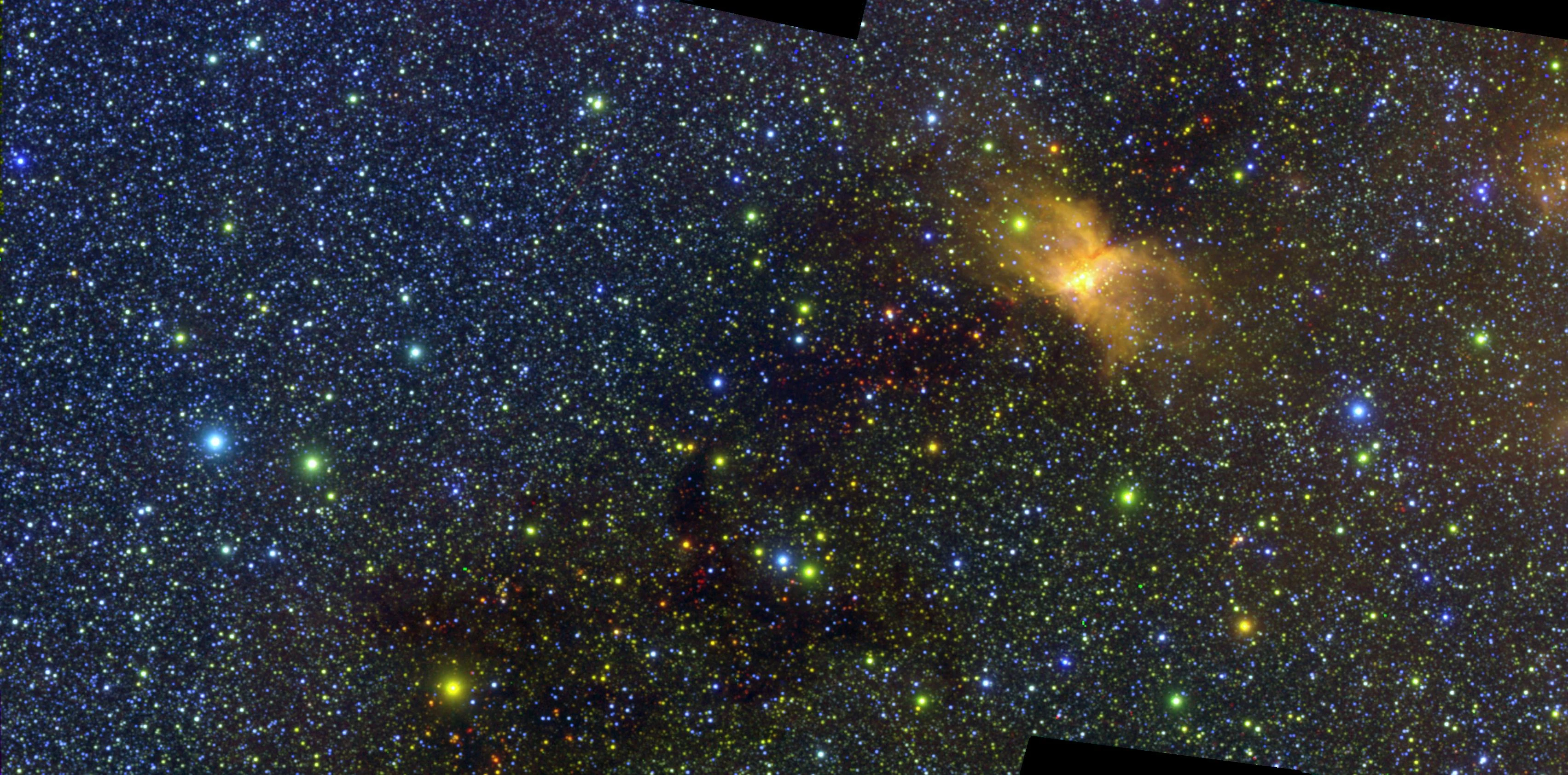
A Spanish-led team has detected erythrulose, a four-carbon ketose and the first true monosaccharide ever confirmed in interstellar space, inside a molecular cloud near the Galactic Center roughly 26,000 light-years from Earth. The preprint, posted to arXiv on June 2, draws a line from a specific interstellar molecule to the chemistry of TNA (Threose Nucleic Acid), a simpler genetic polymer that may have preceded RNA on early Earth.
Not the first “sugar in space” headline, but the first actual sugar
You may remember headlines from 2012 about sugar molecules found near a young star. Those referred to glycolaldehyde, a two-carbon hydroxyaldehyde with the formula C₂H₄O₂. It’s the simplest molecule that participates in sugar chemistry, and it can react with other molecules to eventually form ribose. But glycolaldehyde isn’t a sugar. It has two carbon atoms; the smallest molecule that counts as a monosaccharide needs at least three.
Erythrulose has four carbons (C₄H₈O₄). It’s a ketose, meaning its carbonyl group sits at the second carbon position rather than at the end of the chain. By any textbook definition, it’s a genuine sugar, and it’s the first one confirmed in the interstellar medium.
The distinction isn’t pedantic. Monosaccharides are the structural units behind nucleic acids. Ribose (five carbons) runs the backbone of RNA; deoxyribose runs DNA. If you want to understand whether the precursor chemistry for genetic molecules happens in interstellar space, you need to find actual sugars out there, not just sugar-adjacent aldehydes. That’s what Izaskun Jiménez-Serra’s team at Spain’s Centro de Astrobiología has now done.
How they found it
The detection came from millimeter-wave spectroscopy. Every molecule rotates at specific frequencies determined by its mass, shape, and bond geometry. Point a radio telescope at a molecular cloud and you get a forest of emission lines. Match those lines to a molecule’s predicted rotational spectrum and you have a detection.
Jiménez-Serra’s team used two instruments: the Yebes 40m telescope in Guadalajara, Spain, and the IRAM 30m telescope on Pico Veleta in southern Spain. Both operate in the millimeter and sub-millimeter bands where complex organic molecules leave their strongest fingerprints. The target was G+0.693−0.027, a molecular cloud in the Central Molecular Zone of our galaxy.
Erythrulose lines matched cleanly, and the molecule turned out to be at least eight times more abundant than any analogous three-carbon sugar in the same cloud. Three-carbon sugars like glyceraldehyde, which astrochemists have been hunting in the ISM for years, remain undetected. The four-carbon version showed up first. That was unexpected.
Cold chemistry on dust grains
Erythrulose doesn’t form in the gas phase. The temperatures and densities in molecular clouds don’t favor four-carbon molecules assembling from atoms in open space. Instead, the process runs on the icy surfaces of interstellar dust grains: microscopic silicate and carbon particles coated in thin layers of frozen water, methanol, and simple organics.
The formation pathway, modelled in the paper’s quantum chemical calculations, goes roughly like this. Two-carbon precursors (glycolaldehyde and ethylene glycol, both already detected in G+0.693) freeze onto grain surfaces. Cosmic rays and stray hydrogen atoms create radical fragments from these ices. The radicals recombine into larger structures, and erythrulose is one of the products. The whole process runs at 10–20 K, cold enough that most lab reactions would stop entirely. On grain surfaces, they don’t, because the radicals don’t need thermal energy to meet. They’re trapped on the same ice, a few ångströms apart.
Why four carbons matter: the TNA connection
RNA is built on ribose, a five-carbon sugar. DNA uses deoxyribose, also five carbons. Both are complex molecules with multiple chiral centers, and the question of how they formed prebiotically, before enzymes existed to build them, has been one of the hardest problems in origin-of-life chemistry.
TNA offers a simpler alternative. Its backbone uses threose, a four-carbon sugar with only one chiral center instead of ribose’s three. Threose can be assembled from just two molecules of glycolaldehyde. TNA is easier to synthesize under prebiotic conditions, and lab experiments have shown that TNA strands can base-pair with RNA and DNA, meaning a TNA-based genetic system could have handed off information to RNA as biochemistry grew more complex.
The hypothesis that TNA preceded RNA has been around since Albert Eschenmoser proposed it in 2000. What’s been missing is evidence that four-carbon sugars form readily in space, where molecular clouds seed the raw materials for star systems, planets, and eventually whatever chemistry life needs.
Erythrulose fills part of that gap. In aqueous conditions — on a warm early-Earth surface, or inside a carbonaceous meteorite that’s been heated — ketoses like erythrulose readily isomerize into their corresponding aldoses. For erythrulose, that means erythrose, another four-carbon sugar. From erythrose, the step to threose is a simple epimerization. The entire pathway from interstellar erythrulose to TNA’s backbone sugar involves well-characterized, thermodynamically favorable reactions.
Why this particular cloud keeps delivering
G+0.693−0.027 sits in the Central Molecular Zone, a region within the inner few hundred parsecs of the Milky Way. It’s dense, warm (70–150 K depending on the subregion), and chemically rich. Over the past decade, it has yielded dozens of first-time interstellar detections, including ethanolamine (a phospholipid head-group component), hydroxylamine, and several amino acid precursors.
What makes G+0.693 productive is that it’s quiescent: no active star formation is shredding molecules with UV radiation. The cloud has had time to build chemical complexity without having it destroyed. It’s a natural laboratory for prebiotic chemistry, and the Jiménez-Serra group has been systematically surveying it for years.
What this doesn’t prove
The paper is a preprint. It hasn’t been through peer review, and the authors are careful with their claims. Detecting erythrulose in a molecular cloud 26,000 light-years away doesn’t prove that life on Earth started with TNA. The conversion from interstellar erythrulose to a functional genetic polymer involves many steps: delivery to a planetary surface, dissolution in liquid water, isomerization, polymerization. Each has its own set of open questions.
What the detection does is remove a supply-side objection. If four-carbon sugars couldn’t form efficiently in interstellar chemistry, the TNA-first hypothesis would need another source for its backbone sugar. Now there’s a plausible one, and it appears to form abundantly from two-carbon building blocks that are themselves common in molecular clouds.
A thought from the balcony
I spend most of my observing nights stacking photons from galaxies and nebulae, objects I can image but can’t touch. The molecular clouds where this chemistry happens are invisible to my Seestar, hidden behind thousands of light-years of galactic dust. But knowing that the sugar chemistry behind genetic molecules is running inside those clouds, right now, in conditions we can model and test against lab data, is the kind of result that keeps me reading preprints at 2 AM between imaging runs.
The paper is Jiménez-Serra et al. 2026, arXiv:2606.03313. If you want the broader picture of how prebiotic molecules accumulate in the ISM, the same group’s 2025 review, The Emergence of Prebiotic Chemistry in the ISM, covers the field well.