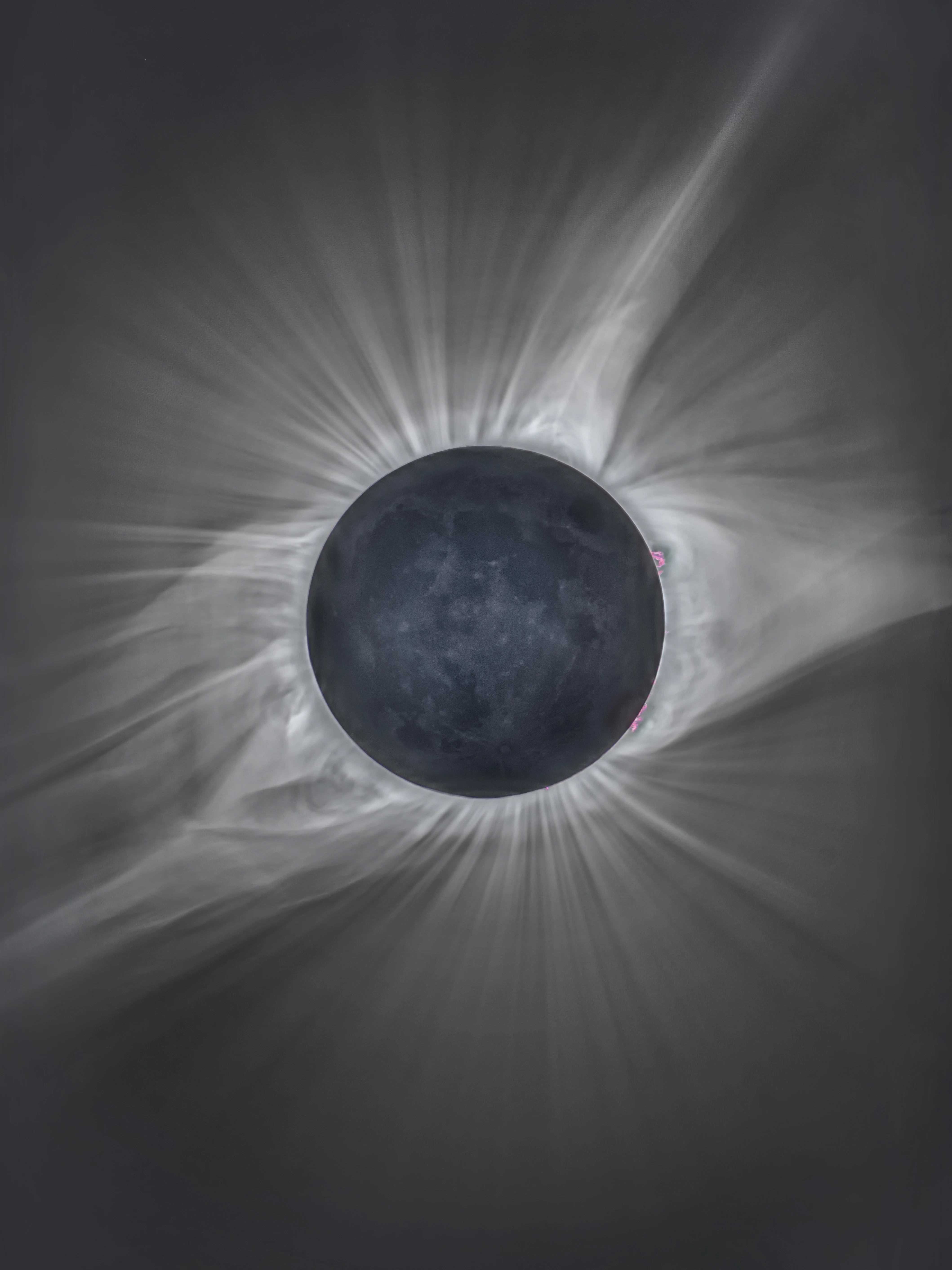
On August 12, 2026, at 18:28 UT, the Moon’s shadow will touch down on the coast of Galicia in northwestern Spain. For about 1 minute 50 seconds in Oviedo — less in Bilbao, more in León — the Sun will disappear behind the Moon while sitting roughly 10° above the western horizon. It will be the first total solar eclipse visible from mainland Europe since August 11, 1999.
Totality happens at sunset, during the Perseid meteor shower peak, under a new moon. For anyone in the path, the sequence is: watch the Sun vanish near the horizon, turn east, and count Perseids across a moonless sky all night.
Sixty days out, this is the planning window. Hotels in northern Spain and Iceland’s Westfjords are filling up fast.
The path: Arctic to Mediterranean
The Moon’s umbral shadow first touches Earth over the Arctic Ocean north of Russia at around 16:45 UT. It races southwest across eastern Greenland — largely uninhabited ice sheet — before crossing the Denmark Strait to Iceland’s Westfjords at approximately 17:44 UT. Ísafjörður, the largest town in the region, gets roughly 1 minute 30 seconds of totality.
The shadow then crosses nearly 2,000 km of open North Atlantic before making landfall again on Spain’s northwest coast at 18:26 UT. From there the path cuts diagonally across the Iberian Peninsula: Galicia, Asturias, Cantabria, Castile and León, the Basque Country, Navarre, Aragón, Valencia, and the Balearic Islands. It lifts off Earth in the western Mediterranean around 18:32 UT.
Maximum totality — 2 minutes 18 seconds — occurs over open ocean between Iceland and Spain. Nobody will see it from a boat unless someone organizes a very specific cruise. On land, the longest durations are in the Westfjords (up to ~1 min 50 sec) and the northern Spanish interior (León: 1 min 45 sec, Oviedo: 1 min 50 sec).
Two destinations, two very different eclipses
Iceland: the Westfjords
Totality arrives at about 17:44 UT (5:44 PM local). The Sun sits around 17–20° above the horizon — comfortable altitude, good light for photography. The Westfjords are remote: Ísafjörður has a population under 3,000 and limited hotel capacity. But the landscape — fjords backed by tundra plateaus, snow patches on ridgelines even in August — will frame the eclipsed Sun against scenery that no other eclipse site this decade can match.
Reykjavik sits right at the southern edge of the path. Downtown gets about 59 seconds of totality, but the margin is thin — a few kilometres south and you’re outside the path entirely. If you base yourself in Reykjavik for logistics, plan to drive north on eclipse day. The Snæfellsnes peninsula or Borgarnes put you safely inside the path with 80+ seconds of totality and an easy same-day return.
Weather risk is real. August in the Westfjords averages 40–60% cloud cover. Iceland’s advantage is mobility: roads are open, distances are manageable, and if you watch satellite imagery the morning of, you can drive to a clear patch within a few hours.
Spain: sunset totality
This is the feature that makes the 2026 eclipse unique. Totality in Spain happens between 20:26 and 20:32 local time (18:26–18:32 UT), with the Sun between 2° and 11° above the western horizon depending on your position along the path.
A low Sun changes what totality looks like. The corona’s light travels through a longer slice of atmosphere, which scatters shorter wavelengths and gives the whole scene a warm amber tinge that mid-sky eclipses don’t produce. The horizon goes 360° sunset orange. Photographs from low-altitude eclipses have a warmth and colour palette that high-Sun totality can’t replicate.
The catch: at 10° elevation, you need an unobstructed western horizon. A hill, a building, a row of trees in the wrong place blocks the Sun entirely. In cities like Oviedo and León, scouting your exact viewing spot matters more than it would for a high-altitude eclipse. Coastal locations facing west — the Asturian shoreline near Gijón, beaches along the Cantabrian coast — have a natural advantage.
City-by-city timing:
| City | Totality start (local) | Duration | Sun altitude |
|---|---|---|---|
| Oviedo | ~20:28 | 1 min 50 sec | ~10° |
| León | ~20:29 | 1 min 45 sec | ~9° |
| Bilbao | ~20:26 | ~29 sec | ~10° |
| Zaragoza | ~20:30 | 1 min 24 sec | ~7° |
| Valencia | ~20:31 | ~1 min | ~5° |
| Palma de Mallorca | ~20:32 | ~20 sec | ~2° |
Bilbao sits right on the northern limit of the path. A few kilometres of positioning make the difference between 29 seconds of totality and none at all. If you’re flying into Bilbao, drive south toward Vitoria-Gasteiz for a more comfortable margin.
Palma gets the opposite problem: the Sun is barely 2° up, minutes from setting. Totality over the Mediterranean horizon could be visually spectacular or completely hidden by low haze. High-risk, high-reward.
Weather: Spain vs Iceland
Northern Spain in August averages 20–30% cloud cover. Asturias has more marine influence — the coast can be foggy — but the interior meseta around León and Burgos is drier. Statistically, the inland plateau is the strongest bet for clear skies in Spain.
Iceland is cloudier on average but offers mobility. You won’t be stuck at a single hotel hoping the forecast holds. The 1999 eclipse taught European observers that lesson: thousands were clouded out across central Europe while a narrow band of clear sky opened over the English Channel.
If I had to pick one number: Spain gives you roughly 70% odds of seeing totality; Iceland, maybe 45%. But Iceland lets you move.
The Perseids bonus
August 12 is also the peak of the Perseid meteor shower. The new moon (17:37 UT on August 12) that causes the eclipse guarantees a completely dark sky afterward — no moonlight washing out faint meteors. The Perseids’ ZHR (zenithal hourly rate) of approximately 100 meteors per hour under ideal conditions makes this one of the best Perseid apparitions in years.
If you’re in Spain and the sky cooperates, you could see totality at sunset and then watch Perseids all night. The radiant in Perseus rises above the horizon by about 22:00 local time in Spain and climbs steadily through the early morning hours.
For anyone chasing both events, the interior meseta around León is the sweet spot: long totality, dry climate, and genuinely dark skies once you’re 20–30 km from town.
Not visible from Cyprus
The partial eclipse zone covers western and northern Europe, parts of North Africa, and northeast North America. It doesn’t extend to the eastern Mediterranean. From Nicosia, the Moon won’t cross the solar disc at all.
I’ve been tracking hotel prices in Asturias since March. They’ve roughly doubled for the week of August 10–14 in Oviedo and the coastal towns. If Spain is your plan, book now — not next month.
Iceland’s Westfjords haven’t priced in as steeply yet, partly because the limited infrastructure caps supply and partly because the weather risk keeps the mass-tourism eclipse chasers away. For someone comfortable with a rental car and flexible lodging, it’s still a viable option at this point.
Sixty days out: the checklist
Pick your destination. Spain for weather odds and a one-of-a-kind sunset totality. Iceland for landscape, mobility, and a higher Sun. Both deliver.
Book accommodation. Oviedo, León, and Gijón are the tightest markets in Spain. In Iceland, Ísafjörður has fewer than 200 hotel rooms, and tour groups have reserved a significant share.
Get eclipse glasses. ISO 12312-2 certified, from a reputable vendor. Buy now, not the week before when counterfeits flood marketplace listings.
Scout your viewing spot. For Spain, you need a clear western horizon. Use a Sun-position app like PhotoPills or The Photographer’s Ephemeris to simulate the Sun’s position at 20:28 local on August 12 from your candidate locations.
Follow the coverage. I’ll publish a detailed Spain regional guide and an equipment checklist for eclipse photography over the coming weeks as part of this site’s eclipse series.
The next total solar eclipse on European soil comes just one year later, on August 2, 2027, when the path crosses North Africa and touches Spain’s southern coast near the Strait of Gibraltar. Two European totalities in consecutive summers, and then a long wait. If totality has been on your list, this is the window.