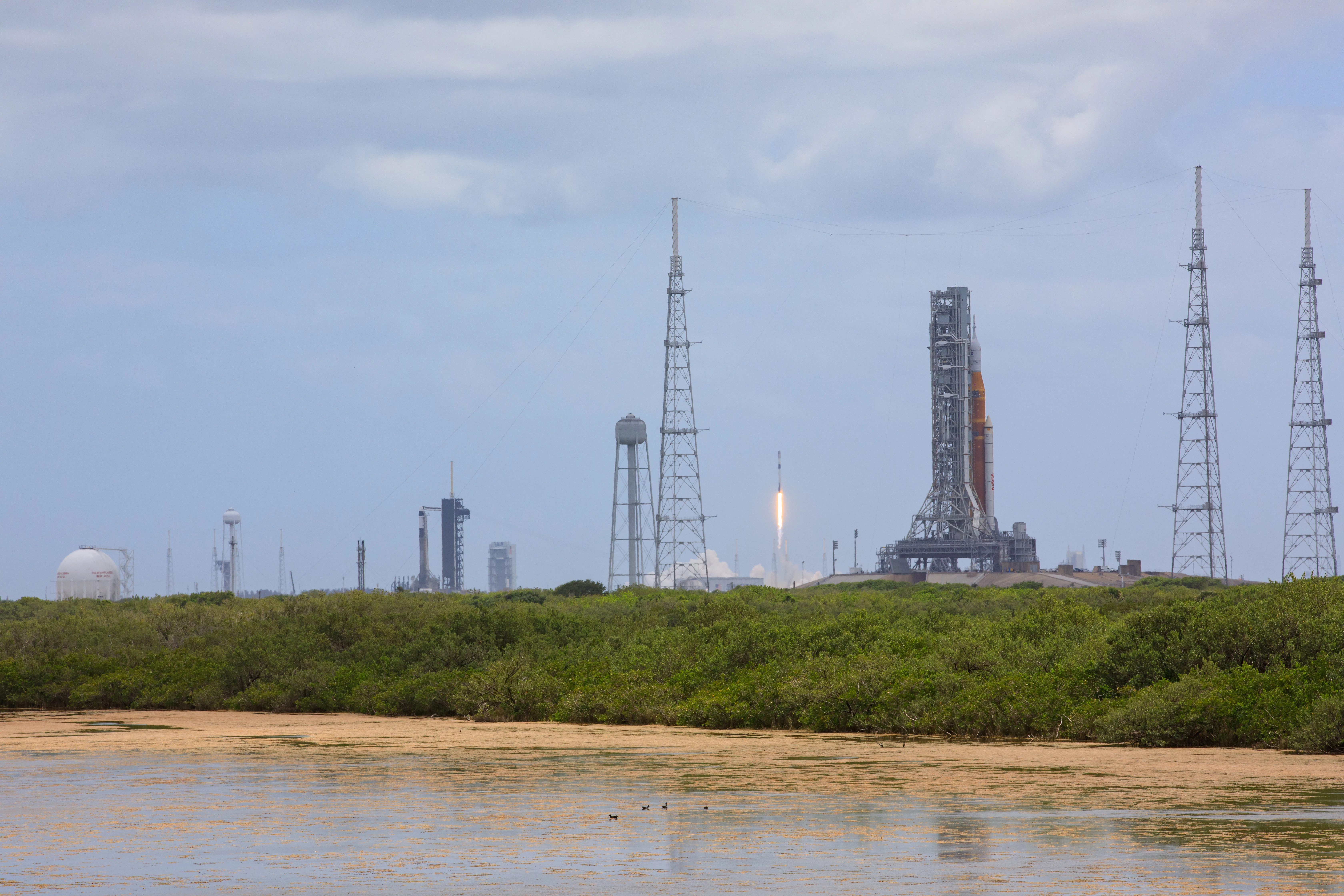
On June 12, SpaceX raised $75 billion in the largest initial public offering in history. The company listed on the Nasdaq at $135 per share, valuing the business at approximately $1.77 trillion — putting it among the ten most valuable public companies on Earth. Within hours of the listing, a Falcon 9 carrying 29 Starlink satellites lifted off from Cape Canaveral. The symbolism wasn’t accidental.
The reason SpaceX commands that valuation isn’t Starship, and it isn’t the Artemis HLS contract. It’s 10,400 satellites already in orbit, beaming internet to paying subscribers in 75+ countries. Starlink generates an estimated 58% of SpaceX’s total revenue. When public investors bought SpaceX stock this week, they bought a satellite internet company that also happens to build rockets.
For anyone who photographs the sky or simply looks up, this matters in a very specific way: the financial structure that keeps those satellites multiplying just shifted from private ambition to public-market growth pressure.
What’s already up there
As of June 1, 2026, astronomer Jonathan McDowell counts 10,413 Starlink satellites in orbit, of which 10,397 are operational. They orbit in shells between 540 km and 570 km altitude, organized into inclined planes that sweep across every patch of sky visible from mid-latitudes within a few hours.
From my balcony in Nicosia, I count satellite passes constantly during the hour after sunset and before sunrise. Through the Seestar’s 10-second sub-exposures, I typically reject 2–3 frames per 30-minute session to satellite trails. That’s manageable. The question is where the numbers go from here.
From 42,000 to one million
SpaceX’s approved constellation cap is 42,000 Starlink internet satellites. They’re roughly a quarter of the way there. But in January 2026, SpaceX filed a separate application with the FCC for something far larger: the “Orbital Data Center System” — up to one million solar-powered satellites at altitudes between 500 km and 2,000 km, carrying onboard machine-learning accelerators and connected by intersatellite optical links.
These aren’t internet terminals. They’re orbital compute nodes for AI workloads. SpaceX told the FCC the system would “operate a constellation of satellites with unprecedented computing capacity to power advanced artificial intelligence models.”
The FCC accepted the filing for review on February 4. SpaceX also requested a waiver of the standard deployment milestones that require half a constellation within six years and full deployment within nine. Even a fraction of a million satellites would dwarf anything currently in orbit.
What the models predict
In a 2021 study, University of British Columbia researchers Samantha Lawler and Aaron Boley modelled how megaconstellations would alter the naked-eye sky. They calibrated their simulations against real Starlink brightness data and found that at 65,000 satellites, one in every 15 visible points of light in the night sky would be a satellite rather than a star.
The human eye can see roughly 4,500 stars under truly dark skies. At a million satellites in low orbit, the model predicts that visible satellites would outnumber visible stars for large portions of the night across most of the world. Boley, now a 2026 Qilak Award recipient for astronomy outreach, put it directly: we would see more satellites than stars.
For observatories, the picture is grimmer. A 2024 study in Monthly Notices of the Royal Astronomical Society tracked Starlink Gen2 “Mini” satellites and found that while brightness mitigation reduced luminosity by roughly a factor of three compared to first-generation hardware, the satellites remained above the threshold set by the IAU for minimal interference with professional observations. The Vera Rubin Observatory in Chile — designed to image the entire visible sky every three nights — has modelled that a fully deployed Starlink constellation would leave satellite trails in a significant fraction of every night’s exposures.
What SpaceX has actually done
Credit where it’s due: SpaceX engaged with the astronomy community earlier than most satellite operators. The progression since 2020:
- VisorSat (2020): a deployable sunshade that cut reflected brightness by ~3×.
- Flight attitude changes: orienting the satellite bus to minimize the reflective cross-section during operational orbit.
- Dielectric mirror film on Gen2 Minis: reflects sunlight away from the ground rather than absorbing and re-emitting.
- Lower operational altitude (540 km vs earlier 550 km shells): satellites spend less time illuminated after sunset because they enter Earth’s shadow earlier. A 2023 simulation found the lower altitude reduced the number of satellites visible to a telescope by about 40%, with only a 5% increase in per-satellite brightness.
These measures help. But they don’t solve the problem at scale. A satellite that’s 3× dimmer is still visible to a sensitive CCD. And dimming each satellite by a factor of three loses all ground when you multiply the constellation size by 25.
What this means at the eyepiece and the sensor
If you’re imaging from a mid-latitude site tonight, here’s the practical reality:
Visual observing is largely unaffected so far — most Starlink satellites are below naked-eye visibility except during twilight and the first hour after sunset. That changes with higher-orbit shells or a constellation measured in hundreds of thousands.
Astrophotography already feels it. Wide-field shots on tracking mounts (2–5 minute exposures) frequently catch one or more satellite trails. Stacking software like DeepSkyStacker or Siril can reject affected frames via sigma-clipping, but you lose integration time. At current densities, I lose maybe 5–10% of frames. At 42,000 satellites, simulations suggest 15–25% frame rejection for wide fields. At a million, the math gets uncomfortable.
The twilight window — the 90 minutes after sunset and before sunrise when low-orbit satellites are still sunlit — is the worst affected. Comets, planets near the horizon, thin crescent moons, and anything requiring low-elevation imaging already contends with satellite traffic that’s only going to get denser.
What you can do
There’s no individual fix for an orbital constellation, but a few things help on the observing side:
- Stack more, reject more. Build extra integration time into your sessions to compensate for frame rejection. Plan 20% longer than you otherwise would.
- Avoid the twilight satellite window for deep-sky targets when possible. Mid-session (local midnight ± 2h) has the fewest illuminated satellites.
- Use satellite prediction tools. Apps like Heavens-Above and the Starlink tracker on N2YO show pass times for your location. Some planning software (Telescopius, Stellarium) can overlay constellation positions.
- Support the regulatory conversation. The IAU’s Centre for the Protection of the Dark and Quiet Sky from Satellite Constellation Interference (CPS) coordinates between operators and astronomers. The International Dark-Sky Association tracks legislative developments. Both accept public input during FCC comment periods.
The structural problem
Before the IPO, Starlink’s growth was constrained by SpaceX’s own cash flow and risk appetite. Musk could slow the constellation if he chose to. Now there are public shareholders, quarterly earnings calls, and analyst coverage. Starlink’s subscriber growth is the single largest driver of the stock price.
The incentive to add satellites — more coverage, more bandwidth per cell, less latency — is no longer one founder’s ambition. It’s a fiduciary obligation to maximize shareholder value. That doesn’t make dark skies impossible to protect, but it does mean the conversation has to happen through regulation, not goodwill. The FCC, the ITU, and national space agencies are the venues that matter now.
For those of us who point telescopes and cameras at the sky, the last week changed the ownership structure of the problem. The satellites were already there. Now so is the market pressure to send more.