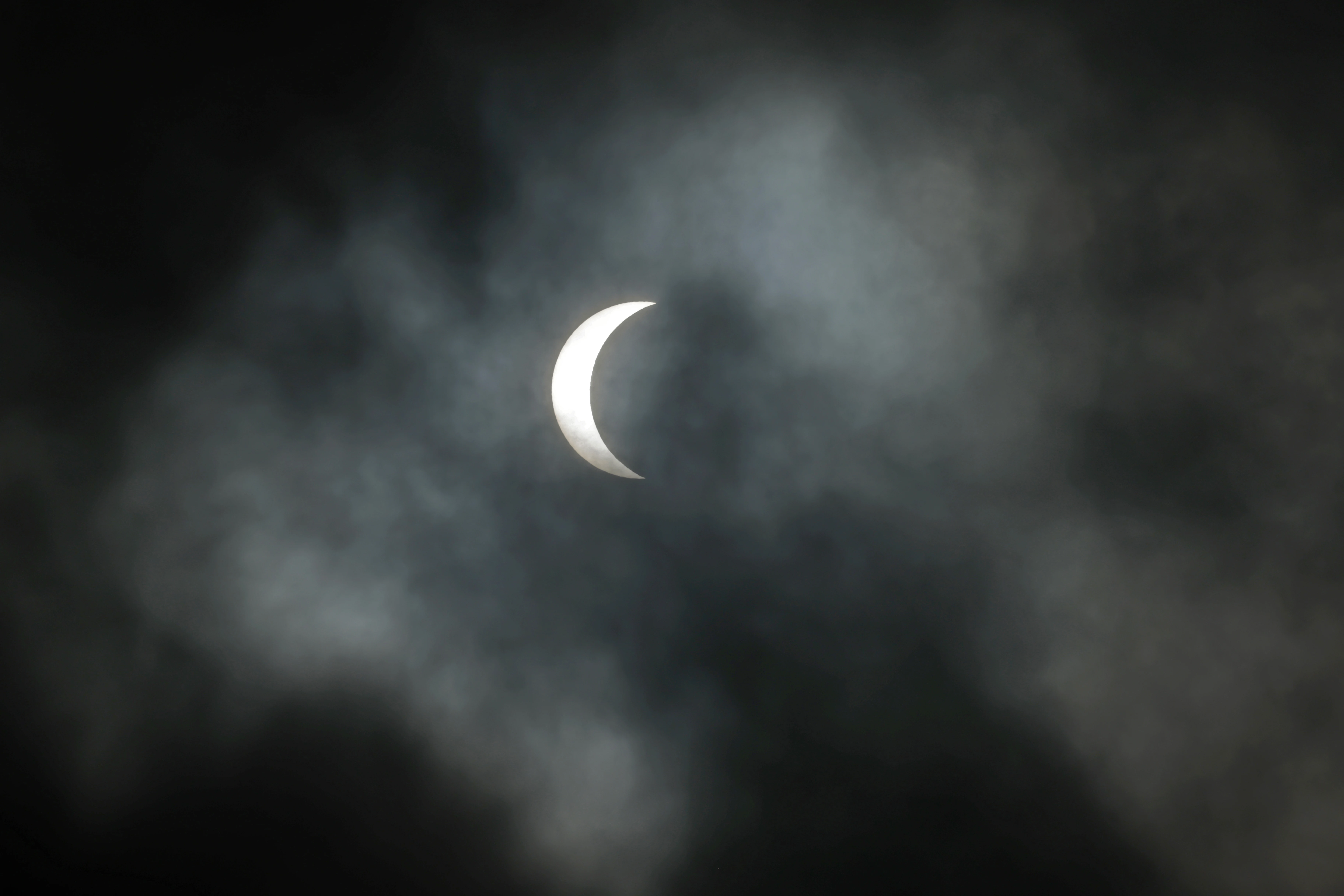
The August 12 total solar eclipse is 55 days out. If you’re planning to photograph it, point a telescope at it, or just watch the partial phases safely, you need a solar filter. Prices are still normal and stock is still available. By late July neither will be true.
Here’s what the numbers on the label mean, which filters are worth the money, and what I’m packing for Spain.
The one number on every solar filter: optical density
Every solar filter blocks a fraction of the Sun’s light. The spec you care about is optical density (OD), a logarithmic scale. OD 5 means only 10^-5 of the incoming light gets through — one hundred-thousandth. OD 4 passes ten times more. That factor of ten is the line between safe for your eyes and not.
Two OD values matter for eclipse work:
- OD 5.0 — visual observation. Safe to look through a telescope eyepiece, binoculars, or as handheld eclipse glasses. The standard for all visual solar filters.
- OD 3.8 — photographic use only. Enough to protect a camera sensor and produce a well-exposed solar image. Not safe for looking through an optical viewfinder. If your camera has an electronic viewfinder or you’re using live view, OD 3.8 works fine because the sensor mediates the light path.
One common confusion: OD and ND (neutral density) from photography. An ND 5.0 filter and an OD 5.0 filter both block 100,000x. But most photographic ND filters aren’t tested for infrared and ultraviolet transmission. A regular ND filter can block visible light while still passing IR straight through to your retina. Solar-specific filters are tested across the full spectrum. Don’t substitute.
Eclipse glasses: the cheapest piece of kit you’ll buy
For the partial phases — the 70+ minutes before and after totality when the Moon is crossing the solar disc but hasn’t fully covered it — ISO 12312-2 certified eclipse glasses are the simplest option. They’re OD 5+ film in cardboard frames.
ISO 12312-2 requires visible-light transmission below 0.00032% and specific UV/IR cutoffs. Before every eclipse, marketplaces fill with cheap glasses that claim compliance without any lab testing behind the claim. The American Astronomical Society maintains a list of vetted suppliers — buy from that list.
Expect to pay $1–3 per pair. Order now. Stock thins sharply in late July and counterfeits multiply.
Eclipse glasses come off during totality — those ~110 seconds in Oviedo when the Sun is completely behind the Moon. You put them back on the instant the first bright bead of sunlight reappears at third contact.
Film filters for telescopes: Baader vs Thousand Oaks
If you own a telescope and want to observe the partial phases at magnification, you need a full-aperture filter that fits over the front of the tube. Two manufacturers account for most of what’s on the market.
Baader AstroSolar Safety Film (OD 5.0, visual grade)
The sharpest film filter available. Baader’s aluminized polyester renders the Sun in a neutral white — closest to the Sun’s actual colour. Through an 8-inch reflector you can resolve sunspot penumbral structure with this film. A4 sheets run about €25–30, which covers telescopes up to 150 mm aperture. Cut the film, build a holder from a ring of foam board and gaffer tape, and you’re set.
The trade-off: it’s fragile. A crease or pinhole compromises the filter. Handle by the edges, store flat, don’t throw it loose in your bag.
Baader also makes AstroSolar Photo Film at OD 3.8 — shorter exposures, more detail, sensor-only (no eyepiece viewing).
Thousand Oaks SolarLite (OD 5.0)
Thicker polymer, noticeably tougher than Baader. You can fold it by accident and it bounces back. The trade-off: a warm orange tint and slightly lower resolution. For visual-only observing, the difference is minor. For imaging, the colour cast needs correction in post-processing.
Thousand Oaks sells pre-made slip-on and screw-on filters for common tube diameters. More expensive than cutting your own Baader sheet, but no DIY.
My choice: Baader if you’re imaging, Thousand Oaks if you’re visual-only and want a filter that survives a backpack.
Glass front-cell filters
Orion, Celestron, and a few smaller makers sell glass solar filters in aluminium cells that screw into or slip over the telescope tube. OD 5.0, prices from $50–120 depending on aperture.
Glass doesn’t flutter in wind, doesn’t crease, and lasts indefinitely. It’s heavier and more expensive than film, and you need the right diameter for your specific tube.
If you already own one, use it. If you’re buying fresh and budget is a factor, film is equally safe and optically competitive.
Camera lens filters
Photographing the eclipse with a DSLR or mirrorless camera and a telephoto lens? You need a front-mounted solar filter over the lens.
Three options, roughly cheapest to most convenient:
- Baader AstroSolar Photo Film (OD 3.8) — cut a square, tape it to a cardboard ring that slides over your lens hood. Under €15 in materials. Optically excellent. Remember: OD 3.8 means don’t look through an optical viewfinder. Use live view or an EVF.
- Daystar Universal Lens Filter — a flexible solar filter that wraps around your lens barrel with elastic, fits diameters from about 60 mm to 90 mm. Quick to deploy, sometimes tricky to centre. About $30–40.
- Threaded glass filters — MrStarGuy and Thousand Oaks make screw-in solar filters in common photography sizes (77 mm, 82 mm). Most convenient if your lens matches. $40–80.
During totality, the filter comes off. This is when you get the corona — streamers, prominences, the diamond ring effect. Pre-programme exposure bracketing for unfiltered shots before the eclipse starts, because those ~110 seconds go faster than you expect.
Smart telescopes
If you own a Seestar S50 or S30, you don’t need to buy anything. Both have a built-in motorised solar filter that drops into the light path when you switch to solar mode in the app. The Seestar’s solar mode shows sunspot detail and, when activity is high, prominences in H-alpha through the integrated narrow-band filter.
Vaonis Vespera models support solar observation through a dedicated solar filter accessory — check whether yours shipped with one or if you need to order it separately.
One hard rule: don’t point a smart telescope at the Sun without confirming solar mode is active in the app. These instruments autofocus. If the solar filter isn’t in the light path, concentrated sunlight burns through the sensor in seconds. The filter has to be in place before the telescope slews to the Sun, not after.
What not to buy
Regular photographic ND filters. Even an ND 100000 (ND 5.0). They aren’t tested for IR/UV transmission. A filter that blocks visible light while passing infrared will damage your retina before you feel any discomfort.
Welding glass below shade #14. Shade #12 and #13 are not safe for direct solar viewing. Shade #14 works but gives a deep green tint and doesn’t adapt easily to telescopes or cameras. It’s a functional last resort, not a first choice.
Stacked sunglasses. No number of sunglasses adds up to OD 5.
Unfiltered phone cameras. Pointing a phone at the Sun during the partial phases probably won’t damage the sensor — the lens is too small to concentrate dangerous energy — but you’ll get a featureless white disc. For totality, just hold the phone up with no filter and let auto-exposure handle the corona. You’ll get a better shot than you expect.
What I’m packing
I’m planning to be in Asturias for the eclipse. The kit:
- Seestar S50 in solar mode for the partial phases, switching to normal mode at second contact for a stacked corona image
- Baader AstroSolar eclipse glasses (OD 5.0) for naked-eye viewing of the partial phases
- Sony a6400 + 200 mm lens with a Baader OD 3.8 photo film ring for filtered partial-phase shots, film off during totality for corona bracketing
- A sturdy tripod — the Seestar has its own, the camera gets a separate one because I don’t want to be swapping during the 110-second window
Total cost of solar filters for the whole setup: about €50. The flights and hotel are the real expense.
Filters ship from European suppliers in about a week right now. By late July, you’ll be paying express shipping or refreshing out-of-stock pages. The eclipse isn’t going to wait.