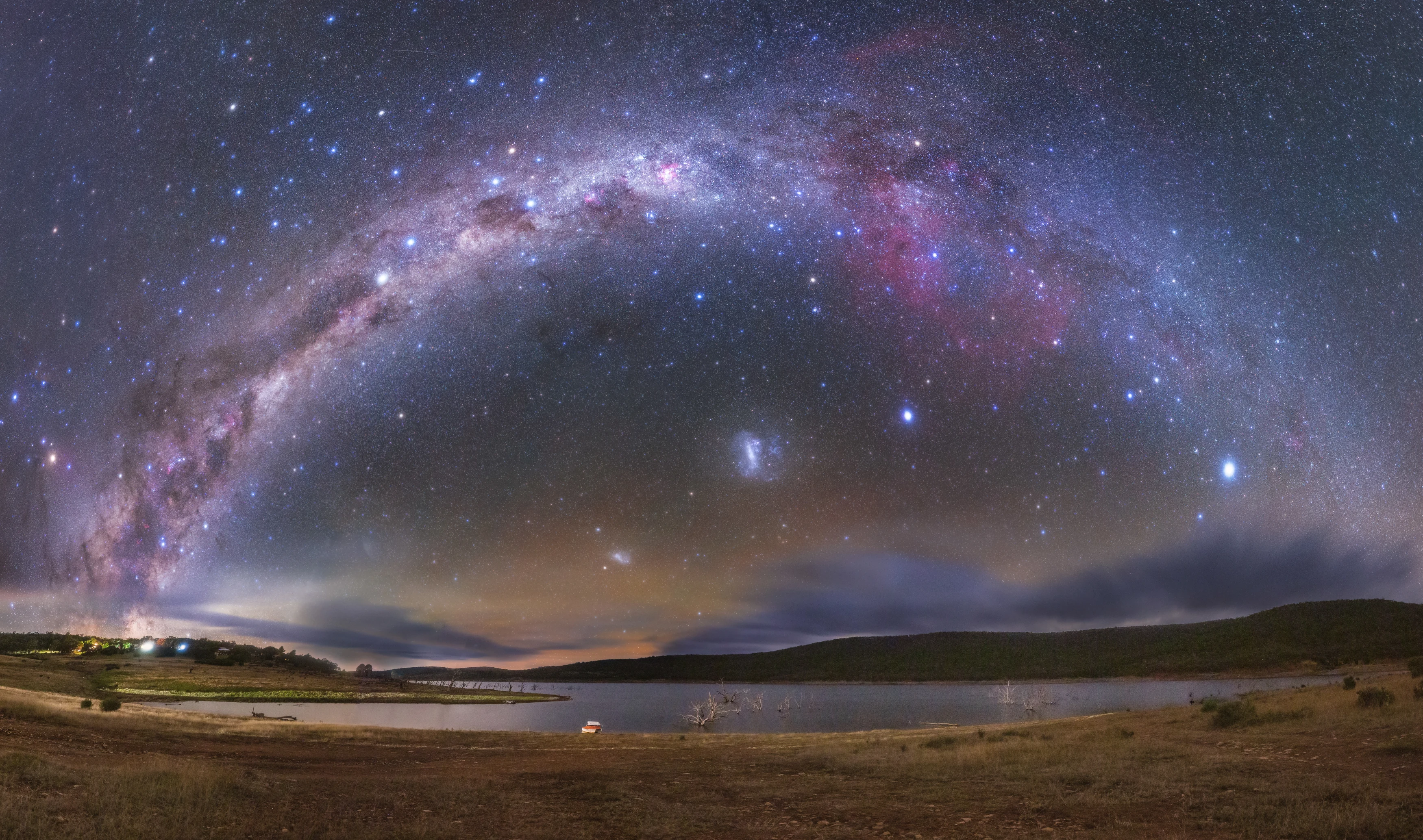
NamibRand Nature Reserve covers 2,150 km² of Namib Desert roughly 400 km southwest of Windhoek. In 2012, the International Dark-Sky Association gave it Gold Tier International Dark Sky Reserve status — the second site in the world to receive the designation, and the first in Africa. The reserve records Bortle 1 sky conditions on a continuously logging Unihedron SQM-LE, with the nearest meaningful light dome more than 70 km away. If you’ve only ever observed from mid-northern latitudes and wonder what the Milky Way looks like when its core passes through your zenith, this is the place to find out.
What you see from 25° south
I observe from Nicosia at 35°N, Bortle 7 on a good night. The Milky Way’s core barely clears 20° above my southern horizon in July before haze and city light eat it. From NamibRand at 25°S, the galactic center in Sagittarius transits nearly overhead — the densest star clouds of the galaxy directly above you, with minimal atmospheric extinction. Observers at the reserve’s lodges report the Milky Way casting visible shadows on the desert floor during moonless winter nights. That’s not hyperbole. At naked-eye limiting magnitudes approaching 7.5, the integrated brightness of the galactic plane produces enough light to create faint but real contrast on pale sand.
The southern sky has objects that don’t exist from European latitudes. The Large and Small Magellanic Clouds, satellite galaxies of the Milky Way, are prominent from NamibRand. The LMC sits at roughly declination -69°, which means it transits at about 46° altitude from 25°S — comfortable binocular territory, high enough that atmospheric absorption is negligible. From Troodos at 35°N, it never rises above the horizon.
The Southern Cross stands high and obvious, flanked by Alpha and Beta Centauri. Alpha Centauri, the closest star system to the Sun at 4.37 light-years, splits into a clean double through 10×50 binoculars at this latitude. From most of Europe, it grazes the horizon or never appears at all.
Then there’s the zodiacal light. I’ve caught it from Troodos at 1,700 m — a faint triangular glow extending from the sunset point along the ecliptic. From NamibRand, it’s not faint. The cone is broad and bright after evening twilight and before dawn, and on the best moonless nights the gegenschein — the antisolar brightening of the zodiacal dust band, directly opposite the Sun — is also visible. I’ve never seen the gegenschein from Cyprus. Too much residual skyglow from Limassol to the south.
When to go
Namibia’s dry winter runs from May through September. June through August is the sweet spot: clear skies on nearly every night, humidity near zero, and air temperatures in the desert drop to 5–10°C after sunset. Cold enough to need a fleece. Not cold enough to fight frostbite.
The Milky Way’s galactic center is well-placed in the evening sky from June onward, reaching the zenith by midnight local time in July. The Magellanic Clouds are circumpolar from this latitude, but they’re highest during southern summer (November–February) — if they’re your primary target, you’re trading stable weather for better Cloud positions. For most visitors, the winter compromise wins.
The wet season (November through March) brings afternoon thunderstorms and higher humidity. Observing is still possible — the storms are often localized and short — but you lose the near-guarantee of cloudless nights.
Moon phase matters more at Bortle 1 than at any other site. From my Bortle 7 balcony, the full moon washes out the Milky Way, but the sky was already washed out by Nicosia. From NamibRand, a full moon erases the very thing you flew 6,000 km to see. The five nights centered on new moon give you darkness from astronomical twilight to astronomical twilight. Check the lunar calendar before booking.
How to get there
Fly into Windhoek’s Hosea Kutako International Airport (WDH). From there, two options:
Drive. Roughly 4.5–5 hours southwest. Paved road to Maltahöhe, then gravel tracks into the reserve. High clearance helps on the final stretches. Most lodges provide GPS waypoints and detailed transfer instructions. Stock up on fuel and supplies at Maltahöhe — population about 4,000, it’s the last town with a fuel station before the reserve boundary.
Charter flight. Several lodges offer light-aircraft transfers from Windhoek to private airstrips inside NamibRand. About an hour in the air. It cuts out the drive but adds to an already substantial bill.
Once inside the reserve, there’s desert, wildlife, and sky. Nothing else.
Where to stay
NamibRand enforces a strict cap of 20 beds per lodge — a conservation measure designed to keep the human footprint minimal across 2,150 km². For stargazers, the practical upside is that no lodge has enough guests to create its own light pollution. All lodges inside the reserve use downward-directed amber lighting or extinguish exterior lights entirely after dark.
Wolwedans Collection. The most established operation in the reserve, running the Dunes Lodge, Dune Camp, Boulders Camp, and Private Camp. The Dunes Lodge sits on a raised wooden platform with some chalets open to the sky. Wolwedans maintains a Celestron CPC 1100 GPS telescope and hosts visiting astronomers for guided observing sessions.
Kwessie Dunes. Twelve chalets in the reserve’s northern section. Regular stargazing programs. Its far-north position puts extra distance between guests and any faint glow on the southern horizon.
The Family Hideout. A self-catering farmhouse in the south of the reserve. No guide, no telescope on-site — but also no schedule. Bring your own gear, observe until you’re done.
Rates reflect the private-reserve model: USD 300–800 per person per night depending on lodge and season, typically including meals and guided activities. That’s the cost of a conservation model built on low volume.
What to bring
If you’re traveling with a telescope, keep it portable. A small APO refractor or a Maksutov on a compact alt-az mount works well. The Seestar S50 would be ideal here — battery-powered, no laptop required, and at Bortle 1 your sky-limited exposures are dramatically shorter than anything I’m used to in Nicosia. A 10-second sub from NamibRand’s sky would outperform the 30-second stacks I run from Bortle 7.
But the best piece of gear for this site is a pair of 10×50 binoculars and a reclining camp chair. When naked-eye limiting magnitude is near 7.5, binoculars become a wide-field deep-sky instrument. You can sweep the Sagittarius star clouds and resolve individual open clusters that simply don’t exist at any magnification from a light-polluted site.
Other essentials: a red headlamp (lodges enforce dark adaptation, and stumbling across desert terrain in the dark is a genuine ankle risk), warm layers for winter nights, and a star atlas for the southern sky. If you normally observe from northern latitudes, your star-hopping muscle memory doesn’t transfer below declination -30°. Everything is mirrored and rotated. Download the southern charts before you fly.
Why it stays dark
NamibRand’s dark sky status isn’t passive certification. The reserve operates a continuous monitoring program with a calibrated SQM-LE that records sky brightness every five minutes, published to the Globe at Night monitoring network. The 20-bed lodge cap, mandatory lighting codes, and the 100 km buffer of Namib-Naukluft National Park to the west all contribute to keeping the readings stable.
The nearest light dome is Maltahöhe, population ~4,000, over 70 km northeast. Windhoek’s glow doesn’t register at the monitoring stations. “Bortle 1” here isn’t estimated by an observer squinting at a star chart — it’s continuously recorded by a fixed instrument in a known location, cross-checked against the IDA’s Gold Tier criteria annually. Very few dark sky destinations on Earth can make that claim with data to back it up.