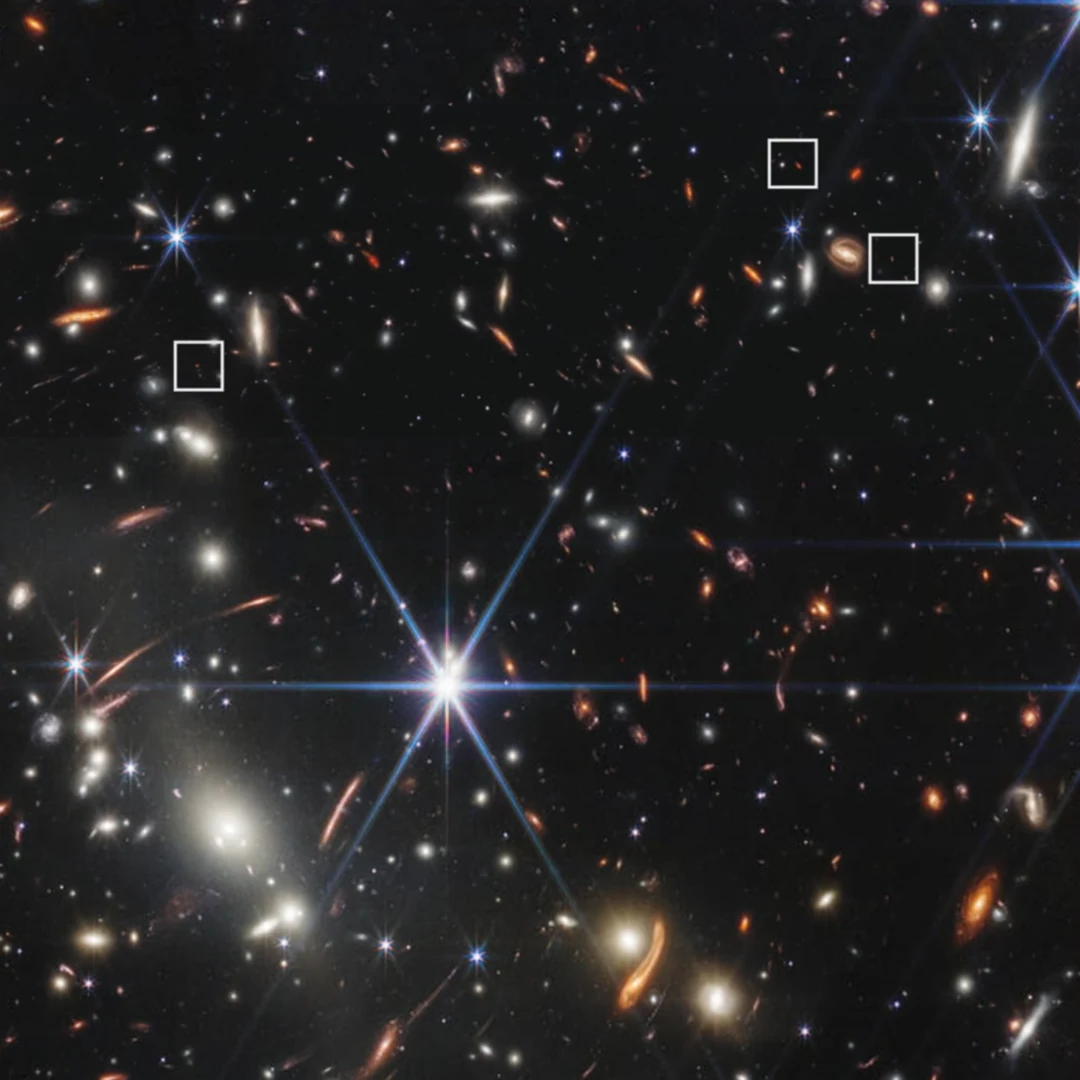
Since 2022, the James Webb Space Telescope has been turning up compact red objects in the deep universe that nobody predicted. More than 300 of these “little red dots” have been catalogued so far, all crammed into a narrow epoch between about 600 million and 1.6 billion years after the Big Bang. For four years, they’ve driven a sharp debate: are they impossibly massive galaxies, overgrown black holes, or something we haven’t modelled yet? A paper published on June 10 in The Astrophysical Journal by Vasily Kokorev and colleagues at the University of Texas at Austin delivers the strongest answer so far. The object they studied, GLIMPSE-17775, is a supermassive black hole cocooned in dense, hot gas — and the data suggest most little red dots are, too.
Eighty hours of staring at one dot
GLIMPSE-17775 sits behind the galaxy cluster Abell S1063, one of the Hubble Frontier Fields clusters whose enormous mass warps spacetime enough to act as a natural magnifying glass. Webb pointed NIRSpec at the dot for 30 hours, but gravitational lensing from the cluster amplified the signal, stretching the effective exposure to roughly 80 hours. The combination produced the richest spectrum ever obtained from a little red dot: more than 40 individual emission and absorption lines, covering rest-frame ultraviolet through optical wavelengths.
Kokorev’s team matched those lines against every plausible model. Starburst galaxies couldn’t reproduce the emission-line ratios. Active galactic nuclei (AGN) models came closer but predicted features that weren’t there. The single model that fit every line simultaneously was the “black hole star” scenario: a supermassive black hole surrounded by a thick cocoon of partially ionized gas, where the cocoon itself produces most of the optical light and electron scattering broadens the spectral lines.
“None of the previous little red dots have all of the pieces of evidence in the same place,” Kokorev told NASA. GLIMPSE-17775 does.
The mass illusion
When JWST first started finding little red dots in 2023, early spectra showed very broad hydrogen emission lines. In standard AGN physics, broader lines mean faster-moving gas, and faster gas near a black hole means a more massive black hole. The initial estimates were alarming: black holes of 10⁸ to 10⁹ solar masses, inside host galaxies far too small to have built something that heavy. The numbers implied that either our models of black hole growth were broken or the early universe had physics we didn’t understand.
A January 2026 paper in Nature by Roberto Maiolino and colleagues at Cambridge changed the picture. Their analysis of the highest-quality JWST spectra showed that the broad lines weren’t caused by high-velocity gas orbiting a huge black hole. Instead, the broadening came from electron scattering inside the dense cocoon surrounding a much smaller hole. Electrons in the cocoon scatter photons many times before they escape, smearing each emission line into a wide profile that mimics Doppler broadening from orbital motion.
When Maiolino’s team corrected for this effect, the inferred black hole masses dropped by roughly two orders of magnitude — from 10⁸–10⁹ solar masses to 10⁵–10⁷. A million-solar-mass black hole 800 million years after the Big Bang is unusual but not impossible. A billion-solar-mass one would be.
GLIMPSE-17775’s spectrum, with its 40+ lines, independently confirms this picture. The narrow intrinsic cores beneath the scattering-broadened profiles point to a black hole in the 10⁶ range. The cocoon is dense (electron densities of roughly 10⁸ cm⁻³), hot, and fed by gas accreting close to or slightly above the Eddington limit — the theoretical maximum rate at which matter can fall onto a black hole before radiation pressure pushes it back out.
How a black hole hides inside a gas cloud
The “black hole star” (BH*) model works like this. A young supermassive black hole sits at the center of a dense, roughly spherical gas envelope. Infalling material feeds the black hole at a high rate, and the accretion disk’s radiation heats and ionizes the surrounding cocoon. The cocoon glows in the rest-frame optical and ultraviolet — that’s where JWST picks up the red dots — while the black hole itself is hidden behind a column of gas and dust thick enough to block X-rays in most directions.
This explains a puzzle that had been nagging X-ray astronomers. Chandra had surveyed many of the fields where Webb found little red dots and saw almost nothing. If these were billion-solar-mass AGN accreting at normal rates, Chandra should have detected dozens. It found one, reported in The Astrophysical Journal Letters, only after Webb identified the infrared counterpart. The cocoon model predicts exactly this: X-rays are absorbed by the dense gas envelope and reprocessed into infrared emission. The dots are bright in the infrared and faint or invisible in X-rays.
The model also explains why little red dots vanish from the population after about 1.6 billion years post-Big Bang. As the black hole grows and its radiation output increases, the cocoon eventually gets blown away. The naked AGN then looks like a normal quasar — blue, bright, and no longer “red” or “dot-like.” The little red dots aren’t a separate class of object. They’re an early phase of black hole growth, a cocoon stage that every massive black hole goes through before it clears its surroundings.
Where the black holes came from
The corrected masses still leave a formation puzzle, just a less extreme one. Getting a 10⁶ solar mass black hole into place by 600–800 million years after the Big Bang requires either very efficient accretion or a head start.
The leading idea is direct collapse: in rare, pristine gas halos in the early universe — ones that had never formed stars or been contaminated by metals — the gas could collapse directly into a massive seed black hole of 10⁴–10⁵ solar masses, skipping the normal route of star → stellar black hole → slow growth. From a 10⁵ solar mass seed, reaching 10⁶ by the epoch when little red dots appear is straightforward at Eddington-rate accretion.
Fabio Pacucci and Avi Loeb at the Harvard–Smithsonian Center for Astrophysics have proposed that the halos producing direct-collapse black holes are ones with unusually low angular momentum. Slow-spinning halos let gas fall inward without fragmenting into stars, creating the conditions for a single massive collapse. If their model is right, the abundance of little red dots in the early universe (roughly 100 per square degree at z > 5) directly traces the tail of the halo spin distribution — a statistic that’s hard to measure any other way.
The reddest dot in the population
Separately, a team at the University of Arizona led by Jianwei Lyu studied an LRD nicknamed “Virgil,” which appeared about 800 million years after the Big Bang. Virgil holds the record for the reddest object in the entire little-red-dot population. In rest-frame ultraviolet light, it looks like an unremarkable young galaxy. In mid-infrared, it transforms into something dominated by an active, massive black hole — invisible at shorter wavelengths, unmistakable at longer ones.
The mid-IR data from Webb’s MIRI instrument imply a black hole mass far larger than the host galaxy should support by any local scaling relation. Virgil is one of the “overmassive” black holes that have been turning up in JWST data since 2023, and it challenges the idea that black holes and galaxies co-evolve in lockstep from the start. In Virgil’s case, the black hole seems to have gotten there first.
What the field has converged on
Four years of competing models — pure starbursts, standard AGN, quasar-galaxy hybrids, exotic stellar populations — have now mostly collapsed into one framework: little red dots are young supermassive black holes in a dense cocoon phase, accreting near or above the Eddington limit. The electron-scattering correction fixes the mass problem. The cocoon model explains the missing X-rays. And GLIMPSE-17775’s 40-line spectrum, the deepest and cleanest test of any model to date, comes down squarely on this side.
“The universe is not broken,” as the NASA press release puts it. The early cosmos didn’t produce impossibly massive black holes. It produced moderately massive ones hidden behind gas clouds that made them look more dramatic than they were.
There are still open questions. How long does the cocoon phase last for a typical black hole? What fraction of today’s supermassive black holes went through an LRD stage? Can we catch one in the act of blowing away its cocoon? Those are the next papers. But the basic identity of the little red dots — four years of “what are these things?” — is, for the first time, on solid ground.
From the balcony
I can’t image little red dots from Nicosia. They’re at redshifts of 5 to 9, magnitude 27 or fainter, the kind of targets that exist only in the deep-field exposures of space-based instruments. But every time I stack a 30-second frame on a nearby galaxy in the Seestar, I’m doing a smaller version of what Kokorev’s team did with GLIMPSE-17775: collecting photons from something far away and trying to figure out what’s actually producing them. The scale is different. The question is the same.
The paper is Kokorev et al. 2026, The Astrophysical Journal. The Maiolino et al. cocoon model that set the stage is in Nature, January 2026.