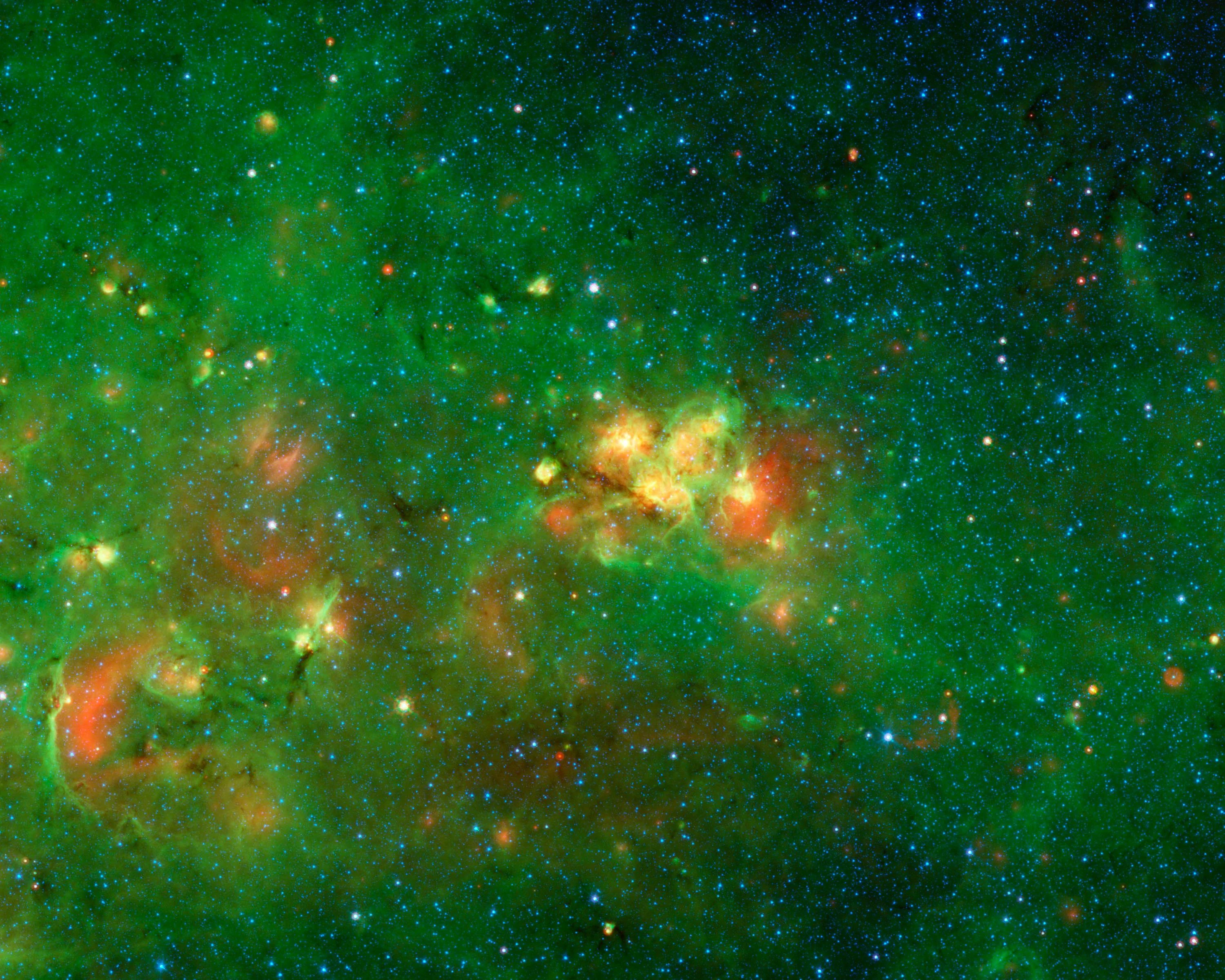
On a June night in Nicosia, ambient 30°C at 11 pm with no breeze, I ran a 40-minute stack on the eastern Veil Nebula with the Seestar S50. The final image looked passable at full zoom-out. At 100% crop the background was peppered with hot pixels, and the faintest filaments had disappeared into a warm, grainy haze that no processing could salvage.
The same target in March, with nighttime temps around 14°C, had noticeably more contrast in those faint regions. Same scope. Same integration time. Same processing. The only variable was temperature.
If you image from anywhere summer nights stay above 25°C, you’ve hit this wall. The Mediterranean, the Gulf states, the US South, most of South and Southeast Asia all qualify. Here’s what’s going on inside your sensor, and what the options look like.
Dark current: the noise your sensor generates for free
Every silicon image sensor produces free electrons from thermal agitation alone, regardless of whether photons are hitting it. This thermally generated signal is called dark current, and in a long-exposure astronomical image it looks exactly like faint starlight.
Dark current scales exponentially with temperature. The standard rule of thumb: it roughly doubles for every 5.8°C increase. A sensor running at 35°C, realistic for an uncooled camera on a warm summer night, generates about 10× the dark current of the same sensor at 15°C. Compared to a cooled sensor held at -10°C, the difference is roughly 200×.
In practice, dark current shows up three ways:
- Hot pixels. Individual photosites that glow visibly at elevated temperatures but stay dark when the sensor is cool.
- Elevated sky background. A uniform glow across the frame that reduces contrast between faint nebulosity and the sky.
- Increased shot noise from the dark signal itself. Dark current carries its own shot noise, proportional to the square root of the accumulated signal. More dark current means grainier backgrounds, independent of sky glow or light pollution.
What I see on warm nights
On a cool March session (ambient ~14°C), a 30-minute Seestar stack on M51 gives a clean background with the outer spiral arms separating well from the sky.
The same target in late June (ambient ~30°C): the background is brighter and rougher. M51’s core and inner arms look identical, because they’re bright enough that thermal noise is irrelevant. But the outer arms fade into the noise floor noticeably sooner. I’d estimate 1 to 1.5 magnitudes of effective depth lost compared to the cool-night image.
The pattern holds across targets. Bright objects don’t care. Faint targets (extended nebulae, galaxy outskirts, tidal tails, anything near the noise floor) take a real hit in warm weather.
How cooled cameras work
Dedicated astrophotography cameras use thermoelectric coolers (TECs) to pull the sensor well below ambient temperature. A TEC is a solid-state device: run current through it and one side gets cold while the other gets hot. A heat sink and a small fan dissipate the hot side. Most modern astro cameras achieve a delta of 35 to 40°C below ambient.
On a 30°C night, that means holding the sensor at -5° to -10°C. At -10°C, dark current is roughly 200× lower than at 35°C. Hot pixels vanish. Background gradients from thermal noise drop to negligible levels. Faint nebulosity that was invisible on an uncooled sensor becomes stackable again.
The second benefit is temperature regulation. A cooled camera locks its sensor to a chosen setpoint, say -10°C, and maintains it regardless of ambient conditions. Your dark frames (calibration exposures with the shutter closed, used to subtract dark current from real data) stay valid across the whole session and across different nights. With an uncooled sensor, the temperature drifts as the air cools: darks from 10 pm don’t match lights from 1 am, and your calibration degrades.
When cooling doesn’t matter
Cooling is irrelevant for planetary and lunar imaging, where exposures run a few milliseconds and dark current can’t accumulate. It’s irrelevant for bright deep-sky objects where signal dominates noise by a wide margin: M42, M31’s core, M45, the Lagoon Nebula.
It’s also largely irrelevant for smart-telescope sessions on most targets. The S50, the S30 Pro, the DWARF 3: none have active cooling, and all compensate with short sub-exposures (10 seconds is typical), aggressive internal stacking, and real-time noise reduction. For the experience of showing a friend the Ring Nebula from a balcony, thermal noise is not the bottleneck.
And of course, cooling is meaningless for visual observing. Your eye doesn’t integrate dark current.
When it does
Cooling starts to pay off when you’re shooting narrowband. Hα, OIII, and SII filters pass very little light, and sub-exposures run 3 to 10 minutes each. At those durations, dark current on a warm sensor swamps the faint signal.
It pays off when you’re chasing faint extended targets: galaxy groups, dim planetary nebulae, tidal streams, integrated flux nebulae. Anything where the signal-to-noise ratio is the limiting factor, not the optics.
It pays off when you need consistent calibration across sessions. Photometry, exoplanet transit timing, variable star monitoring: any work where your noise floor must be repeatable.
And it pays off when you image from a warm climate for most of the year. One hot month is manageable with darks and patience. Six warm months (April through September in Cyprus, year-round in the tropics) make cooling a structural advantage rather than a convenience.
What a cooled rig actually costs
A cooled camera solves the thermal noise problem. But it doesn’t work alone. A realistic cooled deep-sky imaging setup in mid-2026 looks something like this:
- Cooled one-shot-color camera: $1,200 to $1,800 (ZWO ASI2600MC Pro, QHY268C, or similar models from Player One and Touptek)
- Equatorial mount with goto and autoguiding: $1,200 to $2,500 (ZWO AM3, iOptron GEM28, Sky-Watcher HEQ5 Pro)
- Imaging refractor or Newtonian: $500 to $2,000
- Guide scope and guide camera: $200 to $400
- Power supply, cables, dew heaters: $150 to $300
- Imaging computer (ASIAIR, mini PC, or laptop): $150 to $500
Total: $3,400 to $7,500, depending on choices.
A Seestar S50 does the whole job for $499. An S30 Pro for $549. Those scopes deliver 80% of the experience for under 15% of the cost. The trade-off is clear: smart telescopes can’t match a cooled rig on faint targets in warm weather, and the physics won’t let them. But for most hobbyists, that remaining 20% isn’t worth the other $3,000.
Getting more from an uncooled camera in summer
If a cooled setup isn’t in the budget, you can still reclaim some of what heat takes away.
Dark frames at the right temperature. Take 20 to 30 darks at the end of your session, when the sensor is at its warmest. Better yet, build a dark library at a few temperature points (25°C, 30°C, 35°C) and match each night’s data to the closest calibration set.
Shorter sub-exposures. A 10-second sub accumulates a quarter of the dark current of a 40-second sub. Stack more frames to recover the signal-to-noise ratio. Smart telescopes already default to short subs for exactly this reason.
Dithering. Shift the frame by a few pixels between subs. Hot pixels land on different photosites each time, and sigma-clipping in your stacking software (Siril, DeepSkyStacker, or the telescope’s own pipeline) rejects them as outliers. Dithering is the single most effective hot-pixel mitigation on any camera, cooled or not.
Timing. In Nicosia, late-June air temperature drops from 30°C at 10 pm to about 23°C by 2 am. Starting your deepest targets after midnight means measurably less thermal noise. The tradeoff is fewer total hours per session in summer’s short nights.
Target selection. Save the faintest narrowband nebulae for the cooler months. Summer nights are short anyway, and they’re galaxy season. M51, M101, M81/M82, M104: bright cores, strong signal, and thermal noise matters less.
Bottom line
For most hobbyists with a smart telescope or a DSLR on a tracker, a cooled camera isn’t the next upgrade to make. Better darks, dithering, and target discipline will carry you through the summer months.
But if you image from a warm climate year-round, if you keep stacking hours on a target and losing the faint stuff to noise, if your calibration never quite holds because the sensor temperature drifts 8°C between sunset and dawn, a cooled camera solves all of those problems at once. It’s the biggest single upgrade a deep-sky imager can make, ahead of better optics or a better mount.
I’m not there yet. The S50 plus a dark library matched to the night’s temperature gets me through most sessions. But after three months of 30°C stacking, I’ll probably be pricing a cooled OSC and a mount to hold it. Hot nights don’t break your imaging. They just quietly lower your ceiling until you start measuring the gap.