From my balcony in Nicosia I’ll see nothing on August 12. The Moon’s shadow doesn’t reach the eastern Mediterranean, so from Cyprus the Moon never crosses the solar disc at all. This is the guide I’d hand a friend who can get themselves somewhere the eclipse actually happens, whether that’s the path of totality across northern Spain or a deep partial from a back garden in London.
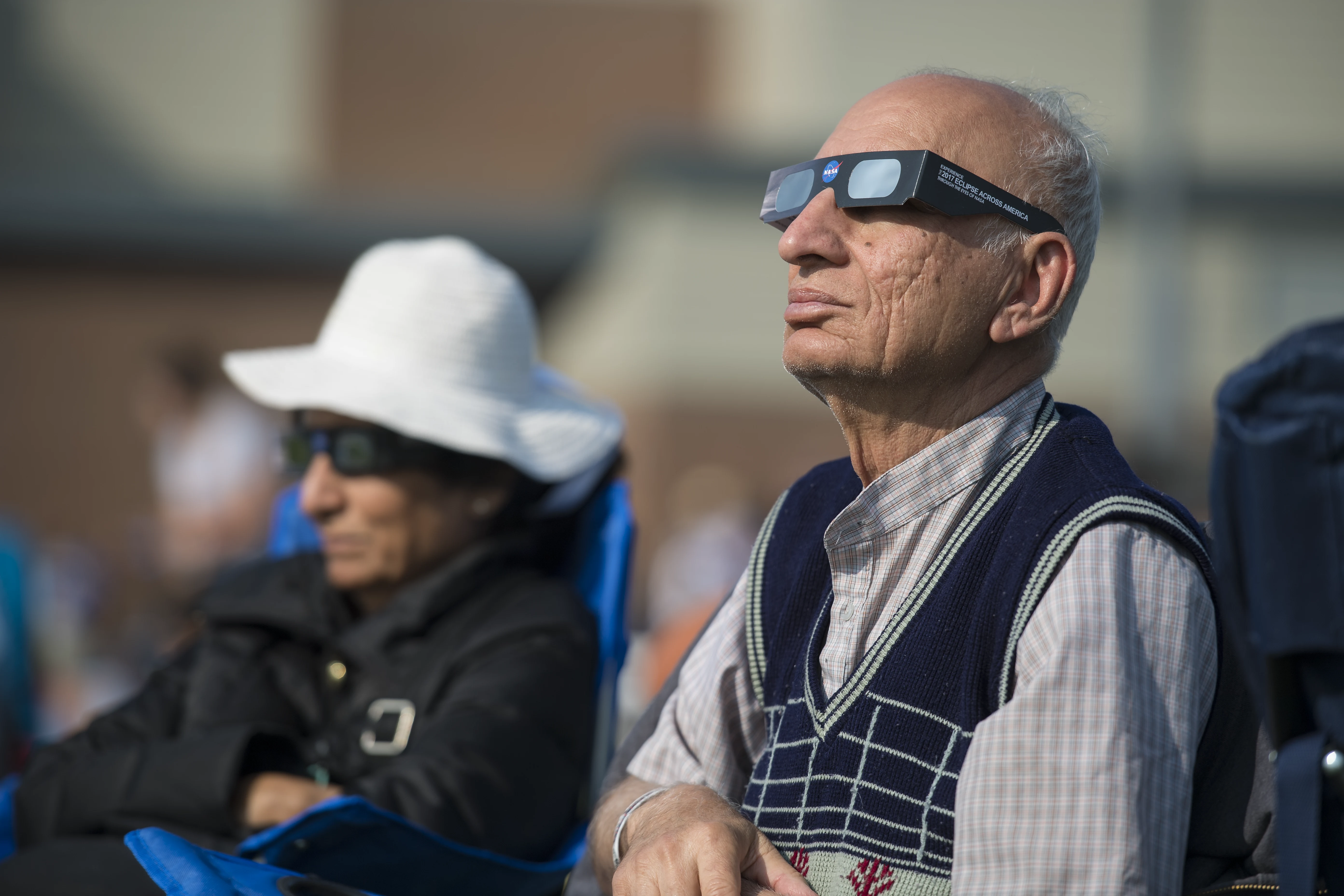
One rule matters more than everything below it: until the Sun is 100% covered, you look through a certified solar filter or you don’t look at all. Not at 90 percent, not at 99. And if you aren’t standing inside the narrow path of totality, that means filters on for the whole eclipse, first bite to last. Everything else here is built around that line.
Why the Sun stays dangerous until the last second
The Sun’s visible surface sits at about 5,800 K and it’s blindingly bright. Blocking 90% of it doesn’t make it a tenth as dangerous. Your eye responds to brightness on a logarithmic scale, so a 90%-covered Sun still reads as a very bright object, and the sliver of surface still showing is thousands of times too intense to stare at. Focused onto your retina, that light causes solar retinopathy: the light-sensitive cells get cooked. The retina carries no pain receptors, so there’s no warning while it happens. You notice the blind spot hours later, and it can be permanent.
The fix is a filter that meets the ISO 12312-2 standard. Eclipse glasses and handheld solar viewers that actually meet it pass roughly one hundred-thousandth of the light: look through a real pair indoors and you should see nothing but a lamp filament, with the rest of the room pitch black. If you can make out the sky, the furniture, anything but the Sun itself, they’re not safe.
Two traps catch people every eclipse. The first is optics. Eclipse glasses over your eyes do nothing to protect you the moment you raise binoculars or put your eye to a telescope, because the lenses gather and concentrate sunlight and that beam burns straight through the film. Binoculars and telescopes need a proper full-aperture filter fitted over the front, never over the eyepiece. I went through what to buy in the solar filter guide. The second trap is phones: a few seconds pointing a phone at the Sun to grab a shot won’t hurt your eyes, since you’re watching the screen, but hold the frame and you can quietly bake the sensor. A small solar filter over the lens solves both.
The friendliest method needs no gear at all. Punch a small hole in a piece of card, or hold up a colander or a straw hat, and every hole throws a little crescent Sun onto the ground. Stand under a tree and the gaps between leaves do it for free, scattering dozens of crescents across the pavement during the deep phases.
There’s exactly one moment the filter comes off, and it applies to almost none of the people reading this: totality. Inside the path, during the seconds the Sun’s surface is completely hidden, you take the glasses off and look straight at it. That window ends the instant the first sliver of surface returns, and the glasses go back on. If you’re not inside the path, that moment never comes for you, and the filter stays on start to finish.
Totality, a deep partial, or nothing
Which of the three you get comes down to which part of the Moon’s shadow you’re standing in.
The dark core of the shadow, the umbra, traces a narrow lane across eastern Greenland, western Iceland, and northern Spain. Stand inside it and you get totality: the Sun fully hidden, the corona out. The much larger, lighter part of the shadow, the penumbra, sweeps across most of Europe, northwest Africa, and a corner of northeast North America. Anywhere under it you get a partial, where the Moon bites into the Sun but never covers it. Past the penumbra’s edge, out in the eastern Mediterranean, the shadow misses Earth’s curve entirely. That’s why I’m out of luck: Cyprus and nearly all of Greece sit beyond the line.
The percentages mislead people. Coverage isn’t a dimmer switch on the experience. A 99%-covered Sun is still daylight, because the last one percent of the surface outshines the entire corona by thousands of times. At 99% you see no corona, no prominences, no planets, no sudden nightfall. All of that arrives only when the disc reaches 100%. The jump from 99 to 100 is the whole event, which is why, if you can plausibly get inside the path, it’s worth going out of your way to do it.
What a deep partial actually looks like
For most of Europe, August 12 is a partial eclipse low in the evening sky. Published forecasts put London around 90% coverage, Cornwall near 95%, the southwest tip of Ireland close to 97.5%, and Lisbon about 95%, with much of France, Belgium, Switzerland, and northern Italy in the high 80s to mid 90s. The UK’s Royal Observatory has a good rundown of local circumstances for British viewers.
The experience is quieter than those numbers sound. Even at 90% the daylight only dims a little and turns slightly flat and metallic, nothing like real dusk. Through your glasses the Sun is a narrowing crescent. Look down and you’ll find that crescent copied in the dappled shade under any tree. The air cools a couple of degrees. Birds go quiet. But the sky stays blue and the corona stays hidden. A partial is a genuinely good thing to catch. It is not a smaller version of totality; it’s a different and lesser event, and going in expecting the second is how people end up let down.
The near-sunset timing hands western Europe a bonus. In some places the Sun sets while it’s still partly eclipsed, and a crescent Sun dropping into a sea horizon makes a strong photograph if your western view is clear. Keep the filter on until the disc is genuinely gone or dimmed to a dull red ember at the horizon. A low Sun is still the Sun.
What totality looks like, minute by minute
If you make it into the lane across northern Spain or western Iceland, this is the sequence to expect. In Spain totality falls between roughly 20:27 and 20:32 CEST with the Sun only 2–11° up; the region-by-region guide has the city timings. In western Iceland it’s a mid-afternoon event near 17:48 local, with the Sun much higher and easier to frame.
First contact comes about an hour before totality, when the Moon takes its first notch out of the Sun’s edge. Glasses only, and for a while nothing much else changes. In the last half hour the light starts to go strange: shadows sharpen as the Sun shrinks toward a point, the world takes on a silvery flatness, and the temperature drops. The crescents multiply under trees and through every pinhole.
The last minute is where it accelerates. Watch the ground and any pale wall for shadow bands, faint rippling lines of light and dark that sometimes skate across surfaces just before and after totality. They’re elusive and never guaranteed. Then, at the Moon’s edge, Baily’s beads appear, the last points of sunlight pouring through valleys on the lunar limb. The final bead flares into the diamond ring, and as it fades the glasses come off.
Totality itself: the corona stands out around the black disc, pearly streamers of the Sun’s million-degree outer atmosphere reaching well past the limb and shaped by its magnetic field. Along the edge you may catch prominences, pink arcs of hydrogen. The horizon glows sunset-orange all the way around. Venus and maybe Mercury snap into view near the Sun, and the brighter stars come out. Because the Spanish Sun sits so low, the corona takes a warmer cast and the whole thing reads as a deep, wrong-time twilight rather than midday switching off.
The hard part about this one is that it’s short. Maximum totality is 2 minutes 18 seconds, and that maximum falls over open ocean between Iceland and Spain. On land you get less: roughly half a minute at Bilbao on the path’s northern edge, up to about a minute and three-quarters along the Asturian centreline. That is not long. Don’t spend it fighting a camera. For a first totality I’d set a phone to record video and audio, prop it up, and then ignore it, because the corona never comes out of a phone looking like it does to your eye, and the sound of a crowd at totality is the part you’ll actually want back. Then everything runs in reverse: the second diamond ring, glasses straight back on, Baily’s beads again, the crescent widening, ordinary evening returning.
A plan for eclipse day
A few things decide whether you actually see it, and the list is short.
Buy glasses now, from a seller you can verify. Fakes with counterfeit ISO 12312-2 printing flood marketplaces before every eclipse. The American Astronomical Society keeps a list of suppliers it has checked; pick a name off that rather than the cheapest bulk listing. For a camera, binoculars, or a scope, use a proper front filter and see the gear guide linked above.
Sort out your western horizon, especially in Spain. Totality there happens with the Sun between about 2 and 11° up, so a single building or ridge in the wrong direction hides the whole thing. You want a flat, open view to the west-northwest, and you should check it with a sun-position app before you commit to a spot. The Spain guide covers the where in detail.
Watch the forecast and stay mobile if you can. A car and the willingness to drive to a clear patch that morning beats a fixed booking stuck under cloud.
Decide in advance what you’ll do with the ninety seconds. For a first totality I’d do almost nothing on purpose: glasses off, look up, look around at the horizon, look at the people next to you. It ends before you feel ready.
For the wider picture of why this eclipse is a big deal and how the path crosses the continent, I wrote the preview last month. And if the clouds win, or you can’t travel this time, the next one isn’t the usual decade away: totality crosses southern Spain and North Africa on August 2, 2027, higher in the sky and longer on the ground. August 12 comes first, though. Sort your glasses out now.