On August 12, 2026, the Moon’s shadow makes landfall in western Iceland before it reaches anywhere else you can practically stand on. It crosses the Westfjords, the Snæfellsnes Peninsula, the northern edge of Reykjavík, and the Reykjanes Peninsula, then leaves the island and heads for northern Spain. If you want the longest totality this eclipse offers on land, a hair over two minutes, and you want the Sun a comfortable 24° above the horizon instead of skimming the sea, Iceland is the place. The catch is the sky. Iceland in August is one of the harder clear-sky bets on the whole eclipse track, and pretending otherwise would be doing you a disservice.
I’ve already made the case for Spain, where totality lands at sunset and the weather odds are far kinder. This is the other end of the path. Colder and wetter, but on a clear afternoon it has the better geometry. Here’s how to think about where to stand.
What Iceland actually gets
Totality only touches the western third of the country. Everywhere else on the island sees a deep partial eclipse, which is worth seeing but is not the same event — a 99%-covered Sun is still daylight, and you never get to take the glasses off. The line between “very deep partial” and “total” is sharp and unforgiving; a few kilometres decides it. So the first job is getting yourself physically inside the path.
Iceland runs on GMT year-round with no daylight saving, so the local clock is also UTC — no conversion needed. The partial phase opens across the country around 16:47, first contact, when the Moon takes its first bite out of the Sun’s western limb. Totality then sweeps west to east: it reaches the Westfjords near 17:44, crosses Reykjavík around 17:48, and clears the Reykjanes Peninsula by about 17:50. The partial phase ends everywhere by roughly 18:47. The whole thing happens in the late afternoon with the Sun in the west-southwest, about 24–25° up; from Reykjavík, totality begins with the Sun at 24.5° altitude. That’s low enough that you want an open western horizon with no hills or buildings in the way, but high enough to clear most obstructions, which is more than Spain’s observers can say.
The three regions, ranked by what you’ll see
The duration of totality depends on how close you are to the centreline, and the centreline runs offshore just west of the country. The point of greatest duration for the entire eclipse, about 2 minutes 18 seconds, sits in the ocean roughly 45 km west of Látrabjarg, the westernmost tip of the Westfjords. On land, the numbers fall off from there.
Westfjords. The remote northwest corner holds the longest totality you can reach on foot. Látrabjarg, the great seabird cliff at the western tip, gets about 2 minutes 13 seconds, the maximum anywhere on Icelandic land. It’s a spectacular place (puffins, a lighthouse, thousand-foot cliffs) and it has essentially no services, so most people base themselves in the towns of Patreksfjörður or Ísafjörður and drive out. Ísafjörður itself, the region’s hub, sits closer to the northern edge of the path and gets a shorter show, around 1 minute 30 seconds. The Westfjords are the highest-effort option: a long drive from Reykjavík on winding roads, or a short domestic flight into Ísafjörður. You’re trading accessibility for those extra seconds and, frankly, for solitude.
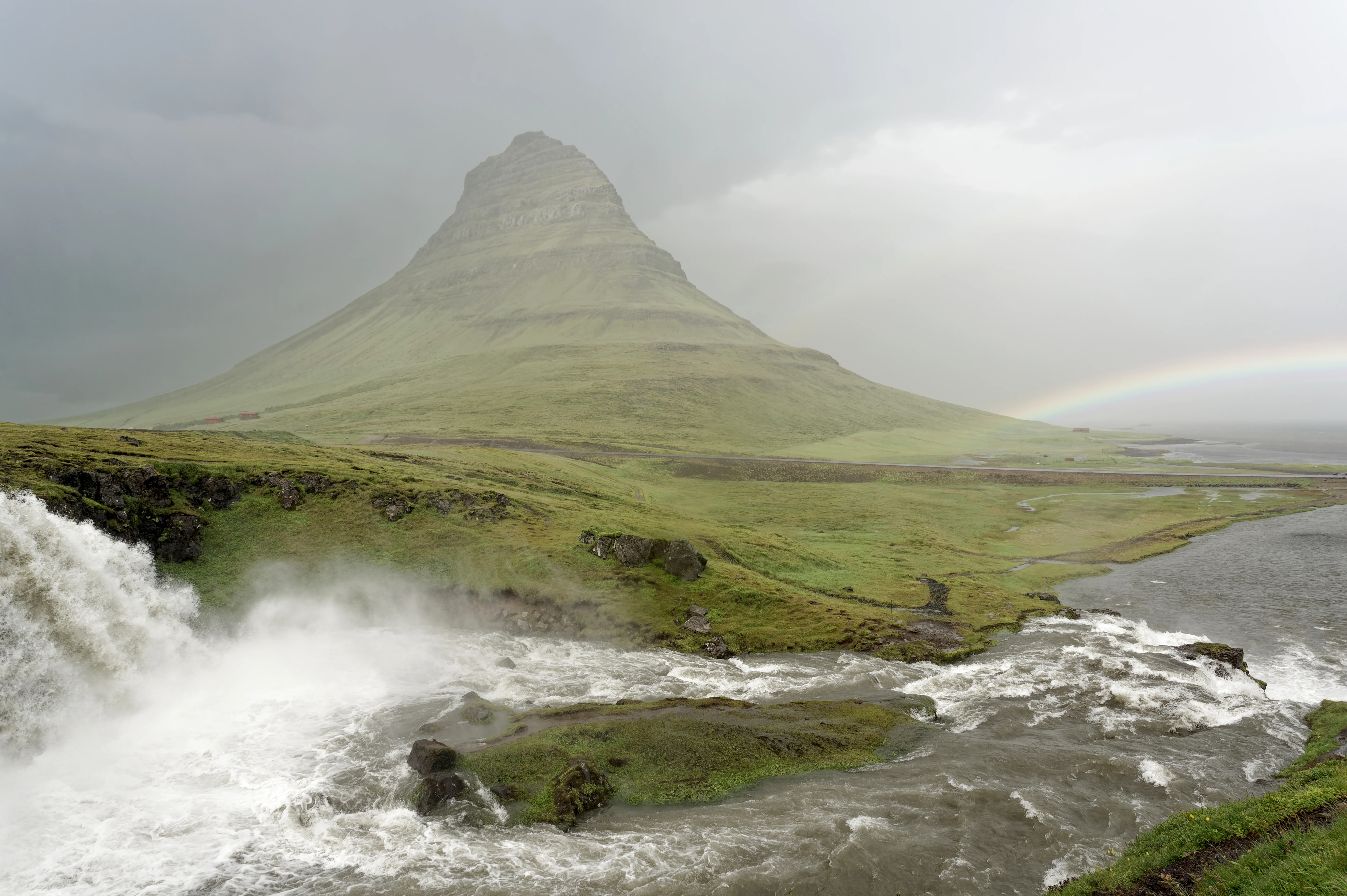
Snæfellsnes Peninsula. This is the sweet spot for most people, and it’s where I’d point a first-timer. Snæfellsnes reaches within about three hours’ drive of Reykjavík and delivers real duration. Ólafsvík, on the north coast, gets about 2 minutes 3 seconds; the peninsula’s western tip, out in Snæfellsjökull National Park under the glacier-capped volcano, gets close to 2 minutes 10 seconds. Stykkishólmur, further east, drops to about 1 minute 28 seconds. Still comfortably total, just shorter. The scenery is the argument here: lava fields, the Snæfellsjökull stratovolcano, and the much-photographed Kirkjufell on the cover of this piece. You get a two-minute totality and a foreground worth the airfare on its own.
Reykjanes Peninsula and Reykjavík. The most accessible ground, right next to Keflavík International Airport. Reykjanes gives you roughly 1 minute 39 seconds near Keflavík: a genuine totality with almost no driving, which is not nothing when you consider the weather logistics below. Downtown Reykjavík is a different story: the city sits right on the southern edge of the path, and central Reykjavík gets only about 59 seconds. Move a short distance north and the number climbs quickly. If you’re staying in the capital, don’t assume your hotel balcony is inside the line — check a proper eclipse map for your exact spot, because the edge runs through the metro area.
The weather, honestly
Now the part the glossy tour brochures underplay. Iceland’s west coast is cloudy far more often than it’s clear, and August is no exception. Cloud climatology for this track, the kind of long-term analysis eclipsophile.com compiles for every eclipse, puts your odds of an unobstructed Sun on the west coast somewhere in the neighbourhood of one in three on a given August afternoon. Put plainly: on any random August 12, the sky over western Iceland is more likely to be cloudy than clear.
There’s a thin silver lining. August is among the driest months in western Iceland, and even under cloud you still get the full experience of totality — the temperature drop, the light draining out of the world, birds going quiet, the sudden false dusk. What clouds steal is the corona and the diamond ring, the parts most people fly across an ocean to see.
The only real defence is mobility. The path is narrow, Iceland’s micro-climates shift fast, and a bank of cloud sitting over Snæfellsnes can coexist with a clear hole 40 minutes’ drive up the coast. So the winning strategy is the same one veteran eclipse chasers use everywhere the climate is marginal:
- Base yourself somewhere with road options in multiple directions, not down a single dead-end fjord.
- Watch the Icelandic Meteorological Office’s high-resolution cloud forecasts (vedur.is) obsessively in the final 24–48 hours.
- Keep the car fuelled and be genuinely willing to drive an hour on the morning of, chasing a gap. Have a plan B location picked in advance.
- Don’t lock yourself into a fixed viewing event that can’t move.
If certainty matters more to you than the northern scenery, this is the honest argument for Spain instead: the Iberian climate that afternoon is far more likely to deliver a clear sky, even if the Sun there is nearly on the horizon.
Getting there and where to sleep
Nearly everyone arrives through Keflavík (KEF), a 45-minute drive from Reykjavík. A rental car isn’t optional for this trip; it’s the whole strategy, per the weather note above. Snæfellsnes is a straightforward half-day drive from the capital; the Westfjords are a serious expedition by road, so factor a domestic flight to Ísafjörður if that’s your target.
Book accommodation now, not in July’s last week. This eclipse has been on chasers’ calendars for years, and the modest number of rooms inside the path, particularly on Snæfellsnes and in the Westfjords towns, fills early. Reykjavík and the Reykjanes area have the most beds and the shortest drive to totality, which makes the capital a reasonable base even though the city centre itself only grazes the path. If the towns inside the path are full, staying in Reykjavík and driving north or west on the morning of is a completely valid plan, and it keeps your options open when the forecast firms up.
Don’t come for the stars, come for the shadow
One expectation to reset. Iceland is famous for dark skies and aurora, but not in August. At Reykjavík’s latitude of 64°N, the Sun only sinks to about 11° below the horizon at local midnight in mid-August. That’s nautical twilight, not true darkness. There’s no proper astronomical night yet, so no Milky Way and no realistic aurora; deep dark and the northern lights return later in the autumn. If you’re picturing an eclipse-plus-stargazing trip, that’s an October–March itinerary, not this one. In August you come for one thing: two minutes of the Moon’s shadow, weather permitting.
For the how-to of the day itself (safe filters, when to remove the glasses, what the corona actually looks like), I’ve written a full safe-viewing guide and a solar filter buying guide for the eclipse. Both apply equally whether you end up in Ólafsvík or Oviedo.
Iceland is the harder bet and the bigger adventure. If the sky cooperates, you’ll stand under a volcano with the corona 24° up and a two-minute totality, the best geometry this eclipse offers anywhere. If it doesn’t, you’ll still feel the dark roll over the lava fields, and you’ll have a reason to chase the next one. Bring layers, rent the car, and watch vedur.is like it owes you money.