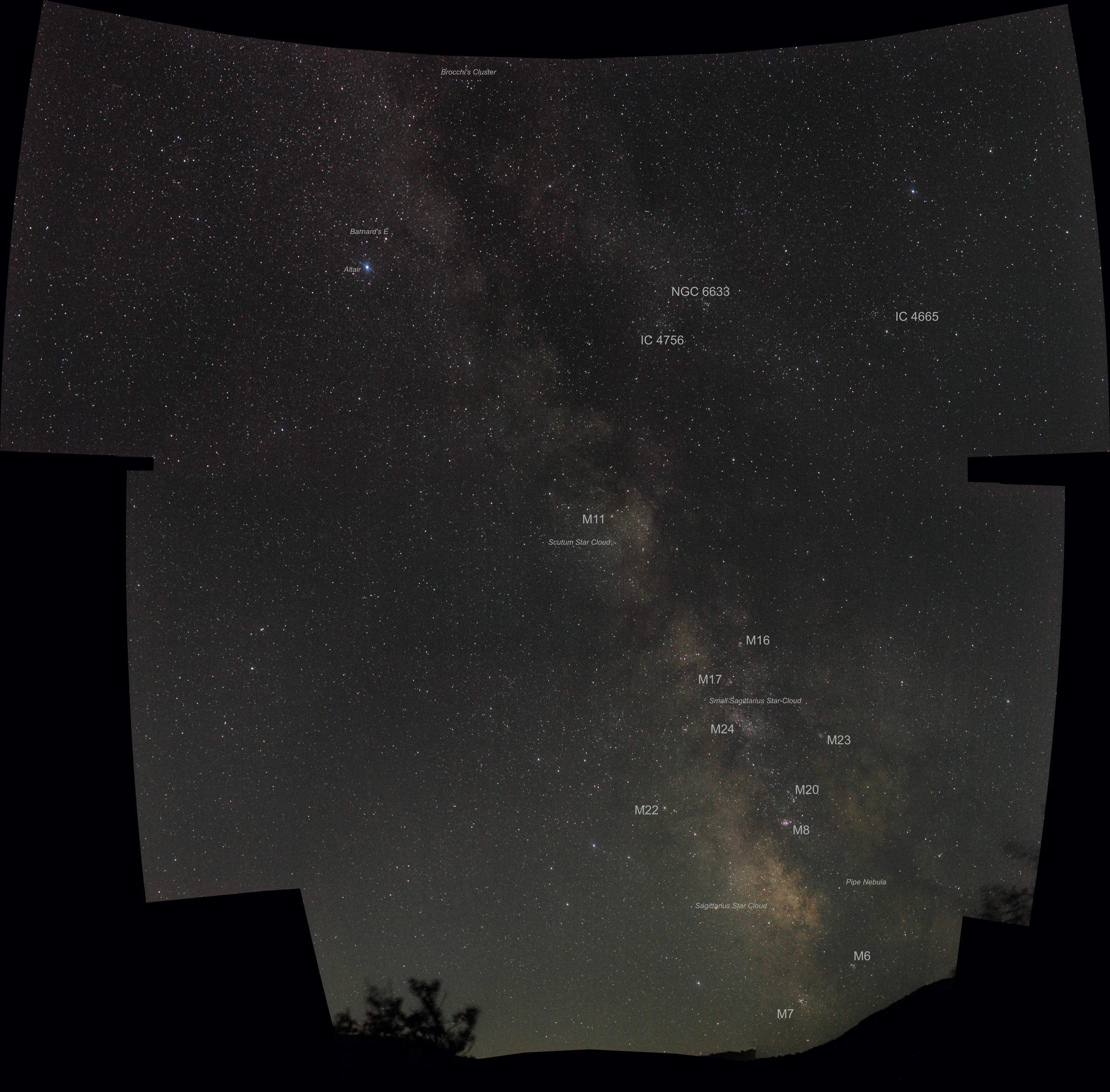
On a dark night this month you can stand in a field, face south, and look almost exactly toward the supermassive black hole at the center of our galaxy. No telescope. No binoculars, though they help. Just your eyes, a clear southern horizon, and enough patience to let them adjust.
The direction sits low in the sky between two constellations that are up all July: Scorpius and Sagittarius. You won’t see the black hole itself (its light is buried behind thousands of light-years of dust), but you can point your face down the barrel toward it and see the thickest, brightest star clouds of the whole Milky Way piled up in that direction. From my usual dark spot in the Troodos mountains, that stretch of sky is the best thing summer offers. Here’s how to find it.
Why this month, and which nights
Two things line up in July. The summer Milky Way is at its best for northern observers, and the Moon gets out of the way mid-month.
The center of the galaxy lies at a declination of about −29°, which from Nicosia (latitude ~35°N) means it climbs only to about 26° above the southern horizon at its highest. Call it two and a half fist-widths at arm’s length, where a clenched fist spans roughly 10°. That’s not high. If you live much further north than the Mediterranean it gets harder still, because the galactic center barely clears the horizon haze from, say, the UK. This is one of the rare cases where being at 35°N in Cyprus or Greece or southern Spain is a real advantage.
The bigger variable is the Moon. A bright Moon washes out the faint Milky Way glow completely. New moon this July falls on the 14th–15th (timeanddate), so the darkest window runs roughly from July 10 to July 20: moonless evenings on one side of new moon, moonless late nights on the other. Right now, in early July, the waning Moon is up for most of the night and fighting you. Wait for the second week.
The galactic center crosses due south (its highest point) around 11 pm to midnight local time in the first half of July, a little earlier each night as the month goes on. So the plan is simple: a moonless night in the second half of the month, sometime around 11 pm, facing south.
Step 1: Find Scorpius and the red star Antares
Scorpius is the easiest starting point in this part of the sky, and one of the few constellations that genuinely looks like its namesake. Face south and look about a third of the way up. You’re hunting for a bright star with an obvious warm, orange-red color: Antares.
Antares is a red supergiant, roughly 700 times the diameter of the Sun. Drop it where the Sun sits and its surface would swallow the orbit of Mars. Its brightness drifts between magnitude +0.6 and +1.6 as the star slowly pulses, though most nights it sits near +1.0, which puts it among the fifteen or so brightest stars in the sky (Kaler’s star notes). Its distance is genuinely uncertain, somewhere around 550 light-years, with real error bars, so don’t quote that number to anyone as gospel. The color is the giveaway. Next to blue-white stars it looks distinctly copper. The name even means “rival of Ares” (Mars), because ancient observers kept confusing the red star with the red planet.
Once you’ve got Antares, trace the line of stars curving down and to the left from it. That curl is the scorpion’s body and tail, ending in the “stinger,” a close pair sometimes called the Cat’s Eyes. From 35°N the whole shape stands up nicely; the further north you are, the more the tail drags along the horizon.
Step 2: Slide left to the Teapot
Now look to the left (east) of Scorpius’s tail. There’s a compact group of eight moderately bright stars arranged in a shape that, once you see it, you can’t unsee: a teapot, complete with a triangular lid, a handle on the left, and a spout on the right. This is the brightest part of Sagittarius.
The Teapot is an asterism: a visual shortcut rather than an official constellation, the same way the Big Dipper is a piece of Ursa Major. But it’s the most useful signpost in the summer sky, because of where the spout points. The spout sits on the right side of the teapot, aimed back toward Scorpius’s stinger. The gap between them is the piece of sky you came for.
If you want a chart to compare against while you’re outside, EarthSky keeps a clear one. A planetarium app on your phone works too, but turn the brightness all the way down and switch it to night mode, because a bright screen wrecks the dark adaptation you need for the faint stuff.
Step 3: The spout points at the center of the galaxy
Just above the spout of the Teapot, right around the Scorpius–Sagittarius border, is the direction of the galactic center. Somewhere out there sits Sagittarius A*, the supermassive black hole around which the whole Milky Way turns, weighing about 4 million times the mass of the Sun.
We know its distance well, because astronomers tracked a single star (called S2) looping around it on a 16-year orbit using ESO’s GRAVITY instrument in Chile. That work put the center at about 8.2 kiloparsecs (roughly 26,700 light-years), with an uncertainty of only about 0.3% (Gravity Collaboration, 2019). Call it 27,000 light-years and you’re barely wrong.
You are not seeing the black hole, though, and you’re not really seeing the center either. Visible light from the actual core is blocked almost entirely by dust lanes strung along the disk between us and it. What your eye picks up instead is the near side of the galaxy’s central bulge and the dense star clouds in front of it — billions of stars too far apart to resolve and too many to count, smeared into a soft glow. You’re looking through the longest, richest sightline our galaxy offers. That’s why this patch of sky is so bright compared with the thin band of Milky Way overhead.
What a dark sky adds
From my balcony in Nicosia, which sits around Bortle 7 (the Bortle scale runs 1 for pristine desert skies to 9 for an inner-city rooftop), I can pick out Antares and trace the Teapot on a clear night, and that’s about it. The star clouds don’t show. The light dome to the south, over the coast, drowns them.
Drive 45 minutes up to Troodos, above 1,500 m and closer to Bortle 3, and the same patch of sky transforms. The Milky Way stops being a rumor and becomes a textured band with a bright, mottled swelling low in the south. That swelling is the galactic center region. The “steam” rising from the Teapot’s spout, in the old stargazers’ description, is exactly this: the star clouds of the inner galaxy.
This is the single biggest reason to leave the city for a summer night. Not a telescope, not fancy gear. Just darkness pointed south. If you’re near the Mediterranean, my Troodos stargazing guide covers where to actually park and look.
A short naked-eye tour while you’re down there
Once your eyes are dark-adapted and the star clouds are visible, a few individual targets are within naked-eye reach from a genuinely dark site, no gear needed:
- M7 (Ptolemy’s Cluster), in the scorpion’s tail, is a large, loose knot of stars at magnitude ~3.3. It’s one of the easiest star clusters to see without any optics, and it has been catalogued since antiquity.
- M8 (the Lagoon Nebula), just off the top of the Teapot, shows as a small elongated fuzzy patch, a genuine star-forming cloud about 4,000 light-years away, visible to the unaided eye under a dark sky.
- The Large Sagittarius Star Cloud, above the spout, is the brightest naked-eye piece of the Milky Way. It’s not a single object; it’s the near edge of the galactic bulge showing through a gap in the dust.
Use averted vision on the faint ones: look slightly to the side of the target rather than straight at it, so the light falls on the more sensitive rod cells off-center in your retina. If that trick is new to you, I wrote up why it works in this piece on dark adaptation. Give your eyes a full 20 to 30 minutes in the dark first; the star clouds simply aren’t there for the first few minutes and then quietly appear.
Timing and a horizon checklist
To recap the plan without scrolling back up:
Pick a night in the second half of July, close to new moon on the 14th–15th. Get somewhere with a genuinely open southern horizon — the galactic center never climbs high, so a hill, a ridge, or the sea to your south beats a tree line every time. Be out and dark-adapted by around 11 pm local. Find orange Antares, trace Scorpius down to the stinger, hop left to the Teapot, and look at the gap above its spout.
The Summer Triangle will be riding high overhead at the same time if you want a second target for the night, and if the star clouds do show for you, a phone on a small tripod is enough to photograph the Milky Way core. The camera picks up color and structure your eye can’t. But start with just your eyes. There’s something worth doing about standing still, facing south, and knowing that the soft glow low on the horizon marks the center of the galaxy you live in.