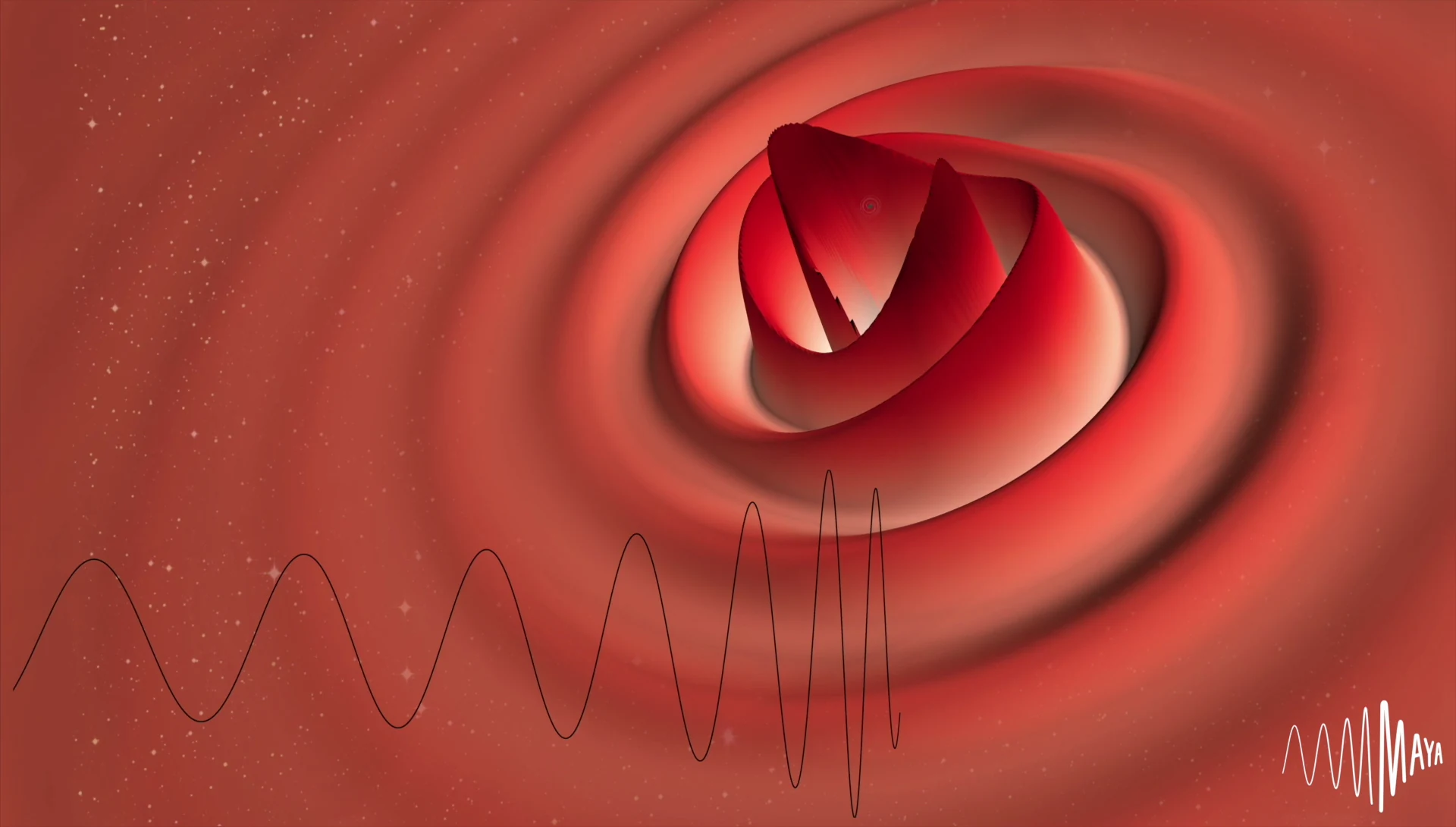
On 14 September 2015, two detectors in Louisiana and Washington State registered a rising chirp that lasted about a fifth of a second: two black holes of roughly 36 and 29 solar masses spiralling together 1.3 billion light-years away, their final orbits stretching and squeezing the ground by less than the width of a proton. That single event, GW150914, opened gravitational-wave astronomy and won a Nobel Prize.
On 26 May 2026, the LIGO–Virgo–KAGRA (LVK) collaboration released GWTC-5.0, the fifth edition of its Gravitational-Wave Transient Catalog. The running total of detected events since 2015 now stands at 390. A pile that size changes what the field can do. Gravitational-wave detection has crossed from hunting individual events into doing population statistics: this is a black-hole census now, and the population is starting to talk back.
From one event to a candidate every few days
A gravitational wave is a ripple in spacetime, produced when very massive objects accelerate hard, predicted by general relativity in 1916 and first caught a century later. The detectors are giant L-shaped laser interferometers: two LIGO instruments in the US with 4 km arms, Virgo near Pisa, and KAGRA in a mine under the Japanese Alps. A passing wave lengthens one arm and shortens the other by a fraction of a proton’s width, and the lasers pick up the difference.
The reason the catalog jumped so fast is sensitivity. Most of that 390 came from a single stretch of observing. GWTC-5.0 covers the second part of the fourth observing run, O4b, which ran from 10 April 2024 to 28 January 2025 and added 161 new events on its own. According to the collaboration, roughly three-quarters of every gravitational-wave event ever recorded was recorded during that one run. Higher-powered lasers and a technique called squeezed-light injection, which tamps down the quantum noise floor of the measurement, pushed the instruments to the point where a credible signal arrives every few days.
“Catalog” has a precise meaning here. An event makes the list when its probability of being astrophysical rather than a noise glitch is at least 0.5. The median component masses across the whole population run from under 6 to about 137 solar masses, and the great majority are black hole pairs. Neutron-star mergers, the kind that also produce light, remain rare in the data.
The loudest one yet, and a test Hawking set in 1971
Volume matters, but a few individual events carry more weight than the count suggests. The clearest signal in the new catalog is GW250114, recorded on 14 January 2025: two black holes of about 32 and 34 solar masses, with a signal-to-noise ratio of 76.9. Signal-to-noise ratio is just how far a signal stands above the detector’s background hiss, and 76.9 makes GW250114 roughly three to four times louder than anything detected before it.
That loudness let the team do something new. When two black holes merge, the final object settles down by “ringing” like a struck bell, radiating a last burst of waves at frequencies fixed by its mass and spin. Astronomers call this the ringdown. GW250114 was clean enough to pull two separate tones out of that ringdown, matching the predictions for a rotating (Kerr) black hole and giving one of the sharpest tests yet of the “no-hair” idea that a black hole is fully described by just its mass and spin.
It also delivered an empirical check on a 55-year-old prediction. In 1971 Stephen Hawking proved that, in general relativity, the total surface area of a black hole’s event horizon can never decrease. Merge two black holes and the area of the remnant has to be at least as large as the two originals added together, even though the merger radiates away enormous energy. Measuring the areas before and after from the GW250114 waveform, the collaboration confirmed the area theorem holds: the final horizon was bigger than the sum of its parents. A theorem that lived on a chalkboard for half a century is now a measurement.
The merger that shouldn’t exist
The heaviest collision in the whole catalog is GW231123, recorded on 23 November 2023 and announced separately in July 2025. Two black holes of about 137 and 103 solar masses merged into a single object of roughly 225 solar masses, both of them spinning near the limit general relativity allows.
The problem is that the two parents fall squarely inside what’s called the pair-instability mass gap, roughly 60 to 130 solar masses, a range where stars aren’t supposed to leave black holes behind at all. In that mass window a dying star’s core gets hot enough to convert gamma rays into electron-positron pairs, which robs the core of pressure support and triggers a runaway explosion that blows the star apart, leaving nothing. A black hole of 137 solar masses can’t form the ordinary way, from one collapsing star.
“This is the most massive black hole binary we’ve observed through gravitational waves, and it presents a real challenge to our understanding of black hole formation,” said Mark Hannam of Cardiff University, part of the LVK collaboration. The likeliest escape route is that these black holes were themselves built from earlier mergers, in crowded places where black holes sink to the center and collide repeatedly.
Black holes made from black holes
That idea, hierarchical merging, is no longer just a fix for one oddball event. GWTC-5.0 flags two events from late 2024, GW241011 and GW241110, that carry the fingerprints of second-generation black holes: masses and spins that fit objects assembled from previous coalescences rather than from single stars. Repeated mergers leave a characteristic spin signature, because the leftover orbital angular momentum gets baked into the remnant, and these events show it.
With hundreds of systems in hand, the collaboration can now measure the shape of the black-hole mass distribution rather than argue over single cases. That distribution isn’t the smooth power law the simplest models predicted. It has bumps, including a pile-up of black holes around 30 to 35 solar masses and structure near the mass gap, features that encode how massive stars actually die and how often black holes find each other in dense clusters. A single detection is an anecdote. Three hundred and ninety of them is a demographic.
What 390 events buys you in cosmology
There’s a payoff beyond black-hole biography. A gravitational-wave signal is what cosmologists call a standard siren: the waveform encodes the source’s absolute distance directly, without any of the rungs in the traditional cosmic distance ladder that leans on parallax, Cepheid variables and supernovae, each calibrated against the one below it. If you can also pin down how fast the source is receding, you get a clean, independent measurement of the Hubble constant, the expansion rate of the universe.
Black-hole mergers usually arrive with no light and therefore no easy redshift. The workaround is the “spectral siren” method: use the shape of the black-hole mass distribution, measured from the whole catalog, as a statistical yardstick to break the distance-redshift degeneracy across the population. With nearly 400 events feeding it, GWTC-5.0’s Hubble-constant estimate is about 25% more precise than the previous gravitational-wave result. It doesn’t yet settle the standoff between the two established measurements of cosmic expansion, but it’s a third method that owes nothing to the distance ladder, and it gets sharper with every observing run.
From the balcony
None of this is observable from Nicosia, or from anywhere with a telescope. Gravitational waves aren’t light; there’s nothing to point a Seestar at, and even GW231123’s 225 solar masses of merging black hole released its entire signal as a fraction-of-a-second tremor in four buildings on two continents. As Leo Tsukada of the collaboration put it, nearly 400 events “have ushered us into a new era of statistical astronomy.”
There’s still a way for backyard observers to join in, though, and it’s the part amateurs can actually act on. When the detectors catch a neutron-star merger rather than two black holes, the collision can throw off a visible fireball called a kilonova, and the LVK network sends an open public alert within minutes so telescopes worldwide can swing over and chase the fading afterglow. That’s how the 2017 event GW170817 was pinned to a galaxy 130 million light-years away and watched across the whole spectrum. O4 was lean on those, dominated by dark black-hole mergers, but the alert stream is public and the next run will be more sensitive still.
I can’t detect a spacetime ripple from my balcony. But the logic is the same one I run every clear night with a stack of 30-second frames: collect a faint signal from something very far away, subtract the noise, and work out what had to happen to produce it. LVK does it with 4 km laser arms and a proton’s width of sensitivity. The scale is absurd. The question is identical.
The catalog paper is GWTC-5.0 (arXiv:2605.27225); the collaboration’s summary of the release is here.