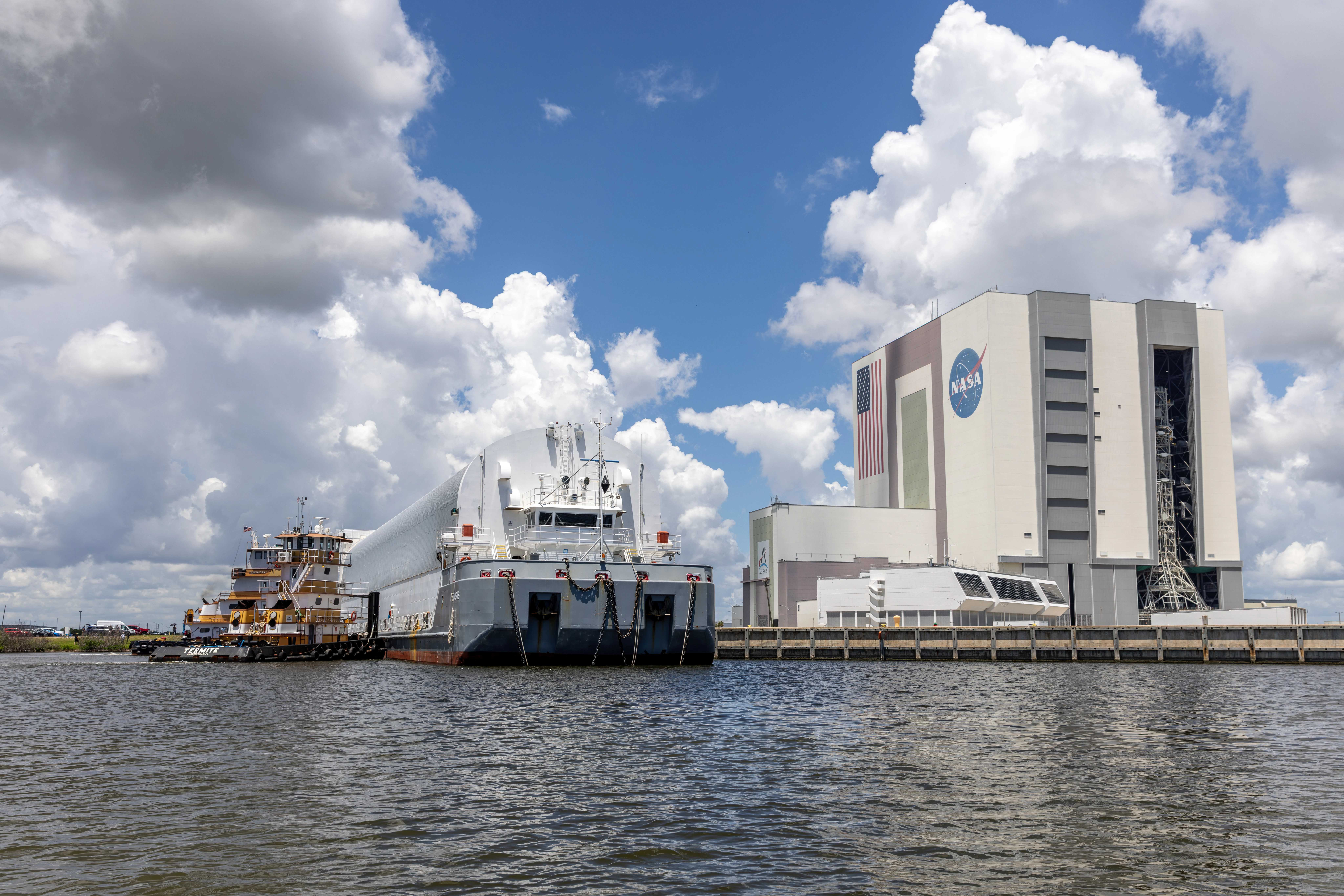
NASA’s Nancy Grace Roman Space Telescope reached Kennedy Space Center on June 21, arriving by barge at the Launch Complex 39 turn basin, the same channel that once floated Saturn V and Shuttle hardware to the pad. It’s now in the Payload Hazardous Servicing Facility being prepped for a Falcon Heavy launch no earlier than August 30, roughly eight months ahead of its original schedule. That last detail is rare enough for a flagship NASA mission to deserve its own headline.
You will never point Roman at anything. Not you, not a professor with a great idea, not even most of the teams who built it. Hubble and JWST spend their lives fielding proposals, and astronomers fight for hours to aim them at one target at a time. Roman works the opposite way. It runs a small number of enormous, pre-planned surveys on a fixed cadence, sweeping the same patches of sky over and over. The payoff for the rest of us is the data that pours out the other end.
What actually shipped to Florida
The hardware is deceptively familiar. Roman’s primary mirror is 2.4 metres across, exactly the same diameter as Hubble’s. The mirror was handed to NASA in 2012 by the National Reconnaissance Office, already figured, which is a large part of why the mission got built as fast and as cheaply as it did.
What’s new is behind the mirror. Roman carries a 300-megapixel near-infrared camera called the Wide Field Instrument, and its field of view is about 0.28 square degrees, over 100 times the sky area Hubble captures in a single pointing. Put plainly: one Roman exposure covers ground that would take Hubble around a hundred exposures to tile. The camera’s broadband filters run from roughly 0.62 to 2.13 microns, so it sees deep-red visible light through the near-infrared, where distant, dust-reddened, and high-redshift objects give up most of their photons.
That combination doesn’t exist anywhere else: Hubble-sharp resolution across a Hubble-dwarfing field, in the near-infrared, from above the atmosphere. JWST is sharper and reaches further into the infrared, but it stares at tiny fields. Ground-based survey machines cover huge areas but fight seeing and skyglow. Roman sits in the empty spot on that chart.
Why “survey machine” isn’t a throwaway phrase
The observatory is bound for the second Sun–Earth Lagrange point (L2), about 1.5 million km out, the same gravitational parking spot JWST uses. From there it runs three core community surveys, and the split between them is the whole design philosophy.
The High-Latitude Wide-Area Survey images something like 1,700 square degrees away from the crowded galactic plane, measuring the shapes and distances of billions of galaxies. Those shapes are subtly distorted by the gravity of intervening matter (weak gravitational lensing), and the pattern of distortion maps where the dark matter sits and how fast cosmic structure grew over time.
The High-Latitude Time-Domain Survey revisits smaller fields repeatedly to catch Type Ia supernovae as they brighten and fade. Type Ia supernovae are the standard candles that first revealed cosmic acceleration in 1998; Roman will pin down thousands of them at greater distances than anyone has measured cleanly before. If you’ve read my piece on the cosmic distance ladder, this is the rung Roman is built to reinforce.
The Galactic Bulge Time-Domain Survey points the other way, straight into the dense star fields toward the galactic centre, and monitors hundreds of millions of stars for microlensing events. That’s the exoplanet engine.
Between weak lensing, supernovae, and galaxy clustering, all three of Roman’s dark-energy probes attack the same question, whether the acceleration of the universe is constant or slowly changing, with independent methods that fail in different ways. That redundancy is the point. It’s the same instinct behind the ML alert brokers I wrote about for the Rubin Observatory: when the dataset is this large, you cross-check the answer against itself.
Microlensing finds the planets transits can’t
Most exoplanet news you read, including the 118 worlds an algorithm pulled out of TESS data this spring, comes from the transit method: a planet crosses its star, the star dims by a fraction of a percent, you catch the dip. Transits are brilliant for planets close to their stars, where orbits are short and dips repeat often. They’re nearly blind to planets far from their stars, and completely blind to planets with no star at all.
Microlensing is the opposite tool. When one star drifts almost exactly in front of a more distant background star, the foreground star’s gravity bends and briefly magnifies the background light. If that foreground star has a planet, the planet adds its own short spike on top of the smooth brightening. You don’t see the planet, you don’t even see its star clearly — you see gravity doing arithmetic on someone else’s photons. It’s a one-shot event that never repeats, which is exactly why you need a survey that watches millions of stars continuously.
Roman’s bulge survey is predicted to find more than 1,000 bound planets this way, weighted toward cold, distant, low-mass worlds: the Neptunes and super-Earths out past the snow line that transits and radial velocity mostly miss. It should also detect a population of free-floating planets: worlds drifting through the galaxy unattached to any star, visible only in the instant their gravity lenses something behind them. NASA’s broader projections run to hundreds of thousands of planet detections once you fold in the transiting worlds Roman will trip over in those dense fields. But the microlensing number, more than a thousand, is the one the survey was actually designed around, and the one I’d trust before launch.
Why an amateur in Nicosia should care
None of this is observable from my balcony. I can’t book Roman, can’t request a target, can’t even watch it work. So why does a wide-field survey telescope matter to someone whose main rig is a Seestar S50?
Because the data comes to me. Roman was planned from the start around prompt public releases and community-defined surveys; the images and catalogues flow into public archives as they’re processed, without the long proprietary lockout that older missions imposed. A billion galaxy shapes, hundreds of millions of monitored stars, and years of near-infrared time-domain imaging, all downloadable. That’s the raw material for exactly the kind of citizen-science and machine-learning projects that have already let amateurs co-discover planets, variable stars, and gravitational lenses in survey data.
It also reshapes what my own gear is for. Roman finds things at scale; small telescopes confirm and monitor them. When a wide survey flags a transient or a candidate, somebody with a modest telescope and a clear night still has to check whether it’s real, get a colour, catch it fading. The professional-amateur pipeline that already feeds off Rubin and the transient brokers gets another firehose in a wavelength range ground telescopes struggle with.
What to watch
Launch is targeted for no earlier than Sunday, August 30, on a Falcon Heavy from Launch Complex 39A, the same pad Roman’s barge sailed past on arrival. NASA will webcast it. After liftoff comes the month-long cruise to L2, then commissioning: cooling the instrument, focusing the optics, checking the detectors. First survey data won’t arrive the week after launch; expect a gradual ramp over the following months.
The primary mission is planned for five years, with the hardware capable of a five-year extension. Roman is named for Nancy Grace Roman, NASA’s first chief astronomer and the person most responsible for Hubble ever flying. There’s a neatness to that: her namesake carries Hubble’s mirror diameter into a job Hubble was never built to do — not looking harder at one thing, but looking at everything, on a schedule, and handing the results to anyone who wants them. For a hobby that runs on shared data as much as shared skies, that’s the launch I’m watching this summer, eclipse included.
You can follow the countdown and commissioning updates on NASA’s Roman mission page and the Roman team blog at Goddard.