I’ve now watched three objects from other star systems pass through ours, and only one of them said anything worth hearing.
The first, 1I/ʻOumuamua in 2017, was gone almost before we understood what it was: a fast, tumbling sliver that never grew a tail and left us arguing about its shape. The second, 2I/Borisov in 2019, was a proper comet with a coma and a tail, alien in origin, but the kind of object we already know how to study. The third is 3I/ATLAS, and it did what the other two wouldn’t. It stayed in front of the James Webb Space Telescope long enough for Webb to read its chemistry line by line, and the readout points to a comet that froze into existence before the Sun did.
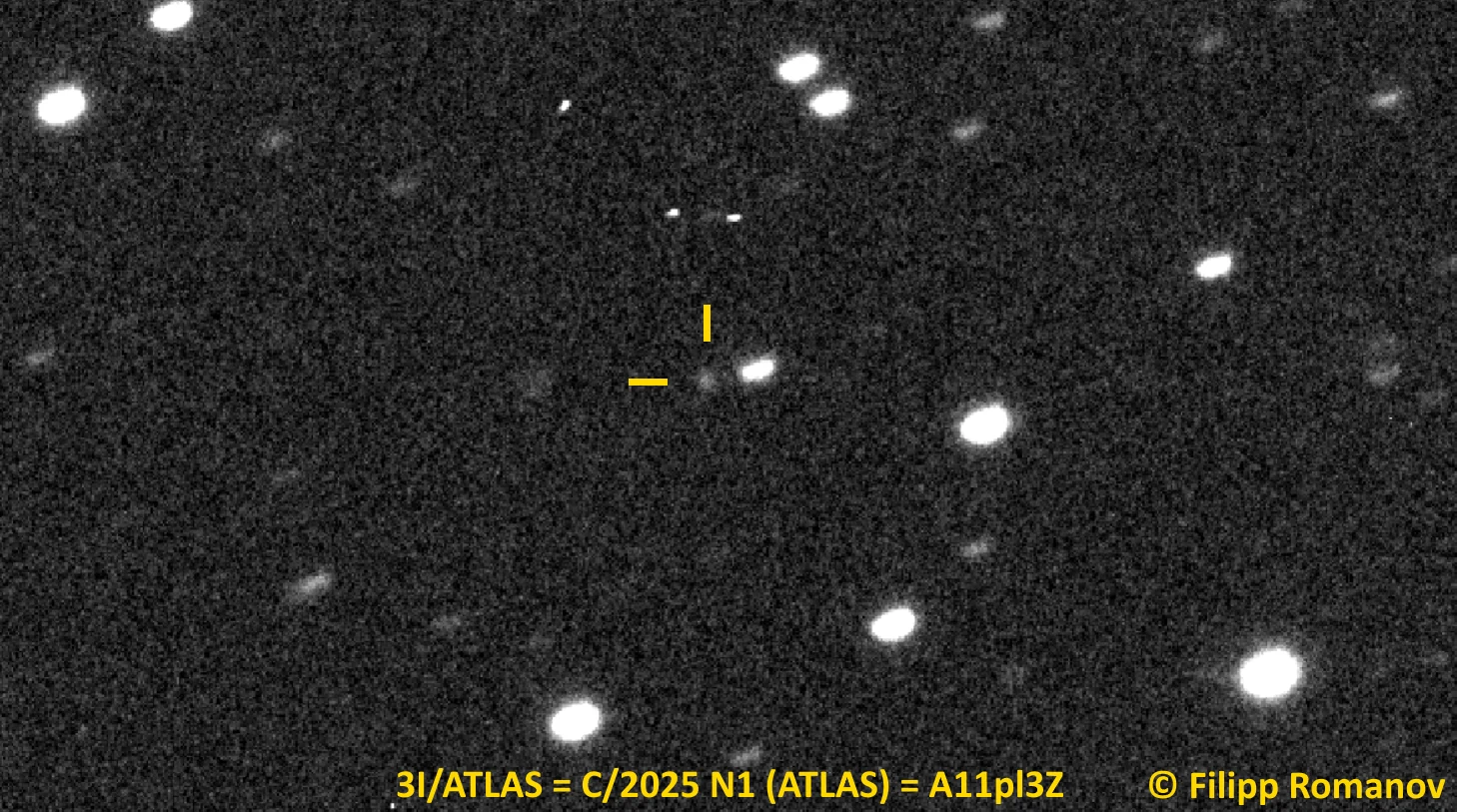
I never saw 3I/ATLAS myself. From my balcony in Nicosia it was hopeless: a faint object low near the Sun, far below anything a Seestar S50 pulls out of a Bortle 7 sky. The image at the top of this post is a real one: Filipp Romanov’s confirmation frame from July 2, 2025, the day after discovery, showing the comet as a dim blob near 17th magnitude. That faintness is the point. This is a story told through spectrographs, not eyepieces. The last comet I actually chased with my own gear was C/2025 R3 from a Cyprus hillside; this one I only ever met as a data product.
A visitor on a one-way orbit
The ATLAS survey picked it up on July 1, 2025, from Río Hurtado, Chile, under the temporary label A11pl3Z. Within days the orbit gave it away. Solar-system comets travel on ellipses and come back. 3I/ATLAS is on a hyperbola with an eccentricity near 6.1, not a marginal 1.01 that might be a scattered Oort-cloud body, but wildly unbound. It carried a hyperbolic excess velocity around 58 km/s (its speed relative to the Sun out where the Sun’s gravity barely reaches), faster than either earlier interstellar visitor. It’s already climbing back out, never to return. The Minor Planet Center gave it the permanent designation C/2025 N1 (ATLAS) and the interstellar tag 3I.
The geometry kept it at a polite distance. Perihelion came on October 29, 2025, at 1.36 AU, about 203 million km, inside the orbit of Mars but well outside Earth’s. Closest approach to us was December 19, 2025, at 1.798 AU, roughly 269 million km. It was never a threat and never a naked-eye object. The nucleus is small and hard to pin down: Hubble could only bracket it between 0.32 and 5.6 km across, with the coma hiding the solid body. It’s probably under a kilometer.
None of that is what makes it worth an article. The chemistry is.
What Webb actually saw
Interstellar objects are hard to study because they’re faint and they don’t wait. ʻOumuamua was caught heading out and gave up almost nothing. Borisov cooperated better but stayed within reach of what we recognise. 3I/ATLAS was spotted early, while still inbound, which meant Webb could aim both of its relevant instruments at it: NIRSpec in the near-infrared, and later MIRI in the mid-infrared.
The first result came from NIRSpec in August 2025. Webb found a coma (the cloud of gas and dust boiling off the nucleus) dominated by carbon dioxide. The CO₂-to-water ratio measured around 8, among the highest ever recorded in any comet (reported in The Astrophysical Journal Letters). Alongside the CO₂ sat water vapour, water ice, carbon monoxide, carbonyl sulphide, and dust, with the outgassing skewed toward the sunward side. Most solar-system comets run the other way round: water-dominated, with CO₂ a minor ingredient. This one had the proportions inverted.
Then came a first. From MIRI observations taken in December 2025 and published in June 2026: methane. No one had ever detected methane (CH₄) in an interstellar object before. And it wasn’t a trace. The methane-to-water ratio was reported at roughly 11 times higher than in any solar-system comet on record (NASA’s Webb detects methane on 3I/ATLAS).
Two ratios, both far off the solar-system scale, both pointing the same direction. CO₂ and CH₄ are volatile: they only stay locked into ice at very low temperatures. A body rich in both froze somewhere extremely cold, farther from its parent star than our own comets formed from the young Sun.
The isotopes are the headline
Abundances tell you what an object is made of. Isotopes tell you where and when it was made. That’s where the June 22, 2026 paper led by Martin Cordiner at NASA Goddard (Webb finds clues to an ancient, distant origin, published in Nature) did the real damage to any “ordinary comet” reading.
Start with deuterium: heavy hydrogen, an atom carrying an extra neutron. The ratio of deuterium to ordinary hydrogen (D/H) in a comet’s water works as a thermometer for the environment its ice condensed in: colder clouds lock in proportionally more deuterium. In solar-system comets, deuterium makes up about 0.03% of the hydrogen. In 3I/ATLAS, the team measured close to 1%, roughly 30 times higher than any solar-system comet ever recorded. That excess implies water ice that formed below about 30 K (–243 °C), colder than nearly anything in our own comet population.
The carbon told a matching story. 3I/ATLAS is badly depleted in carbon-13 relative to carbon-12: its ¹²C/¹³C ratio ran above 150 for carbon monoxide and around 170 for carbon dioxide, where solar-system comets sit just below 100. Different element, same verdict: this material was assembled from a gas reservoir chemically unlike the one the Sun and planets condensed out of.
Older than the Sun
Put the pieces together and you get an age. The Cordiner team estimates 3I/ATLAS formed something like 10 to 12 billion years ago, with the paper’s full range spanning 7.6 to 14 billion years at 68% confidence. The Sun is 4.6 billion years old. Even at the young end of that range this comet predates the Solar System; at the old end it’s closing on the age of the universe itself, about 13.8 billion years — a number that comes out of the same cosmological toolkit I wrote about in the cosmic distance ladder.
Two independent lines of evidence agree, which is why the claim holds. The chemistry (deuterium, carbon isotopes, volatile ices) points to a cold, ancient molecular cloud. The dynamics point the same way: even before Webb’s spectra, modelling of the comet’s velocity through the galaxy had tied it to the Milky Way’s thick disk, an older population of stars that formed during the galaxy’s early, busy era of star formation. A body born then was assembled around what astronomers call cosmic noon, when the universe built stars at its peak rate, several billion years before our Sun’s own cloud collapsed.
So this is, plausibly, a piece of another planetary system’s raw material (ices from around a star that may no longer exist) arriving intact with its original chemistry still legible. We don’t get samples like this. We get one every few years, for a few months, and then it’s gone.
The part where someone says “aliens”
Every interstellar object now arrives with a side order of speculation that it’s a spacecraft, and 3I/ATLAS got the usual treatment: its sunward jet and its fast, old orbit were enough to set the theories running online. I’ll be blunt. Nothing Webb measured needs anything exotic. A CO₂- and methane-rich body with a large deuterium excess and depleted carbon-13 is exactly what an extremely old, cold-formed comet should look like. The data don’t point at engineering. They point at a very long time in the dark.
Why I care, from a balcony that couldn’t see it
Here’s what I keep returning to. Everything I image from Nicosia (M13, the Ring Nebula, the odd faint galaxy) is ours, made from the same well-mixed solar nebula, carrying the same isotopic fingerprints. 3I/ATLAS is the first object I can point at and say the ice in it froze around a different star, under conditions the Sun never saw, before the Sun existed. Webb read all of that off a smudge fainter than most of my failed subframes.
It’s leaving now, back out into the galaxy on the same hyperbola it rode in on. We won’t see it again. But we caught the spectrum, and the spectrum is a record of a place and a time we have no other way to reach. For once “once-in-a-lifetime” is close to literal: this exact object will never cross anyone’s telescope again.