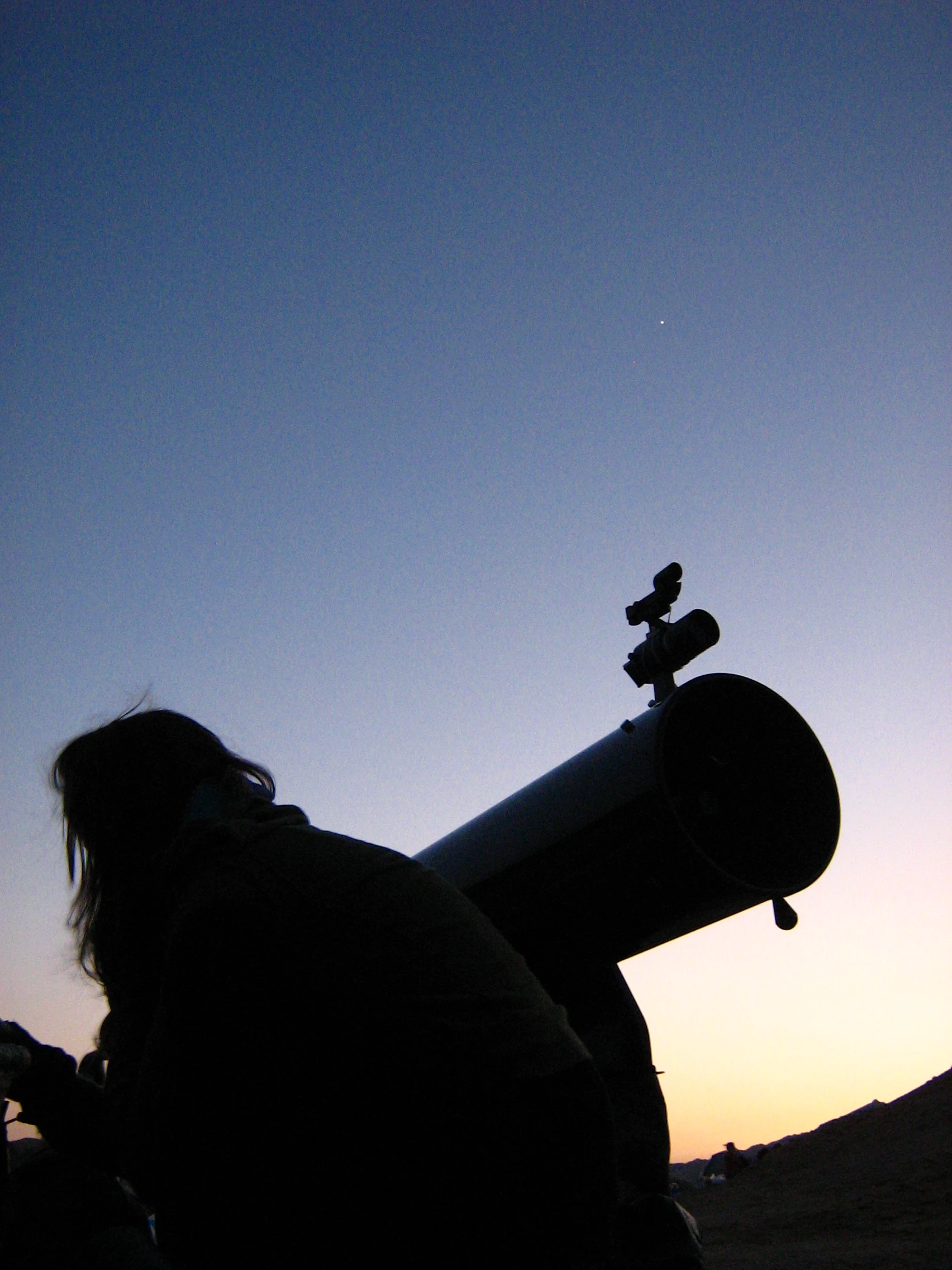
The two most useful eyepieces you can own probably aren’t the two that came in the box, and choosing them takes two numbers, not brand loyalty. Your telescope most likely arrived with a 25mm and a 10mm eyepiece. This piece is about what those millimetres actually do, why the 10mm is so uncomfortable to look through, and which two eyepieces to add first so you cover the sky from wide star fields to the cloud belts on Jupiter. No “best eyepiece” ranking. Just the arithmetic, worked on the scopes beginners actually buy.
After my binoculars-or-first-telescope piece a few readers wrote in having bought an 8-inch Dobsonian, gotten exactly two eyepieces with it, and then hit a wall: everything looked either too small or too dim and jittery, and the shop pages were a wall of names with no explanation. So here’s the explanation.
The number on the barrel: focal length
Every eyepiece has its focal length stamped on it in millimetres: 25mm, 10mm, 6mm. Magnification is just your telescope’s focal length divided by the eyepiece’s:
magnification = telescope focal length ÷ eyepiece focal length
My visual scope is an 8-inch Dobsonian: 203mm of aperture, 1200mm focal length, so it works out to f/5.9. Drop in the 25mm and I get 1200 ÷ 25 = 48×. Swap to the 10mm and it’s 120×. Smaller eyepiece number, higher magnification. That’s the entire relationship.
The same eyepiece behaves completely differently on a different scope, which is why “what magnification is this eyepiece” is an unanswerable question. Put that 25mm into an 80mm f/6 refractor (480mm focal length) and it gives 19×, not 48×. The 10mm gives 48×. Magnification lives in the pairing, never in the eyepiece alone.
Why you can’t just keep going smaller
There’s a hard ceiling. The most magnification a telescope can usefully deliver is about 2× its aperture in millimetres, or roughly 50× per inch. My 203mm Dob tops out near 400× on paper. I’ve reached that maybe twice, both times from Troodos at 1,700m on a dead-still night. From my Nicosia balcony the air is boiling most evenings and 200× is the honest limit before Jupiter turns to pudding.
So a 6mm eyepiece, which gives 200× on this scope, is usually my real high-power end. A 4mm pushing 300× just magnifies the turbulence, and a 2.5mm sold as “480×” is marketing. Buy for the sky you actually have, not the number on the box.
Exit pupil: the number nobody prints
This is the one that quietly decides what you should buy, and it’s almost never on the packaging. Exit pupil is the width of the pencil of light leaving the eyepiece and entering your eye. Two ways to get it:
exit pupil = eyepiece focal length ÷ focal ratio, or equivalently aperture ÷ magnification
Both give the same answer; use whichever numbers you have handy. On my f/5.9 Dob the 25mm gives a 4.2mm exit pupil, the 10mm gives 1.7mm, and a 6mm gives 1.0mm. If you own binoculars you already know this quantity: a 7×50 binocular has a 50 ÷ 7 = 7.1mm exit pupil, which is exactly why 7×50s are the classic low-light glass.
Two limits bracket the useful range, and they’re the reason a random cheap eyepiece can be a bad buy on your particular scope.
Go too big and you waste the telescope. Your pupil only opens so far in the dark: about 7mm in your twenties, closer to 5mm once you’re past 45 or so. If the exit pupil is wider than your own pupil, the outer ring of light lands on your iris and never gets in, so you’ve effectively stopped the telescope down to a smaller aperture. A 40mm eyepiece in this f/5.9 Dob gives a 6.8mm exit pupil: fine for a young observer, quietly wasteful for an older one. There’s a second penalty in the city. A fat exit pupil pours skyglow straight into the view, and from my Bortle 7 balcony anything past about 5mm washes the background to grey and drowns the faint targets I’m chasing. (It’s the same reason a light-pollution filter earns its keep more at low power than high.)
Go too small and the image dims while your own eye starts getting in the way. Below about 0.5mm you’re squinting through a pinhole, floaters drift across the field, and everything goes dark. Planetary high power lives around 0.5 to 1mm exit pupil, and that’s about as far as it’s worth pushing.
The comfortable zones sit between: roughly 2 to 3mm exit pupil is the deep-sky contrast sweet spot under a decent sky, and 0.7 to 1mm is where the Moon and planets snap into detail on a steady night.
True field of view, and why the barrel width matters
Magnification tells you how big; field of view tells you how much sky fits in the circle. Every eyepiece has an apparent field of view designed into it: a simple Plössl shows about 50°, a modern wide-angle around 68°, an ultra-wide 82° or more. Your true field on the sky is:
true field ≈ apparent field ÷ magnification
At 48× my 50° Plössl frames about 1° of sky, two full-Moon widths, enough to hold a big open cluster whole. At 120× a 60° eyepiece shows half a degree. Low power buys you a wide field for finding targets and sweeping the Milky Way; high power narrows the window and digs out detail.
One catch trips people up here: the barrel. A 1.25-inch eyepiece has a physical opening, the field stop, that caps how much sky it can show, around 27mm across. On a 1200mm scope that limits you to about 1.3° no matter which 1.25-inch eyepiece you screw in. To go wider at low power you need a 2-inch eyepiece and a focuser that accepts one. If your Dob or refractor has a 2-inch focuser, that’s what makes a 30 to 32mm wide-field worth the money; if it’s 1.25-inch only, a 24 to 25mm is the practical widest field there is and paying for more just wastes it.
Eye relief: why your kit 10mm hurts
Eye relief is how far your eye sits from the glass while still seeing the whole field, and in simple designs it roughly tracks focal length. A 25mm Plössl gives you a relaxed 17 to 18mm. A 6mm Plössl gives about 4mm, which means you mash your eyelash against the lens and still lose the field edges. That’s the single most common reason a beginner decides they hate high power. It isn’t the magnification doing it; nobody can use 4mm of eye relief comfortably.
If you wear glasses, this decides your purchase outright. You need 15 to 20mm of eye relief to keep them on, which rules out the cheap short Plössls and points you at long-eye-relief designs. They cost more and it’s worth it. One thing you can skip the glasses for: a telescope’s focuser corrects plain short or long sight, so if that’s all you have, observe without them and the view is fine. Astigmatism is the exception, because the focuser can’t correct it. Keep the glasses on for that, especially at low power where the large exit pupil shows astigmatism most; at high power the tiny exit pupil acts like a pinhole and it mostly vanishes.
So which two to actually add
You already own a decent middle. The kit 25mm gives 48× at a 4.2mm exit pupil, the 10mm gives 120× at 1.7mm. The two eyepieces worth buying first bracket that pair, one wider and one higher.
A low-power, wide-field eyepiece for sweeping and finding. On an f/5.9 scope a 30 to 32mm lands around a 5 to 5.4mm exit pupil and about 38×. This is the eyepiece you use to find a cluster before zooming in, and the one that shows the most Milky Way at once. From Troodos my 32mm turns the Dob into a rich-field sweeper: the Double Cluster in Perseus sits in the field whole, with dark space around it. Buy it in a 2-inch barrel if your focuser takes one; otherwise cap it at 24 to 25mm in 1.25-inch. Don’t push the exit pupil past about 5.5mm unless you’re young and under genuinely dark skies, because in the city that just adds skyglow.
A high-power eyepiece for the Moon and planets. A 6mm gives 200× and a 1.0mm exit pupil on this scope, which is my practical ceiling most nights. A 9mm, at 133× and 1.5mm, is the gentler choice for average seeing and an easier place to start if you’re not sure your air will hold 200×. If you wear glasses, buy the long-eye-relief version of whichever you choose rather than the bare Plössl.
That gives you a four-eyepiece spread from two purchases: 32 / 25 / 10 / 6mm, which is 38× / 48× / 120× / 200×. Wide fields, general deep sky, and planets, with nothing redundant in the set.
The Barlow shortcut
A 2× Barlow is a small lens that doubles the magnification of any eyepiece behind it, effectively halving that eyepiece’s focal length. A good one turns your 25mm and 10mm into 25 / 12.5 / 10 / 5mm without a single new eyepiece. There’s a bonus that matters if you wear glasses: a Barlow hands you high power while keeping the longer eyepiece’s comfortable eye relief, so a 2× Barlow plus a 20mm delivers 10mm-level magnification at 20mm-level eye relief.
The catch is quality. A cheap Barlow smears the image and undoes the sharpness you paid for in the eyepiece, so this is not the place to save five euros. A decent one is one of the best-value buys in the hobby.
The whole thing in two divisions
None of these numbers are secret and none of them need a brand argument. Magnification is your telescope’s focal length over the eyepiece’s. Exit pupil is the eyepiece over the focal ratio, and it tells you whether you’re wasting aperture or drowning in skyglow before you’ve spent a cent. Do those two divisions for your own scope, decide what you actually want to look at, and buy the two eyepieces that bracket what you already have. The physics is identical in every barrel; only the price tag pretends otherwise.