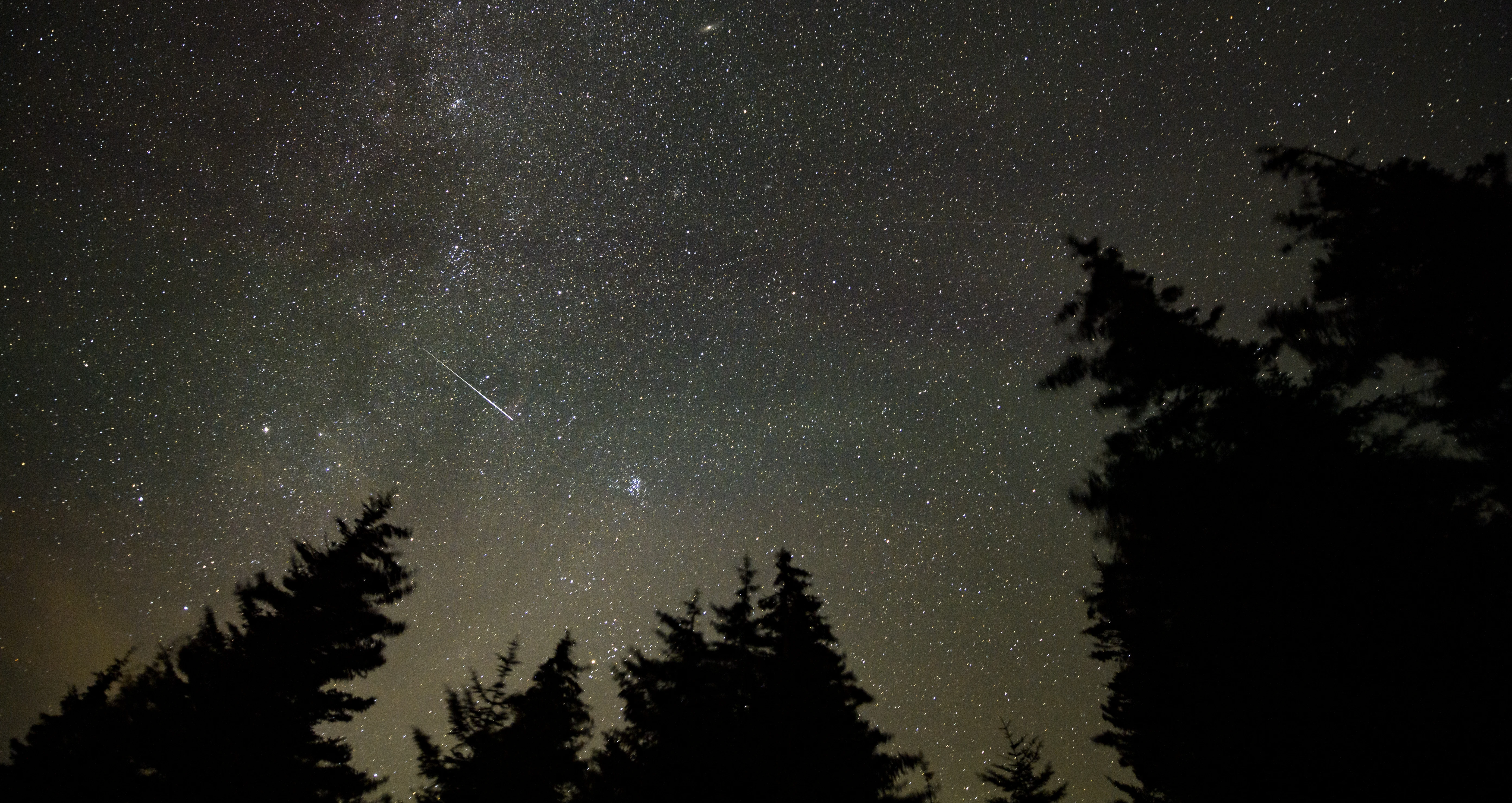
Two meteor showers reach their peak on the night of July 30: the Southern Delta Aquariids and the Alpha Capricornids. In a good year that’s a fine reason to drive up to Troodos and lie back for a couple of hours. This is not a good year. The Buck Moon turns full on July 29 at 14:36 UT, and two nights later it’s still 96% lit and up from dusk to dawn, parked in the same corner of the southern sky the meteors come from. The plan, then: don’t waste a special trip on July 30. Learn what these two showers are, catch a few of the brighter ones in the darker nights beforehand, and save your effort for August 12, when the Moon disappears entirely.
What actually peaks on July 30
The Southern Delta Aquariids are the bigger of the two. Their radiant, the point the meteors appear to stream from, sits in Aquarius at right ascension 22h40m, declination −16°, and the American Meteor Society gives a peak zenithal hourly rate (ZHR) of about 25. ZHR is an idealised number: it’s what a single observer would count under a perfectly dark sky with the radiant straight overhead. Real counts always come in lower, and this year they’ll come in a lot lower. The parent body is comet P/2008 Y12 (SOHO), a small sungrazer only picked out of the SOHO coronagraph data. The debris stream was mapped before anyone had a good look at the comet itself.
The shower isn’t a sharp spike. EarthSky describes it as a broad plateau running from mid-July into late August. There’s no single make-or-break night, then, so missing July 30 costs you very little.
The Alpha Capricornids share the same peak night but behave differently. Their ZHR is only about 5, so you won’t be swamped, but they’re known for slow, bright fireballs. The meteoroids hit the atmosphere at roughly 23 km/s, gentle as these things go, which gives each one a long, unhurried burn. Some reach apparent magnitude −4 (brighter than Venus) and the occasional one flares far past that. Their parent is comet 169P/NEAT. Where the Delta Aquariids trade on numbers, the Alpha Capricornids trade on the odd showstopper, and a bright fireball is the one kind of meteor a full Moon can’t easily erase.
From Cyprus the geometry is kinder than it is for most of Europe. A radiant at −16° declination climbs to about 39° above the southern horizon from Nicosia’s 35°N latitude. You can work this out yourself: altitude at culmination is 90° minus the gap between your latitude and the radiant’s declination. That happens around 03:00 local (EEST, UT+3). Observers in Britain or Germany see this radiant scrape much lower, so the southern Mediterranean has the better seat here. In a moonless year I’d rate this a solid two-hour session from a dark site. This is not that year.
Why the Moon wins this time
A full Moon is the worst thing that can happen to a meteor shower. It floods the whole sky with scattered light, lifts the background brightness by two or three magnitudes, and every faint streak vanishes into the glow. You’re left seeing only the handful of meteors bright enough to beat the Moon — which, for a ZHR-25 shower, is close to nothing.
The timing this year is about as bad as it gets. The Moon turns full on July 29, so on peak night it’s a waning gibbous barely a day and a half past full, still 96% illuminated. It rises around the end of evening twilight and stays up until dawn, so there’s no dark window to wait out. Worse, it tracks through Capricornus and into Aquarius on these nights, which is the same swathe of sky the meteors radiate from. The glare lands exactly where you’d point your eyes. You can’t turn your back on the radiant and the Moon at the same time. Realistically, from a dark site under that Moon I’d expect a handful of meteors an hour at most, and most of those the brighter Alpha Capricornids punching through the glow rather than the fainter Delta Aquariids.
There’s one move that helps a little: put a building, a wall, or a ridge between you and the Moon so it’s out of your direct field of view, then watch the darkest patch of sky you can still see. It won’t rescue the Delta Aquariids, but it gives an Alpha Capricornid fireball a fighting chance to register.
What’s still worth doing before peak night
If you want Delta Aquariids this year, the nights before the peak beat the peak itself. The shower’s broad plateau means July 22–26 delivers nearly the same rate as July 30, and on those nights the Moon is still waxing and sets after midnight. That hands you an hour or two of genuinely dark sky in the pre-dawn, right when the radiant is climbing highest. A moonless 03:00 in the last week of July will show you more Delta Aquariids than the moon-flooded peak will.
The method is the usual one, and it costs nothing. Get away from direct lights, give your eyes a full half hour to adapt — I wrote up why your eyes need that 30-minute wait and how one glance at your phone undoes it — and lie back so you’re taking in as much sky as possible. Don’t stare straight at the radiant; meteors near it have short trails, and the longer, more dramatic ones appear 40–60° away. No telescope, no binoculars. A reclining chair and a dark southern horizon are the whole kit. If you want to find your way around the summer sky while you wait, the galactic centre is right there in Sagittarius, low and bright.
I went through almost this exact situation in May with the Eta Aquariids under an 84% Moon — same lesson, same shrug. Some years the sky just doesn’t cooperate, and the right call is to manage expectations rather than pretend a bright Moon isn’t there.
The payoff is two weeks away
Here’s the reason not to burn yourself out on July 30. The same Moon that ruins these showers keeps waning, and it reaches new on August 12 at 17:37 UT — zero percent lit, gone from the sky. That’s the night the Perseids peak, with a ZHR up to 100 and fast, bright meteors from comet 109P/Swift-Tuttle. A new Moon landing within a day of the Perseid maximum happens in only about one year in fifteen, so 2026 is the rare one worth planning around. The best hours are pre-dawn on August 12–13, from roughly 02:00 to first light, when the radiant in Perseus rides high.
And it’s the same date as the total solar eclipse crossing Greenland, Iceland, and northern Spain: a dark, moonless night bolted onto the first totality to cross the country in decades. If you’re travelling for one, you get the other for free. I’ve written up how to watch the eclipse safely; a full Perseid preview will follow as the peak gets closer.
Treat late July as the warm-up act. Watch for an Alpha Capricornid fireball if you’re out anyway, steal a few Delta Aquariids from the dark pre-dawns before the Moon fills out, and keep August 12 clear. That’s the night the sky finally gets out of its own way.