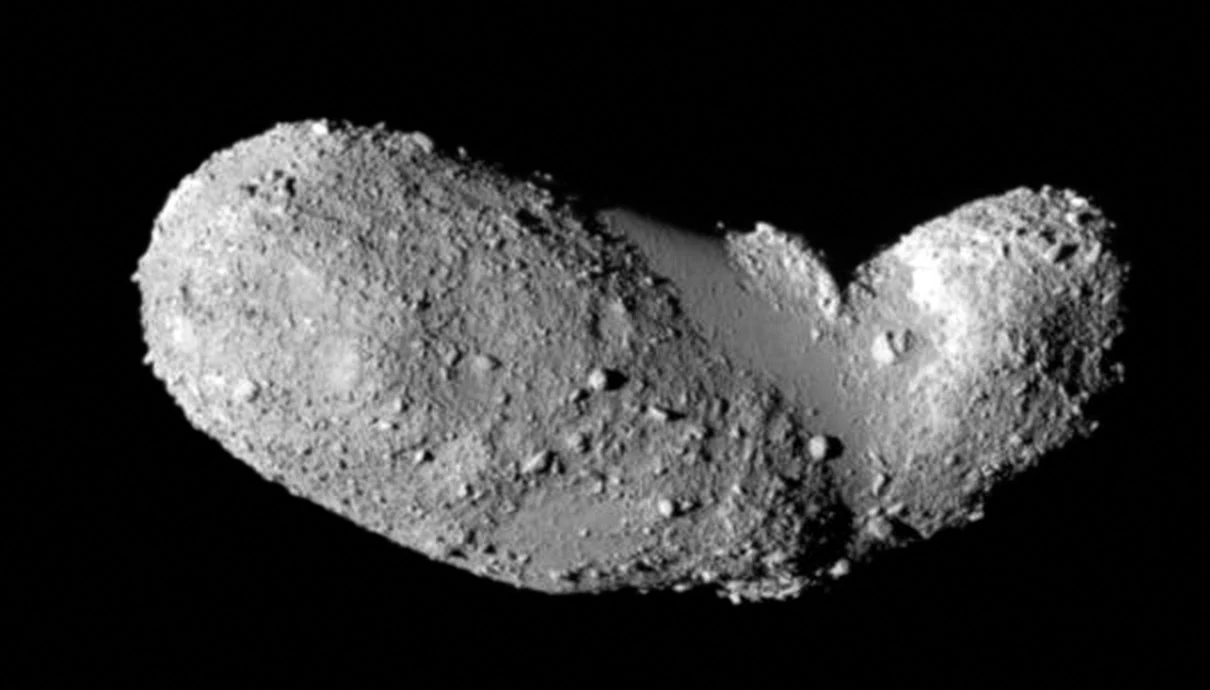
A Chinese spacecraft is now station-keeping about 20 km from a rock the size of an office block that has been shadowing Earth for at least a century. On July 6, the China National Space Administration released the first close-up image of asteroid 469219 Kamoʻoalewa, confirming that Tianwen-2 had caught its target after a 13-month, roughly one-billion-kilometre chase. The image showed a small, elongated body, the shape you get from a loose pile of rubble rather than a solid boulder.
The mission’s job is to grab a sample and fly it home. And the timing is almost too good: Tianwen-2 arrived at Kamoʻoalewa just as the leading explanation for what the thing is, a fragment blasted off the Moon, started coming apart.
Earth’s most stable quasi-moon
Kamoʻoalewa isn’t a moon in any real sense. It orbits the Sun, not the Earth, on a path that takes almost exactly one year. Because that period matches ours so closely, it stays near us year after year, appearing to loop around Earth from our point of view without ever being gravitationally bound. Astronomers call this arrangement a quasi-satellite: a 1:1 co-orbital resonance rather than a captured moon. It never comes closer than roughly 14 million km, about 38 times the distance to the real Moon, and it’s the most stable object of its kind we know, locked into this pattern for centuries in either direction.
Pan-STARRS found it in 2016 from Haleakalā, which is why it carries a Hawaiian name drawn from the Kumulipo creation chant; Kamoʻoalewa refers to an oscillating fragment. Size estimates put it at roughly 40 to 100 metres across, small enough that its exact dimensions stayed fuzzy until Tianwen-2 got close.
You won’t see it. From my Bortle 7 balcony in Nicosia, or even up at Troodos under a proper dark sky, Kamoʻoalewa is hopeless: at its brightest it hovers around magnitude 16 and moves fast against the stars, a target for professional survey instruments with a precise ephemeris, not a Seestar. That difficulty matters for the story, because almost everything we thought we knew about this rock came from squeezing information out of a faint smudge of reflected sunlight.
The chunk-of-the-Moon idea
In 2021, Benjamin Sharkey and colleagues reported in Communications Earth & Environment that Kamoʻoalewa’s reflectance spectrum was strange. It was extremely red, redder than typical near-Earth asteroids, and the closest match in their comparison set wasn’t an asteroid at all. It was space-weathered lunar silicate, the kind of material in the Apollo sample trays. Pair that with an unusually Earth-like orbit and you get a provocative idea: Kamoʻoalewa might be a piece of the Moon, thrown into solar orbit by an ancient impact.
Later dynamical modeling even floated a birthplace. The young far-side crater Giordano Bruno, which you can’t see from Earth at all, came up as a plausible launch site, its ejecta drifting into an Earth-like orbit over millions of years. For five years, “the Moon’s lost fragment” was the headline every time Kamoʻoalewa appeared.
Two 2026 results that don’t fit
Then the case started leaking from two directions at once.
The first hit was statistical. In a January 2026 preprint, Fenucci and colleagues modeled the population of near-Earth asteroids and asked how often the ordinary main belt should produce a Kamoʻoalewa-like object versus how often lunar ejecta from Giordano Bruno should. Their numbers weren’t close: about 1.2 expected objects from the main belt against 0.04 from the crater, more than an order of magnitude apart. On the dynamics alone, a boring main-belt origin is the far likelier bet, no Moon required.
The second hit came from the spectrum itself, and from an unexpected place. Sharkey — the same lead author who’d made the lunar case — went back to Kamoʻoalewa with the James Webb Space Telescope. In a June 2026 preprint, that team reported that JWST’s near-infrared spectrum looked notably less red, more neutral, than the ground-based data from 2021. There’s a faint silicate absorption near 0.93 μm and no 2.0 μm band, a combination that, in their words, looks “more similar to S, V, or E-type silicate asteroids and unlike the reddened, space-weathered lunar-like silicates suggested by previous observations.” They even flag an enstatite-rich, E-type composition as a candidate — an ordinary, if uncommon, stony asteroid, not lunar dirt.
Both are preprints, not yet through peer review, so hold them loosely. But it’s a striking thing to watch: the person who proposed the lunar link is the one now walking it back with a better instrument. That’s science working the way it’s supposed to.
Why you send a spacecraft instead of taking another spectrum
The frustrating part is also the reason Tianwen-2 is worth a billion kilometres of flight: reflectance spectra are ambiguous. Sunlight, micrometeorites and the solar wind redden and darken airless surfaces over time — the process called space weathering — and a heavily weathered ordinary asteroid can end up looking a lot like lunar material at the wavelengths we can measure from here. Even JWST and an 8-metre ground telescope, working the same rock, produced spectra red enough in 2021 to say “Moon” and neutral enough in 2026 to say “asteroid.” The signal is that thin.
A returned sample ends the argument. In a lab you get mineralogy, grain by grain, plus isotope ratios and cosmic-ray exposure ages. Lunar rock carries fingerprints that reflected light can’t fake: a specific oxygen-isotope signature, solar-wind gases implanted in the outermost grains, glassy agglutinates welded by micrometeorite impacts. If a few tens of grams of Kamoʻoalewa come back looking like Apollo regolith, the far side is missing a piece and we’ll have the receipt. If it comes back as an enstatite chondrite, the lunar story is finished. There’s no third reading of that data.
What Tianwen-2 will actually do
Tianwen-2 launched in May 2025 and is China’s first asteroid sample-return mission. Right now it’s surveying Kamoʻoalewa from close range, mapping the surface to pick a spot solid enough to touch. The spacecraft carries more than one way to grab material: a touch-and-go scoop like the ones Hayabusa2 and OSIRIS-REx used, and a novel anchor-and-attach mode that grips the surface and drills, useful on a body whose gravity is so weak that any contact risks bouncing you off into space.
The plan is to leave Kamoʻoalewa around April 2027 and drop a sample capsule back to Earth in late November 2027. That isn’t the end of the mission, either. After releasing the capsule, the spacecraft is meant to use an Earth gravity assist and set off on a much longer cruise to 311P/PANSTARRS, an active object in the main asteroid belt, arriving in the mid-2030s. One launch, two very different small bodies.
What this means if you never point a telescope at it
You can’t observe Kamoʻoalewa, so why should an amateur care? Because it’s not a one-off. It’s one member of a growing swarm of small co-orbital bodies that surveys keep turning up — 2024 PT5, the widely reported “second moon” of late 2024, had its own lunar-origin debate before it drifted off. Pan-STARRS caught Kamoʻoalewa; the Vera Rubin Observatory is about to find faint, fast movers like it by the thousand. The population of things quietly sharing Earth’s orbit is a lot larger and stranger than “one Moon” suggests, and we’re only now building the tools to catalogue it.
It’s also a clean lesson in the limits of looking. We watched the interstellar comet 3I/ATLAS leave the solar system with nothing but spectra and a stopwatch, because it was never coming back. Kamoʻoalewa we can actually hold. The difference between “our best guess from reflected light” and “the answer” is a spacecraft and eighteen months of patience.
And there’s a nice symmetry to it. The reference sample in this whole argument, the lunar material Kamoʻoalewa’s spectrum was measured against, is the Moon you can see out the window tonight. The proposed source crater, Giordano Bruno, is the one part of it you never will. Late 2027 is when we find out whether the two are related at all.