The ZWO Seestar S50 I reviewed in May is out of production. Walk into the smart-telescope aisle today and the Seestar you can actually buy new is a 30 mm scope: the S30 or the S30 Pro. The “successor” has 20 mm less aperture than the thing it replaced. If you’ve spent any time reading telescope forums, that sentence should make you flinch, because aperture is the one number those forums agree on. The question I keep getting emailed: does a 30 mm smart telescope give up too much from a light-polluted balcony, and should you hunt down a used S50 instead?
Here’s the short version, then the math. From a fixed Bortle 7–8 balcony, the drop from 50 mm to 30 mm costs you less than the spec sheet suggests, and the wider field you get in exchange fixes the S50’s most annoying limitation. But it does cost you something real, and there’s a specific kind of observer who should still chase the old scope.
What actually changed
ZWO stopped making the S50. That’s confirmed straight from the company on the forums, not a rumor about low stock. The current lineup is the base S30 (around $350) and the S30 Pro (around $599, the same price the S50 held at full retail). Prices on these things wander a bit between retailers and sales, so treat those as ballpark.
There is a true 50 mm successor coming. A Seestar S50 Pro has been shown and widely reported, expected later in 2026, and it would pair the 50 mm aperture with a modern sensor. But ZWO hasn’t published final specs, a price, or a date, so everything about it is reported rather than confirmed. If you’re buying this summer, it isn’t a product yet. It’s a reason some people are stalling.
Why the replacement is smaller
Start with the thing that makes 30 mm sound like a step backwards, because it partly is. A telescope’s light-gathering scales with the area of the aperture, which goes as the square of the diameter. Run the ratio:
(50 ÷ 30)² ≈ 2.78
The S50 collected about 2.8 times as many photons per second as any 30 mm scope. For a faint target, that’s the difference between a ten-minute stack and a twenty-eight-minute one for the same signal. Aperture is time, and time under a clear sky is the scarcest thing an imager has. On raw light grasp, the S30 Pro is a real downgrade from the S50, and no amount of marketing changes the geometry.
ZWO went smaller because it spent the aperture budget on the sensor and the field instead.
The S50 used a Sony IMX462, a 1920 × 1080 chip — about 2 megapixels, the resolution of a cheap webcam. The S30 Pro carries a Sony IMX585: 3840 × 2160, roughly 8.3 megapixels, on a physically larger sensor, behind a four-element apochromatic lens. It adds a second wide-angle camera for framing and Milky Way shots, 128 GB of onboard storage, a solar mode, and a battery that lasts five to six hours instead of the 2.5–3 hours I actually measured on the S50 in a Nicosia winter. On paper, everything except aperture moved forward.
The interesting part is that the sensor change and the aperture change pull in opposite directions, and which one wins depends entirely on what you point the thing at.
Aperture versus field: what your target list decides
Smart-telescope targets split cleanly into two groups, and the S50-to-S30 tradeoff lands differently on each.
Take the small, faint objects first: globular clusters, compact galaxies, planetary nebulae, anything a few arcminutes across. These live and die on integration time, and integration time is where aperture does the most work. The S50’s 50 mm pulled M13’s outer halo out of my Bortle 7 sky faster than 30 mm can. The S30 Pro’s better sensor claws some of that back through higher quantum efficiency and lower read noise, but it doesn’t erase a 2.8× light deficit. On these targets you simply stack longer for the same result.
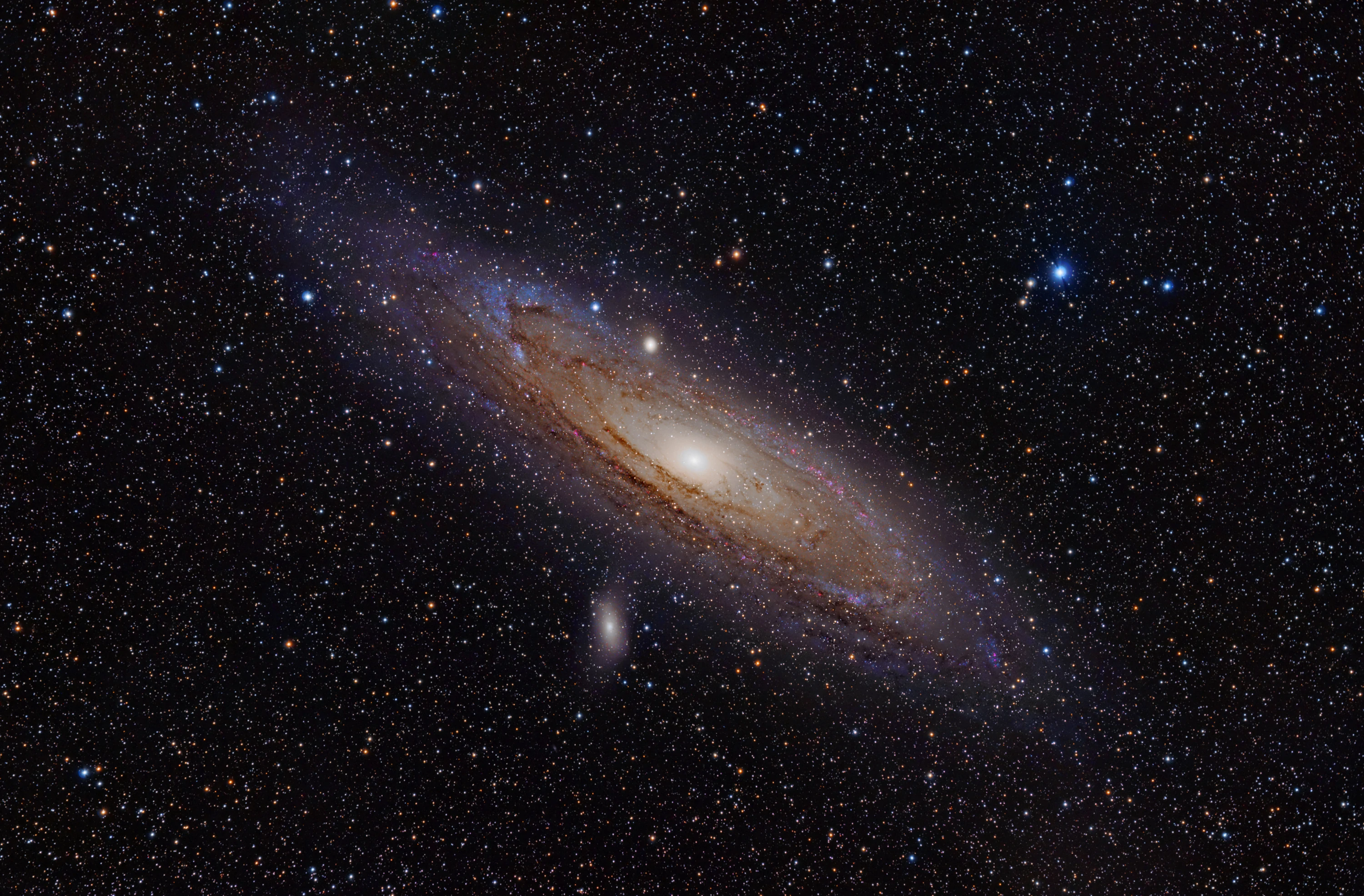
Now the large objects: the Andromeda Galaxy on the cover, the Pleiades, the North America Nebula, the Veil. Here the limiting factor isn’t light, it’s how much sky fits on the sensor. The S50’s telephoto field ran about 1.3° on its long axis, and I spent six months watching big targets spill out of frame. M31 didn’t fit. The Pleiades didn’t fit at all. The S30 Pro frames roughly 4.6° across the diagonal, enough to hold the whole of Andromeda or the Pleiades in one shot. On wide targets the smaller scope is flatly the better instrument.
There’s a third number worth a glance: pixel scale. Both the IMX462 and the IMX585 use 2.9 µm pixels, so the difference in how finely each scope samples the sky comes purely from focal length. The S50 at 250 mm works out to about 2.4 arcseconds per pixel; the S30 Pro at 160 mm to about 3.7. Under the 2–4″ seeing you get from a warm city balcony, neither is limited by its pixels in a way you’ll notice. The coarser sampling is simply the price of the wider field, and from a rooftop it’s a price worth paying.
From a Bortle 7 balcony specifically
Now the part the spec sheets never account for: where you’re standing.
From a light-polluted balcony, aperture isn’t usually the thing capping your images. Sky glow is. Nicosia’s orange-white sky sets a noise floor that no small refractor punches through on faint broadband detail, whether it gathers 30 mm or 50 mm of light. What actually rescues deep-sky imaging from the city is the built-in dual-band filter that every Seestar carries, which passes the H-alpha and OIII wavelengths nebulae emit and blocks most of the broadband municipal glow. That filter matters more from a balcony than 20 mm of aperture does, and the S30 Pro keeps it. (If filters are new to you, I went deep on what does and doesn’t help from a Bortle 7 balcony here.)
And the frustration I hit most often with the S50 wasn’t faintness. It was framing: good targets running off the edge of that narrow field. The S30 Pro’s field would have solved that on most of the nights I remember being annoyed. For a fixed city site, honestly, the tradeoff mostly favors the buyer.
Where 30 mm genuinely costs you
I don’t want to wave the downgrade away, because for some observers it’s the deciding factor.
If your target list skews toward small, faint galaxies (5-to-10-arcminute smudges around apparent magnitude 10 to 12), the S50’s aperture pulled them out of the noise in less time, and you’ll feel the 30 mm scope asking for longer sessions. If you image from a truly dark site rather than a city, where sky glow isn’t the limiter, that extra aperture does more work and the argument for it gets stronger. And if you care about planets at all, none of these scopes is your answer: at 160–250 mm of focal length, Jupiter is a handful of pixels. A 150 mm Dobsonian with a planetary camera will bury any Seestar on the Moon and planets, which is the same advice I gave in binoculars or a first telescope.
What to buy in summer 2026
Sorting the options by who you are, not by spec rank:
Buy the S30 Pro new if you’re imaging deep-sky from a fixed, light-polluted site and want the wide field, the sharper sensor, and the framing camera. For a balcony observer, it’s the default, and it’s the one I’d hand a friend starting today.
Hunt for a used or clearance S50 (roughly $350–400 while stock lasts) if your targets skew small and faint, if you image from a darker site where aperture stretches its legs, or if you simply find one cheap. The firmware is mature now, and 50 mm is 50 mm.
Buy the base S30 (around $350) only if budget is the hard wall. You accept the 2 MP sensor and the smaller storage, and in return you get outside tonight. That’s not nothing — the scope that gets used beats the one you couldn’t afford.
Wait for the S50 Pro only if you’re genuinely not in a hurry and you want 50 mm behind a modern sensor. Just know you’re waiting on an unannounced price and date, and “I’ll get the next one” is how people stay telescope-less for years. My own bias is not to wait.
Skip smart telescopes altogether if the Moon and planets are your thing, or if handing your telescope’s every decision to a phone app makes your teeth itch.
Six months with the S50 taught me the lesson I keep coming back to: the scope that gets carried onto the balcony beats the one with more aperture sitting in a closet. Going from 50 mm to 30 mm reads like a step down, and on small faint targets from a dark site it is one. From a Bortle 7 rooftop pointed at the things a wide field can finally hold whole, it isn’t. Buy for the sky you actually have.