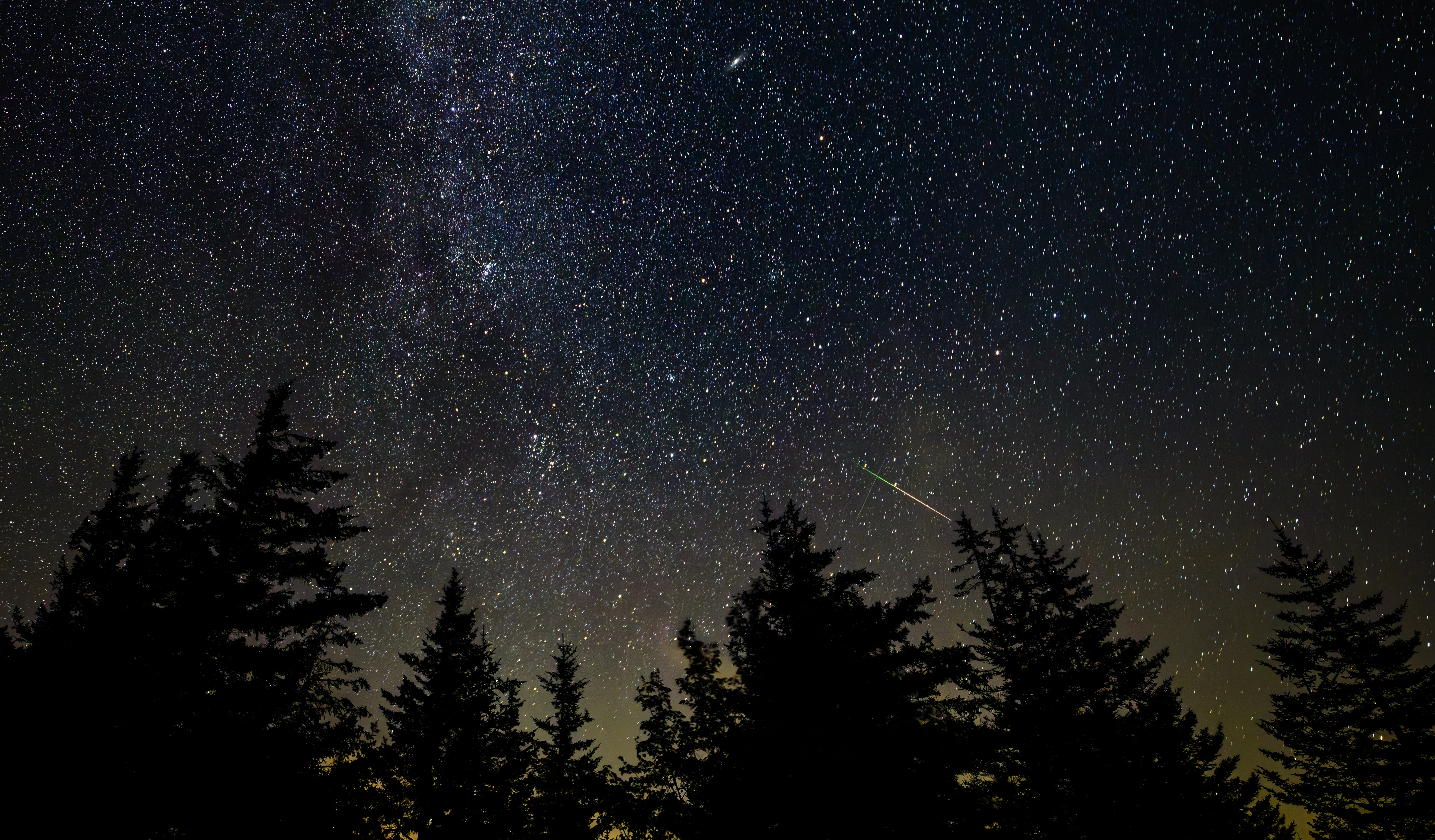
The Perseids peak overnight on August 12–13, and this year the Moon stays out of the way entirely. It turns new on August 12 at 17:37 UT, so the peak night is as dark as any night gets. That combination, the richest summer shower landing on a moonless sky, is what observers wait years for, and it hasn’t happened since 2021. If you clear a single night for meteors in 2026, make it this one. Here’s when to be out, where to point your eyes, and why the eclipse dominating everyone’s calendar that same day is, for those of us in the eastern Mediterranean, the less interesting half of August 12.
What a new moon does for the Perseids
A meteor shower lives or dies by the background sky. The Delta Aquariids peaking this week are a good demonstration of the opposite case: a fine shower gutted by a near-full Moon that floods the sky and erases every faint streak. Moonlight lifts the background brightness by two or three magnitudes, and against that glow only the brightest meteors survive.
The Perseids get the reverse deal. The Moon reaches new at 17:37 UT on August 12, which means it sits between us and the Sun and vanishes from the night sky completely. There’s no moonrise to wait out, no glare to hide behind a ridge. Full darkness from the end of twilight to first light, on the same night the shower runs hardest.
That alignment is rare. A new Moon within a day of the Perseid maximum falls in roughly one year in fifteen. The last time the peak came this dark was 2021, and by the reckoning of several forecasters the next comparably favourable year won’t arrive until 2029. The “best in five years” line you’ll see everywhere is just arithmetic: it’s what the Moon phase gives you.
The eclipse that skips us
August 12 is also eclipse day. A total solar eclipse crosses Greenland, western Iceland, and northern Spain at sunset, the first totality to touch mainland Europe in decades, and the preview I wrote back in June still holds if you’re travelling for it. But check who actually sees it. The partial zone reaches much of Europe, northwest Africa, and northern North America, but stops well short of the eastern Mediterranean. From Cyprus, timeanddate lists no eclipse at all on August 12; the same is true across Greece and Turkey, where at best a sliver grazes the far northwest of the Greek mainland. Nicosia’s next partial solar eclipse isn’t until August 2, 2027.
There’s a neat physical link between the two events, though. A solar eclipse only happens at new moon, when the Moon slides directly between Earth and Sun. That’s the exact same geometry that clears the Moon out of the night sky for the meteors. The alignment robbing us of the eclipse is the one handing us a perfect Perseid sky. If you’re anywhere south and east of the partial zone, August 12 is a meteor night, not an eclipse night, and it’s a very good one.
When to actually be outside
The predicted maximum, from the International Meteor Organization and EarthSky, is 14:53 UT on August 13. That’s the middle of the afternoon across Europe, so there’s no single “peak moment” you can catch — the Sun’s up. What you want instead are the dark hours flanking it: the pre-dawn of August 13, a few hours before the peak, and the pre-dawn of August 12 the night before. EarthSky rates both mornings as prime, and the night of August 13–14 is still worth an hour if the first two clouded out.
The Perseid radiant climbs through the small hours, so the rule is the same every year: the later you stay up, the more you see. From Cyprus (EEST, UT+3), the radiant is already useful by midnight and best from about 02:00 to first light around 05:00. Rates roughly double between late evening and the hour before dawn as the radiant rises, so if you can only manage a short session, make it the last one before sunrise rather than the first after dark.
None of these nights carry any Moon, which is the whole point. Pick the clearest forecast among the 11th–12th, 12th–13th, and 13th–14th and commit to it.
What you’re looking at
The meteors stream from a radiant in Perseus, up near the Cassiopeia border at a declination of about +58°. From Nicosia’s 35°N that’s a gift. Using the same trick as always (altitude at culmination is 90° minus the gap between your latitude and the radiant’s declination), the radiant reaches about 90 − 23 = 67° up, two-thirds of the way to overhead. It’s high enough that it never fully sets from Cyprus; it just loops low across the north in the evening and rides up into the pre-dawn sky, which is exactly when you want it high anyway. Observers in northern Europe watch it climb even higher, so this is one shower where latitude doesn’t hand the Mediterranean any disadvantage.
The often-quoted rate is a zenithal hourly rate (ZHR) of about 100. Keep that number honest: ZHR is an idealised count for a single observer under a perfectly dark sky with the radiant straight overhead. Real life subtracts from it. From a genuinely dark site with the radiant high, 60–90 an hour is a realistic haul at the peak; from a light-polluted balcony you might see 10–20 of the brightest. The American Meteor Society publishes the full profile if you want to compare across sites.
What the Perseids do have going for them is speed and drama. They hit the atmosphere at about 59 km/s, near the fast end for meteors, which makes them bright and gives many of them a persistent train, a glowing streak that hangs for a second or two after the meteor itself is gone. The parent body is comet 109P/Swift-Tuttle, a 26-km nucleus on a 133-year orbit that last rounded the Sun in 1992; every Perseid is a sand-grain to pea-sized fragment of it, shed on some earlier pass and burning up at the end of a very long fall.
How to watch, and where
The kit list is short because there isn’t one. No telescope, no binoculars: a scope’s narrow field is the wrong tool for streaks that can cross 40° of sky. What you need is a dark horizon, a reclining chair or a mat, and patience.
Three things make or break the session. First, get away from direct light. From Nicosia I’d drive up to Troodos; at 1,700 m the sky is a different animal from the Bortle 7 glow over the city, and on a moonless August night the Milky Way through Cygnus stands out plainly overhead. Second, give your eyes the full half hour to adapt. I’ve written up why that takes 30 minutes, and a single glance at a white phone screen resets the clock. Use red light only. Third, don’t stare straight at the radiant. Meteors near it have foreshortened, stubby trails; the long, photogenic ones appear 40–60° away, so take in as much sky as you can rather than fixing on one point.
While you wait for the rate to build, the summer sky gives you plenty to name. The galactic centre in Sagittarius sits low and bright in the south on these nights, and the Perseus radiant itself rises beneath the distinctive W of Cassiopeia in the northeast. There’s no rush. The best Perseid hours come late, and the sky is dark for all of them.
Plan it now
The reason to sort this out in late July rather than on the night is simple: the good sites fill and the weather doesn’t negotiate. Keep the nights of August 11–12 and 12–13 loosely blocked, watch the cloud forecast for Troodos as it firms up in the last few days, and pick your window then. Charge a headlamp with a red mode, throw a jacket in the car (1,700 m gets cold even in August), and plan to be out until the sky starts to grey around 05:00.
Some meteor showers are worth a glance if you happen to be outside. This one is worth a night. A moonless Perseid peak is about as good as a summer sky gets from here, and it won’t line up this well again until the end of the decade.