Most dark-sky destinations ask you to drive somewhere remote, set up your own gear, and hope the weather holds. Pic du Midi does something almost no other site in Europe offers: it puts a 130-year-old research observatory on a 2,877-metre summit, runs a cable car up to it, and, if you can stomach the price, lets you sleep the night at the top with the telescopes. It sits at the centre of France’s only International Dark Sky Reserve. This is a guide to what the sky is actually like there, how to get up, what the overnight stay includes, and the much cheaper way to use the same dark skies from the valleys below.
I write this from Nicosia, where my home sky is Bortle 8 and I drive an hour to Troodos for anything approaching real darkness. Pic du Midi is a different category of site: a working professional observatory, at altitude, inside a protected reserve. I haven’t spent a night at the summit yet; it’s near the top of my own list. But the logistics and the numbers are worth laying out clearly, because this is one of the few places where “astrotourism” means something more than a hotel with a telescope in the car park.
Why the sky is dark here
Pic du Midi de Bigorre was labelled an International Dark Sky Reserve by DarkSky International (then the International Dark-Sky Association) in December 2013. The process had been initiated back in 2009, during the International Year of Astronomy. At the time it was the sixth reserve in the world, the first in continental Europe, and it remains the only one in France.
The reserve is big. It covers roughly 3,000 km², about 65% of the Hautes-Pyrénées département, spanning the valleys of Gavarnie, Luz, and the mountains around the peak itself. That scale matters: a dark summit surrounded by bright towns is a bad reserve, because skyglow leaks in from the horizon. Here the protected buffer is large enough that the core zones stay dark.
Two things stack in your favour. First, altitude. At 2,877 m the summit sits above a meaningful fraction of the atmosphere and, more importantly, above most of the water vapour and low-altitude haze that scatter light near the ground. Second, the reserve’s lighting rules keep the surrounding valleys under control. In the darkest core valleys, away from the ski stations, you’re looking at roughly Bortle 2 skies: the band where the Milky Way isn’t just visible but structured, with dust lanes splitting the star clouds. For comparison, my Troodos site is more like Bortle 3–4, and it already feels like another planet after the city.
One caveat: the ski resort of La Mongie, where the cable car starts, is not dark. Its lighting is resort lighting. The darkness lives above it at the summit and out in the surrounding valleys, not at the base station.
A working research observatory
What separates Pic du Midi from a scenic overlook is that science still happens there. The observatory dates to 1878, when construction began under a local learned society; by 1882 the costs had outgrown the society and the French state took the site over. It has been operating at altitude ever since, and it’s one of the longest-running high-mountain observatories anywhere.
The largest instrument on the summit is the Bernard Lyot Telescope (TBL), a 2-metre reflector installed in 1980, still used today for stellar spectropolarimetry (measuring magnetic fields on other stars). There’s also a 1.06-metre telescope, installed in 1963, with a genuine claim to fame: it was used to take detailed photographs of the lunar surface in preparation for the Apollo landings. NASA needed high-resolution maps of where the astronauts were going, and Pic du Midi’s steady mountain air delivered some of the sharpest Moon images of the era. The site also has a long history in solar physics. Bernard Lyot, who the big telescope is named for, invented the coronagraph, and the summit has hosted coronagraphs studying the Sun’s outer atmosphere for decades.
You won’t get to point the 2-metre yourself, obviously. But knowing the sky above you is good enough for professional spectropolarimetry changes how the night feels. This is a site chosen by physicists for its seeing, and you’re borrowing it for an evening.
How to get up there
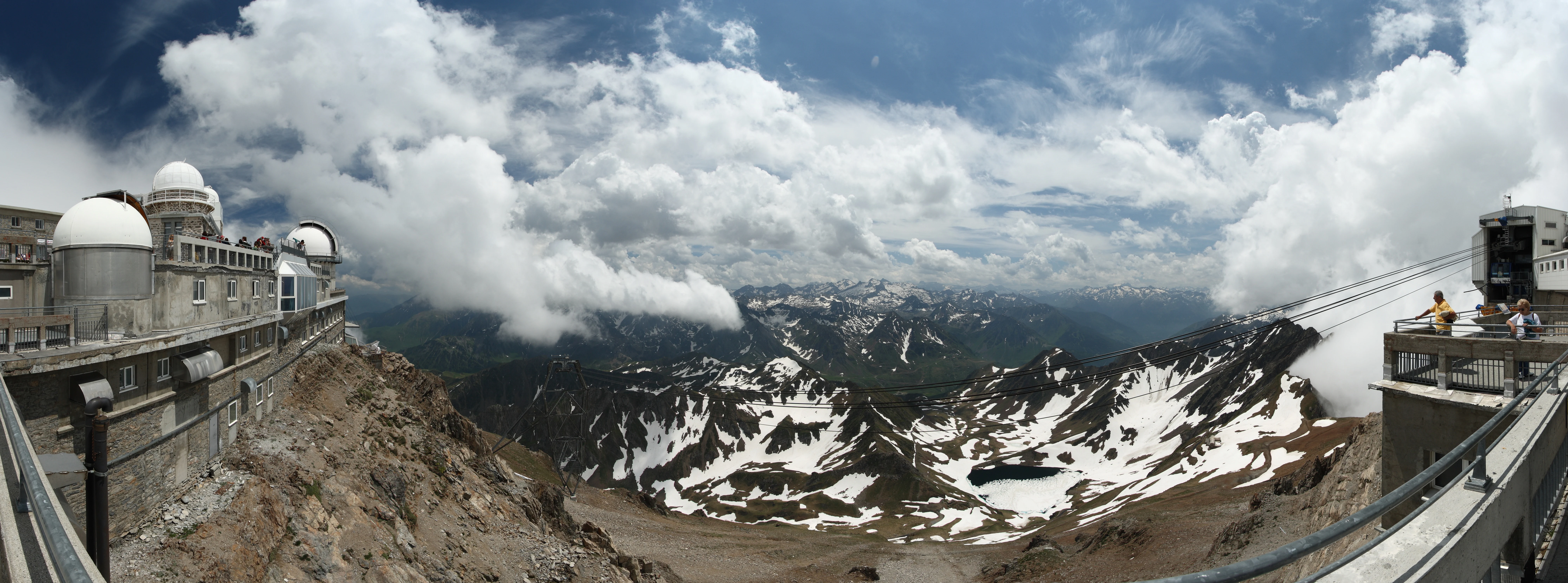
You do not drive to the summit. Access is by cable car from La Mongie, a ski village on the Col du Tourmalet road in the Hautes-Pyrénées. The ride goes up in two sections, with a change at the Taoulet mid-station, and takes about 15 minutes end to end. The top station opens straight onto the observatory’s terraces, which wrap around the summit and give you that full 360° Pyrenean panorama the site is famous for.
Getting to La Mongie itself means a car for most people. It’s roughly an hour and a half from Tarbes or Lourdes (both have train stations, and Lourdes–Tarbes airport is the closest), climbing the Tourmalet, the same Tour de France col. In summer the road is open and the drive is straightforward; in winter it’s a working ski access road.
One scheduling detail that catches people out: the site closes for maintenance 1–31 May and 1–30 November every year. Plan around those two windows. Outside them it runs year-round, which is unusual: most high-altitude observatories are effectively inaccessible to visitors in deep winter.
The night at the summit
The headline experience is La Nuit au Sommet, a night at the top. There are only 15 rooms, so it books out well ahead, especially around new moon and the summer meteor showers. Pricing starts from around €539 for a double room, and that number is doing a lot of work: the package bundles the cable car ascent, a welcome drink, sunset from the terraces, dinner, a guided stargazing session, the overnight stay, and sunrise the next morning, plus a look at the scientific quarters. You check in at the Comptoir du Pic in La Mongie, and there’s a hard cutoff: you need to be there before 4:00 p.m. to collect your access passes for the evening ascent.
Two warnings. The altitude is real: 2,877 m is high enough that the operator advises against the overnight for pregnant visitors and people with heart conditions, and even fit people can feel the thinner air. And the cost puts this firmly in “special occasion” territory, not a casual night out. What you’re paying for is scarce: a bed inside a working observatory above the clouds. But go in knowing it’s a splurge.
If the sky cooperates, the payoff is the reason people come back: sunset over a sea of peaks, the Milky Way arching overhead in a Bortle 2 sky with no light on the horizon, and the option to just stay out on the terrace as long as the cold lets you.
The cheaper way to use the same reserve
You don’t need to sleep at the summit to observe under this sky. The reserve is 3,000 km² of protected darkness, and the valleys below (around Luz-Saint-Sauveur, the Gavarnie valley, and the quieter side roads off the Tourmalet) give you Bortle 2–3 skies for the price of a tank of fuel and a fold-out chair.
This is how I’d actually do it on a normal budget: base yourself in a gîte or small hotel in one of the reserve villages, drive to a dark pullout away from the resorts after dinner, and set up your own kit. A pair of binoculars is enough to make the trip worth it; a star tracker and a camera will get you Milky Way images you can’t make anywhere near a city. You lose the observatory and the guided session, but you keep the sky, which is the rare part. For a lot of amateurs that’s the better deal, and it’s the version I’d start with before committing to the summit night.
You can also do a day visit to the summit by cable car without the overnight (the terraces, the small museum, and the views are open to day-trippers), and then observe from the valley the same night. That splits the difference nicely.
When to go, and what you’ll see
For the Milky Way, target June through September, when the galactic centre in Sagittarius and Scorpius rides highest after dark. August is close to ideal: the core is well placed in the evening, the road is easy, and the summit is open. If you’re planning a 2026 trip, the Perseids peak on the moonless night of August 12–13, the best conditions in five years. A Bortle 2 Pyrenees sky is about as good a place to catch them as exists in western Europe. Learn to find the galactic centre with your naked eye before you go and you’ll get far more out of the night.
Winter flips the menu: Orion, the Pleiades, and the great winter constellations dominate, the air is often driest and steadiest, and the summit sits above any valley fog. But the cold at nearly 2,900 m is serious, and you’re committed to the cable car schedule. Spring and autumn straddle the two maintenance closures, so check the calendar carefully.
The one variable you can’t control is Pyrenean weather. Mountains make their own clouds, and a summit that’s crystal clear at sunset can fog by midnight. Give yourself more than one night if you can, and treat any single clear night as a bonus rather than a guarantee.
Who this is for, and who should skip it
Skip the overnight if you’re on a tight budget, uneasy at altitude, or you mainly want to set up your own imaging rig. The valley option gives you the dark sky without the constraints, at a fraction of the cost. But if you want the rare thing, a night inside a real observatory, above the clouds, under one of the darkest protected skies in Europe, Pic du Midi delivers something only a handful of sites on Earth can. Pair it with a few valley nights of your own, and you get both the once-in-a-while experience and the flexible dark-sky observing that actually fills a trip.
If you’re weighing it against the other great European mountain-observatory destination, La Palma offers darker year-round skies and easier winter access but no summit hotel you can book. Pic du Midi’s edge is the bed at the top. For anyone driving through southwest France in summer, there’s also a dark sky reserve the size of a small country waiting in the valleys below.