If you’ve never sat out on purpose to watch a meteor shower, the night of August 12 into the morning of August 13 is the one to start with. The Perseids peak then, and this year the Moon is new, so there’s no moonlight to drown the fainter streaks. It’s the darkest Perseid peak since 2021. You don’t need a telescope, binoculars, an app, or any skill you don’t already have. You need somewhere reasonably dark, something to lie back on, and about an hour of patience. Here’s exactly what to do with it.
What you’re actually looking at
Every August, Earth drives through a trail of debris left behind by comet 109P/Swift-Tuttle. The comet swings through the inner solar system once every 133 years and leaves a river of grit along its orbit. Most of the particles are between a grain of sand and a pea. They hit the top of the atmosphere at about 59 km/s and burn up around 80 to 100 km overhead.
The flash you see isn’t the grain itself glowing. It’s a thin column of air, briefly heated and ionised as the particle rips through it, that lights up and fades in well under a second. “Shooting star” is a lovely name and a terrible description: nothing stellar is involved, and the thing making the light is smaller than a raisin.
They’re called Perseids because if you trace the streaks backwards, they all seem to fan out from a point in the constellation Perseus. That point is the radiant. It’s a perspective effect, the same way straight rows of streetlights seem to converge down a long road. The useful part for you: you do not need to find Perseus. More on where to actually look in a minute.
Why 2026 is a good year to start
Two things line up this August.
First, the peak is broad. The Perseids are active from roughly mid-July to August 24, and the rate builds gently toward maximum rather than spiking for a few hours. Under a genuinely dark sky with the radiant high, the shower’s zenithal hourly rate (ZHR) runs around 100. That ZHR is an idealised figure, though: it assumes the radiant is straight overhead and your sky reaches magnitude 6.5. From a real spot you’ll see fewer. Realistically that’s maybe 10 to 20 an hour from a city edge, and 40 to 80 an hour from somewhere properly dark.
Second, and this is the part that makes 2026 stand out, the Moon is new on the 12th. Moonlight is the usual thief at a meteor shower. A bright gibbous moon can erase everything but the fireballs. This year the sky stays dark all night, which is why it’s the best Perseid peak in five years. (For the eastern Mediterranean, where I observe, this is also our headline sky event of August 12. The total solar eclipse that day is a European event far to the west of us; the Perseids are the show we actually get.)
If you want the observer’s-eye numbers version of all this, I wrote a longer preview of the 2026 Perseids with radiant altitudes and timing. This guide is the ground-level how-to.
When to go out
Earlier is not better. Perseus sits low in the north-northeast in the evening and climbs through the night, reaching its highest in the hours before dawn. The higher the radiant, the more of the sky’s meteors are above your horizon rather than hidden below it. So the rich window is roughly midnight to the first hint of dawn, and the two hours before morning twilight are usually the best of the night.
From my latitude in Cyprus (35°N) the radiant technically never fully sets, but in the evening it skims low across the north and the rates are thin. If you can only get out for an hour, make it the small hours. If you go out at 22:00, don’t write the night off after twenty quiet minutes: early evening is when you might catch an earthgrazer, a long, slow meteor that enters at a shallow angle and skims most of the way across the sky. There are few of them, but they’re the ones people remember.
Clouds on the 12th aren’t a disaster either. Because the peak is broad, the nights of August 11 and 13 deliver most of the same rate, and even the 9th, 10th, 14th, and 15th are worth a look.
Where to go
Darkness does more for your meteor count than anything you could buy. From my Bortle 7 balcony in Nicosia I’ll still catch the bright ones, but drive 40 minutes up into the Troodos mountains and the count roughly triples for the same hour under the same sky. Wherever you are, the single best move is to put city lights behind you and get away from the nearest streetlamp.
You don’t need wilderness. A dark field, a quiet beach, a hilltop with the town glow low on one side. What you want is an open view of as much sky as possible, especially from the northeast up through overhead. Avoid anywhere with a light shining directly into your eyes, since it’ll wreck your night vision every few seconds.
What to bring
None of it is optical.
- Something to lie on. A reclining garden chair is ideal; a foam mat with a pillow works. You’ll be looking straight up for an hour, and your neck gives out long before the sky does.
- Warm layers, even in August. Lying still for an hour cools you down fast, and it’s genuinely cold at altitude.
- A red light. A head-torch with a red mode, or your phone screen dimmed and set to a red tint, lets you see your feet without resetting the dark adaptation you spent half an hour building.
- Water, a snack, and ideally a friend. Two people cover more sky and keep each other awake.
Leave the binoculars in the bag for the meteors themselves. Optics narrow your view to a couple of degrees, and meteors are fast and can appear anywhere. You want the widest, most relaxed view you can manage. (Binoculars do earn their place once you’ve had your fill of meteors and want to swing over to the Double Cluster, which sits close to the radiant in Perseus.)
How to actually watch
Give your eyes time. Rod cells in your retina need about 20 to 30 minutes in the dark to reach full sensitivity, and one glance at a bright phone screen resets the clock. I go into the physiology of dark adaptation elsewhere, but the practical rule is simple: get comfortable, put the phone away, and wait it out.
Then, the counterintuitive bit: don’t stare at the radiant. Meteors near their radiant are foreshortened into short stubs. The long, dramatic trails appear 40 to 60 degrees away from it. So aim your gaze high, about two-thirds of the way up the sky, in whatever direction is darkest for you. Straight overhead is a safe default. Take in a wide patch rather than fixing on one star, and let meteors come to you in your peripheral vision.
Meteors also clump. You’ll get three in two minutes, then nothing for ten. This is normal and it’s why the most common beginner mistake is quitting after fifteen minutes. Give it an hour before you judge the night.
What you’ll actually see
Set the bar honestly. Most Perseids are quick, faint streaks that are gone before you can point. Every so often one flares far brighter, a fireball, sometimes leaving a faintly glowing trail that lingers for a second or two afterward. The Perseids produce more of these than most showers, so a couple of really bright ones per session is a fair hope from a dark site.
Colour varies. Fast meteors often read as white or bluish; slower ones low near the horizon can look yellow or orange. There are no guarantees on any single streak.
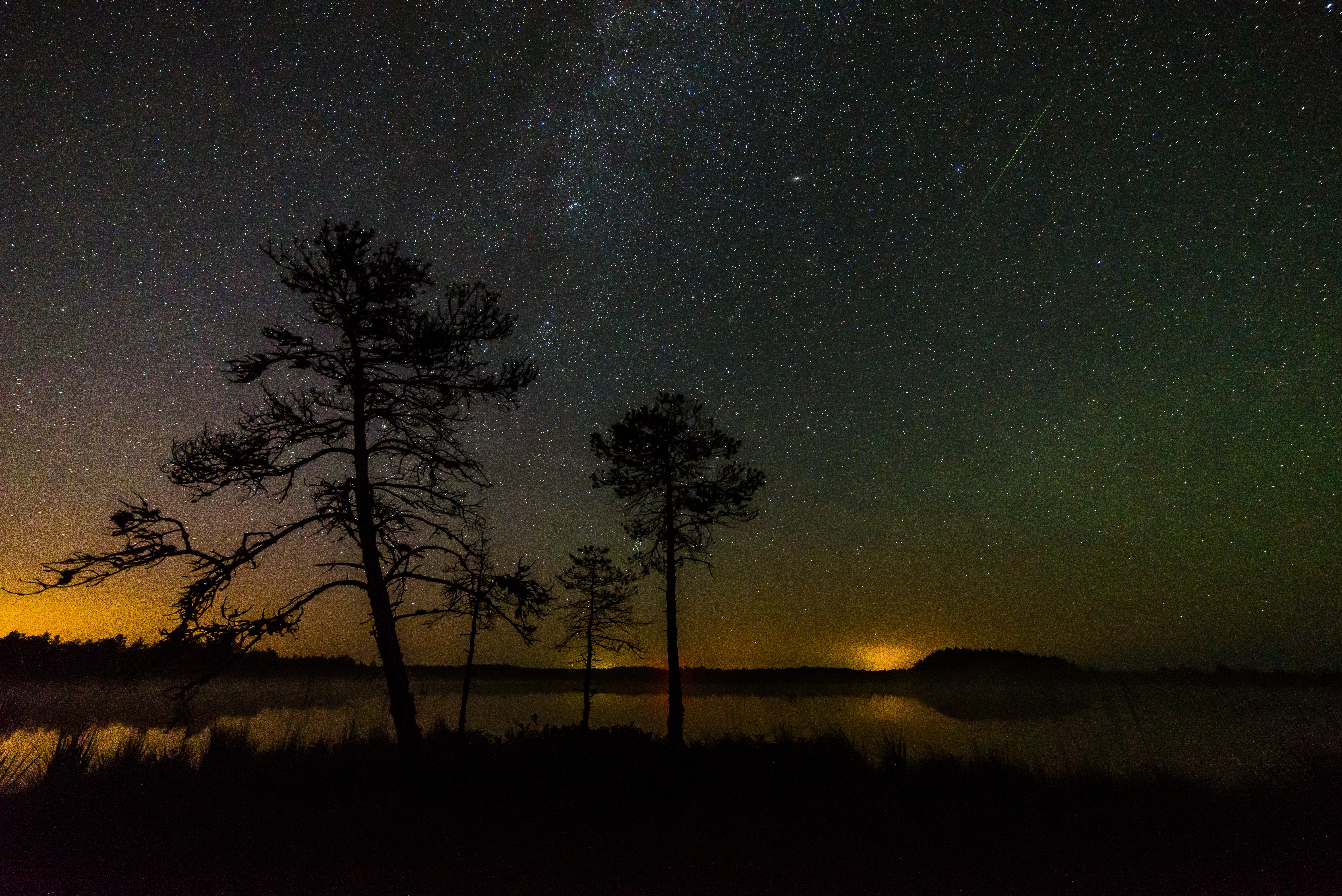
A good Perseid night from a dark site is roughly one meteor every minute or two. That’s a wonderful rhythm to lie under, but it isn’t a downpour, and anyone selling you a “sky raining shooting stars” is selling you something. The cover photo on this article is a fair picture of the reality: one clear meteor, the Milky Way behind it, and a smear of light pollution along the horizon. Manage the expectation and you’ll enjoy the night far more.
The plan
Mine is unglamorous and it works. On the night of the 12th I’ll drive up to Troodos, set up a reclining chair pointed at the darkest part of the sky, pour something warm from a thermos, and put my phone in airplane mode. If the mountain road is socked in with cloud, I’ll settle for the balcony and the bright ones and try again on the 13th. Either way the routine is the same: lie back, let your eyes adjust, look up, and wait. The sky handles the rest.