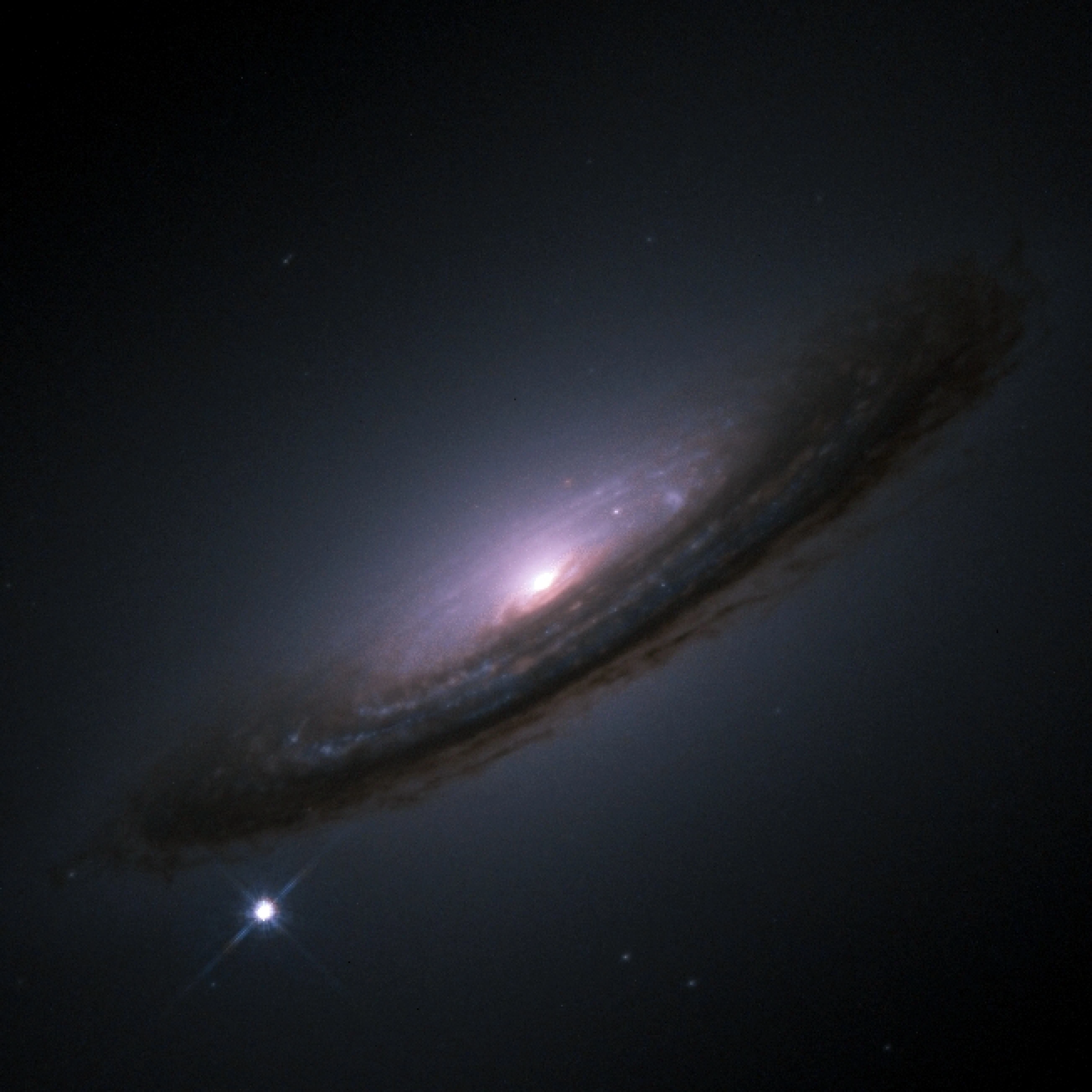
On 21 March 2026, an X-ray telescope in orbit registered a faint flash from a galaxy about 500 million light-years away. It lasted roughly seven minutes and then faded. That flash was the first light of a supernova — not the slow brightening you normally see over weeks, but the instant the explosion’s shock wave punched through the surface of the star. Astronomers call it a shock breakout, and this is only the second time in about two decades one has been caught cleanly in X-rays.
The event now carries two names: the X-ray transient EP260321a, and the supernova SN 2026gzf. Two papers in The Astrophysical Journal Letters work through what happened, and between them they turn a seven-minute blip into a fairly complete account of how one specific 20-solar-mass star died.
What a shock breakout actually is
When you watch a supernova through a telescope, you’re watching the aftermath. The star’s core collapses, a shock wave tears outward through the overlying layers, and for weeks afterward the expanding debris glows as radioactive nickel and cobalt decay inside it. That’s the light curve amateurs image: a rise over a couple of weeks, then a long, slow decline.
The shock breakout comes before any of that. The shock wave races through the star faster than light can leak out ahead of it, so the surface gives no warning. Then the shock reaches the surface and the trapped radiation escapes all at once, in a brief, hot pulse. For a compact, stripped star that pulse is mostly ultraviolet and X-rays, and it’s over in seconds to hours.
That’s why almost nobody catches it. You have to be pointed at the right patch of sky in the right few minutes, at a wavelength that never reaches the ground. The last comparably clean case was SN 2008D in 2008, an X-ray flash the Swift satellite happened to record while it was watching an unrelated supernova in the same galaxy.
How Einstein Probe caught this one
The catch came from Einstein Probe, a wide-field X-ray observatory launched in early 2024. Rather than staring at one target, it uses lobster-eye optics to watch large swaths of sky at once, which is exactly the strategy you need for events that flare and vanish. Its stock-in-trade is the fast X-ray transient (FXT): a burst of X-rays lasting minutes to hours, often from a source that’s hard to pin down afterward.
EP260321a was, per the discovery team, the nearest FXT Einstein Probe has found, at redshift z ≈ 0.034 (a luminosity distance of about 158 megaparsecs). The X-ray spectrum was thermal, with a temperature around kT = 130 eV and a peak luminosity near 1 × 10⁴⁵ erg per second. That combination points to a shock breaking out of a star rather than to a jet or a feeding black hole.
Within an hour, ground-based telescopes swung over. The Dark Energy Camera on the Blanco 4-metre at Cerro Tololo picked up an optical source; over the following days it brightened, and spectra from DESI, Gemini, SOAR and Palomar confirmed a supernova. Chandra and the Very Large Array covered X-rays and radio. This is the modern way to catch a supernova young: an X-ray trigger from space, then a relay of telescopes locking on before the fireball has really got going.
The star that blew up
Piecing the observations together, the progenitor was a Wolf-Rayet star of roughly 20 solar masses: a massive star that had already shed its hydrogen and helium, leaving a bare carbon-oxygen core. When a star like that collapses, you get a Type Ic supernova: no hydrogen lines in the spectrum (that’s Type I) and no helium either (that’s the “c”).
SN 2026gzf is more specific than that. It’s a broad-lined Type Ic, or Ic-BL. The “broad-lined” part means the debris is moving so fast that the spectral lines smear out across a wide span of wavelengths. Ic-BL supernovae are the class tied to long gamma-ray bursts: the same core-collapse events that sometimes launch a jet of material at nearly light speed, bright enough in gamma rays to be seen clear across the observable universe.
The gamma-ray burst that never showed up
Its supernova properties (expansion velocities, the nickel mass driving the light curve, the shape of the decline) sit comfortably inside the range for GRB-associated Ic-BL supernovae. On paper, SN 2026gzf should have produced a gamma-ray burst. It didn’t.
No gamma rays were recorded, and the follow-up ruled out the wreckage a burst would leave behind. Chandra’s deep X-ray limits found no afterglow. The radio campaign, running from about 6 to 55 days after the flash, excluded an on-axis jet carrying more than ~10⁴⁹ erg of kinetic energy for any plausible density of surrounding gas. The same radio data kept the progenitor’s mass-loss rate below about 1.2 × 10⁻⁵ solar masses per year, in line with a Wolf-Rayet wind.
The reading, spelled out in a companion paper titled “Failed jet breakout,” is that the jet choked. The central engine tried to launch one, but it stalled inside the star or in the gas around it and never got free. What escaped instead was the shock breakout — the flash Einstein Probe saw. This looks like a genuine intermediate case: a supernova with the machinery for a gamma-ray burst, caught in the act of failing to make one.
One object, and a hint about the rest
A single event is a single event. What makes this one useful is a rate argument in the multi-wavelength paper. If every Ic-BL supernova produced an X-ray shock breakout as luminous as EP260321a, Einstein Probe should be catching somewhere between about 4 and 16 of them a year. It isn’t catching nearly that many. The most likely explanation is that EP260321a sits near the bright end of what these explosions produce, and most Ic-BL supernovae break out with fainter X-ray signals that current instruments miss.
That fits the discovery paper’s own title, which calls this the faintest shock breakout yet tied to a broad-lined supernova. Faint as it was, it was still bright enough to trip the alarm, which tells you how much of this population we’ve probably been walking past.
Why I’m paying attention from a balcony
I can’t observe any of this. At 158 megaparsecs the supernova peaked far below anything a Seestar on my Nicosia balcony could reach, and the shock breakout itself came out in X-rays that never make it through the atmosphere. This is a space-telescope story from start to finish.
What pulls me in is the plumbing. The flash landed in the COSMOS Deep Drilling Field — the same patch of sky the Vera C. Rubin Observatory just started imaging, which I wrote about last week. An archival Dark Energy Camera frame from 2016 already had a faint blue source sitting at the position, waiting in an archive for a reason to matter. Put those pieces together: an X-ray monitor watching most of the sky, an optical survey imaging the same fields every few nights, and the machine-learning alert brokers that sort the flood in real time. Catching a star in its first minutes stops being luck and starts being a workflow. EP260321a is the second clean X-ray breakout in twenty years. I doubt the third takes another twenty.
The two papers are open access if you want the details: O’Connor et al., “EP260321a/SN 2026gzf: The Faintest Shock Breakout Associated with a Broad-Lined Supernova”, and Rastinejad et al., “A Multi-Wavelength View of the First Type Ic-BL Supernova with an Einstein Probe X-ray Shock Breakout”, both in The Astrophysical Journal Letters.