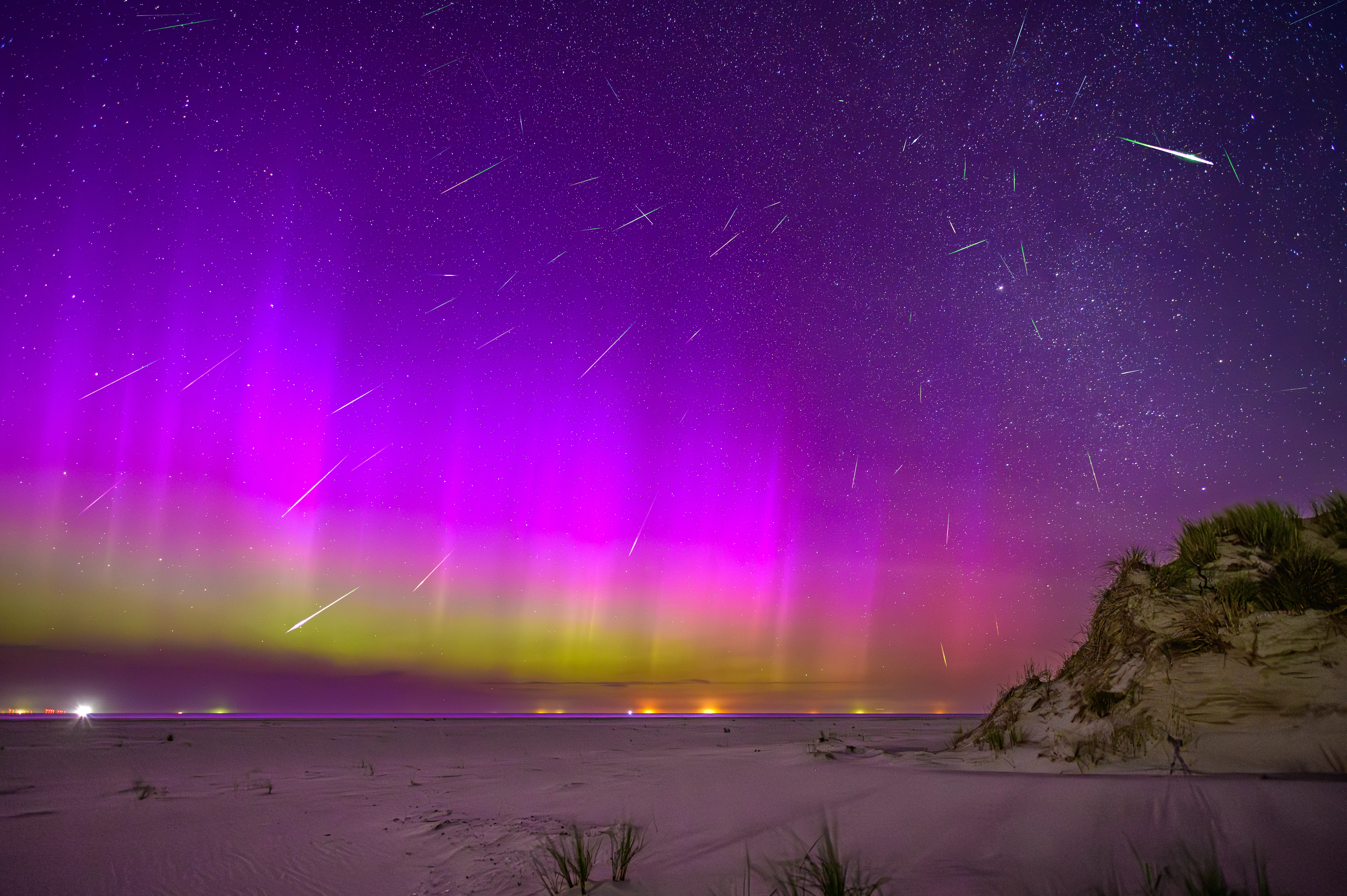
In three nights the Perseids peak under a new moon, the darkest Perseid maximum in five years. I’ll be up at Troodos with a reclining chair and a tally sheet, counting by eye the way people have counted meteors for a century. Overhead, a network of more than 1,300 cameras will be counting too, and solving an orbit for every meteor bright enough to trigger two of them at once. What made that automation possible is a piece of software: a neural network that learned to tell a meteor from an aeroplane.
This is the quiet corner of the hobby, the code watching the sky when nobody is looking at the screen. Below is how it works, and the numbers behind it.
The bottleneck was never the cameras
Point a sensitive all-sky camera at the sky and it flags anything that moves and brightens. Meteors, yes, but also aircraft strobes, satellites, birds lit up in the infrared, insects near the lens, lightning, and the drifting edge of a cloud catching a town’s glow. A single station on a busy night throws hundreds to thousands of candidate events, and the large majority are not meteors.
For years the fix was a person. Someone opened the night’s detections in the morning and clicked through them: meteor, not a meteor, plane, plane, bird, meteor. That scales to one camera. It does not scale to a thousand. The Global Meteor Network (GMN), the largest amateur-run system, passed 1,300 cameras across 42 countries in 2025, and no volunteer pool clicks through that.
Hard-coded computer vision helps, but only so far. Rules about how straight and fast a real track should be will reject a lot of planes, and they also reject the interesting meteors: an Earthgrazer that crawls along the horizon, a head-on Perseid that shows up as a single point flash, a fireball that saturates the sensor and blooms across half the frame. Tighten the rules to kill false positives and you start throwing away real data. That trade-off is what machine learning broke.
Teaching a network what a meteor looks like
Frame it as a classification problem. Given a short clip, or the track of brightness over time, is this a meteor or not? That is the shape of problem convolutional neural networks are good at, and the meteor community moved on it early.
The reference result is Peter Gural’s 2019 paper in Monthly Notices of the Royal Astronomical Society, built on data from NASA’s CAMS (Cameras for Allsky Meteor Surveillance), the SETI Institute network that maps shower activity by triangulating meteors from multiple sites. Gural trained on roughly 100,000 confirmed meteors and 100,000 false alarms and pitted several architectures against each other. A convolutional network he called MeteorNet, working on the 2D imagery, reached 99.94% recall at 0.4% leakage. In plain terms it caught essentially every real meteor while letting through roughly one non-meteor in 250. A time-series network reading the track itself did nearly as well, at 98.1% recall. Gural put the human-analyst baseline at about 99%. The model matched the person and then edged past, at a throughput no person can touch. (Gural 2019, MNRAS 489, 5109)
Two words there carry the whole argument, so define them once. Recall is the fraction of real meteors the model keeps; miss too many and your shower rates come out too low. Leakage is the fraction of junk that slips through wearing a meteor label; let too much through and a human is back to cleaning up the catalogue by hand. Getting both right at the same time is the hard part, and it is where deep learning pulled clear of the old rule-based filters.
The lineage is worth naming for anyone following the AI side of astronomy. The first serious attempt came out of NASA’s Frontier Development Lab in 2017, which threw random forests, LSTMs, and CNNs at CAMS data with the stated goal of replacing the human analyst so the survey could grow. Gural’s paper is the sharpened, published version of that push.
What runs on the Raspberry Pi over your head
GMN is the system most readers can actually reach out and touch. Each station is a low-cost CMOS video camera wired to a Raspberry Pi running open-source detection software. It watches all night, flags candidates on the spot, and uploads them. The central server hunts for the same meteor seen from two or more stations, triangulates the path in 3D, and solves the orbit, which tells you where the meteoroid was before Earth ran into it. By the network’s methodology paper (Vida et al. 2021) it had already logged more than 220,000 precise orbits by mid-2021, and the archive is public and refreshed every morning. (Vida et al. 2021, MNRAS 506, 5046)
Machine learning sits in the filtering layer. A 2023 study led by Eloy Peña-Asensio, working on the Spanish Meteor Network, took an image network pre-trained on ordinary photos and fine-tuned it to separate real meteors from false detections. That is transfer learning, and it means you do not need a million hand-labelled meteors to get started. They reported 98% precision, and used a method called Grad-CAM to draw a heat-map of where in the frame the network was looking, which doubles as an automatic way to pin down the meteor’s position for measurement. (Peña-Asensio et al. 2023, Planetary and Space Science)
One piece of this you can use on Wednesday night: GMN publishes a live flux page. Flux is the honest version of a meteor rate, given as meteoroids per 1,000 km² per hour. Unlike the headline ZHR, it is not an idealised figure; it is measured and corrected for how much sky each camera covered and how faint it could see. Through the night of the 12th to 13th you can watch the curve climb, then set what the cameras logged against your own count. My tally from Troodos will be a column of tick-marks on paper. The network’s will be thousands of tracks with orbits attached, posted by breakfast.
From “is it a meteor” to “what was it made of”
Detection is largely solved now, so the research has moved up the stack. Two recent results show the direction.
Unsupervised clustering is being used to find the showers themselves. Rather than checking each orbit against a hand-built lookup table, Peña-Asensio and Ferrari (2025) ran HDBSCAN, a density-based clustering algorithm, over the CAMS orbit database. From one set of orbital coordinates it recovered 39 streams, 21 of them lining up strongly with the established catalogue, and the authors argued the clustering held together better statistically than the lookup method. It is the difference between checking meteors against a list you already have and letting the data draw the list for you. (Peña-Asensio & Ferrari 2025)
A 2026 paper in Icarus, part of the Meteoroids 2025 special issue, pushes into composition. Starting from 13 directly measured GMN parameters, the authors used factor analysis to compress them and a Gaussian mixture model to sort meteoroids by how they burn up, which stands in for physical strength, running from dense iron-rich bodies down to fragile cometary dust. The Perseids sit at the fragile end: debris from comet 109P/Swift-Tuttle, loosely packed, which is why they flare and sometimes leave a glowing train. Reading material strength off a light curve, automatically and at scale, is what used to take careful case-by-case work a decade ago. (Icarus 2026, arXiv:2604.22986)
Why I still count by hand
None of this makes the naked-eye count pointless. Long visual records are how we know what these showers did before cameras existed, and there is real calibration value in a person reporting forty meteors in an hour from a known dark site. But the honest picture of the 2026 Perseids will not come from any single observer. It will come from a thousand Raspberry Pis running a classifier that learned, from a couple hundred thousand labelled examples, the difference between Swift-Tuttle dust hitting the air at 59 km/s and a moth drifting past the lens.
So go out on Wednesday. The new moon makes this the best Perseid sky since 2021, and I wrote the no-gear observing guide for exactly that night. Count what you see. Then some morning after, open the flux page and look at what the machines caught while you were driving home.