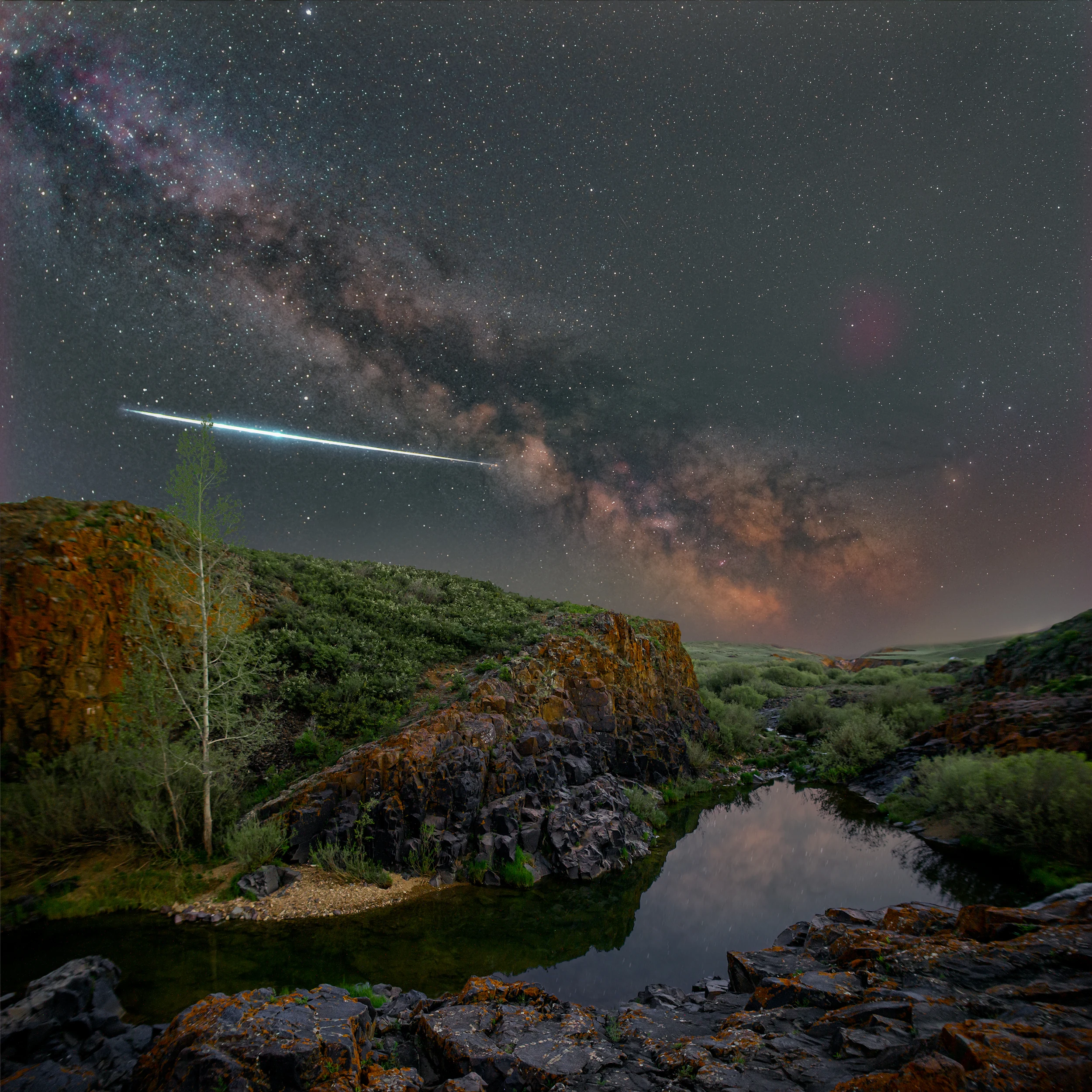
The single most useful thing I can tell you before the Perseids peak this week: leave the star tracker at home. For meteors you want the opposite of what a tracker gives you: a wide, fixed field of sky and a long run of short exposures, waiting for something to fall into frame. A camera, a fast wide lens, a sturdy tripod, and a cheap intervalometer will catch Perseids all night. That’s the whole kit.
The timing is as good as it gets. The 2026 peak is predicted for around 14:53 UTC on August 13, so the two best windows are the pre-dawn hours of August 12 and 13 (EarthSky’s meteor guide has the numbers). The Moon is new, which means no lunar glow washing out the faint ones. Under a dark sky EarthSky notes observers frequently report 90 meteors an hour or more at maximum. A new moon won’t line up with the Perseid peak again until 2045, so this is the year to point a camera up.
Why a tracker is the wrong tool here
A star tracker earns its keep on deep-sky targets. It rotates the camera at the sidereal rate to cancel Earth’s spin, letting you stack minutes of exposure on a nebula without the stars smearing into arcs. I wrote a whole guide to choosing one for Milky Way season, and I stand by every word of it, for the Milky Way.
Meteors are a different problem. A Perseid crosses the sky in well under a second (they hit the atmosphere at about 59 km/s, debris from comet 109P/Swift-Tuttle). You can’t plan for one, you can’t track one, and you don’t need a long exposure to record it: the streak writes itself in the fraction of a second it’s burning. What you need is coverage. As much sky as possible, exposed continuously, for as many hours as your battery and patience last. A tracker works against that. It keeps the stars pinned but drags any foreground (a ridgeline, a tree, the Troodos pines) into a blur, and it adds setup, alignment, and one more thing to drain power in the dark. For a meteor night, a locked-down tripod is simpler and better.
The kit
Four things matter, and none of them is exotic.
Your money goes on the lens. Wide catches more sky, so more meteors land in frame; fast (a large maximum aperture) lets the faint ones register. Aim for 14–24 mm on full-frame, or roughly 10–16 mm on APS-C, at f/2.8 or faster. A Samyang/Rokinon 14 mm f/2.8 is the classic budget entry at around $300, fully manual, which is fine here because you’re focusing by hand anyway. If you already own a 24 mm f/1.4 or a 20 mm f/1.8, use it wide open or stopped down a third of a stop. Kit zooms at f/3.5–5.6 will still record the brightest Perseids, but you’ll miss most of the faint ones.
The tripod is less a gear pitch than a warning. A flimsy travel tripod vibrates in the slightest breeze, and across a 20-second frame that turns every star into a fuzzy blob. Whatever you have, splay the legs low, hang your bag from the center column, and leave the thin bottom sections retracted if you can.
The accessory people skip and shouldn’t is an intervalometer. It fires the shutter back-to-back, all night, without you touching the camera. Many mirrorless bodies have one built into the menu (look for “interval timer” or “interval shooting”); if yours doesn’t, a generic wired remote runs about $20–30. Set it and walk away. Reaching over to start each frame both wastes meteors and shakes the shot.
That leaves power and dew. Continuous shooting eats batteries, so bring two or three, or a USB dummy battery run off a power bank. Dew is less of a problem in a Cyprus August than in northern Europe, but a $15 USB heater strap around the lens barrel is cheap insurance anywhere humid, and a lens hood helps.
Notice what’s not on the list: filters, a mount, an app, a laptop. Light-pollution filters in particular do almost nothing for meteors, which emit across a broad spectrum rather than in the narrow lines a duo-band filter isolates. I went into what those filters actually do from a Bortle 7 balcony; meteor photography isn’t the use case.
Settings that work
Shoot manual, shoot RAW. Then:
- Aperture: wide open, or one-third of a stop down if your lens is soft in the corners at maximum. On an f/2.8 lens, stay at f/2.8.
- ISO: 1600 to 3200. Under this year’s moonless sky you can push toward 3200 without the background blowing out. Brighter skies (a city balcony) want 1600 or lower.
- Shutter: 15 to 25 seconds. The limit is star trailing. The old rule of thumb divides 500 by your focal length (and by your crop factor) to get the seconds before stars visibly streak, so about 25 s at 20 mm on full-frame, longer as you go wider. High-resolution sensors trail a little sooner than that rule suggests, so if you’re pixel-peeping, back off a few seconds.
- Focus: manual, and get it exactly right, because a soft frame ruins the whole night. Switch to live view, magnify a bright star (Vega and Deneb are high overhead in August), and turn the focus ring until the star is the smallest, hardest point you can make it. Then tape the ring down. Autofocus will hunt in the dark and fail.
- White balance: set it around 3800–4200 K so the preview looks roughly neutral. You’re in RAW, so you’ll fine-tune it later regardless.
- Stabilization: off. IBIS or lens IS can introduce drift on a locked tripod.
That’s a setup you can dial in once and leave running for four hours.
Where to point
Not at the radiant. The radiant, the point in Perseus the meteors appear to stream from, climbs the northeast sky through the night. Aim straight at it and the meteors are flying toward you, so they look short and foreshortened. Point your camera 40 to 60 degrees away and a bit higher, and the same meteors show their full length as long streaks. Any dark quadrant of sky works; the summer Milky Way running down toward Sagittarius makes a good backdrop, and a low ridge or a lone tree along the bottom of the frame gives the shot scale. That reflected canyon and its bolide up top is exactly the kind of composition to aim for.
From my Bortle 7 balcony in Nicosia I’ll catch the fireballs and little else, too much skyglow for the faint ones to register. The real photographs come from the 40-minute drive up to Troodos, where the sky is dark enough that a 20-second frame fills with stars and the occasional Perseid cuts clean across it.
The one problem that’s specific to August here
Cold isn’t the enemy on a Mediterranean summer night. Heat is. A camera sensor left running for hours in 25–30 °C air builds thermal noise, a grainy speckle that gets worse the longer the sensor stays warm and the higher the ISO. There’s no filter for it. What helps: keep the ISO no higher than you need, give the camera a minute to breathe between long sessions if you can, and shoot a set of dark frames (same settings, lens cap on) at the end of the night to subtract that noise pattern in processing. I dug into why warm sensors misbehave in the piece on imaging at 35 °C; for meteors the short version is that thermal noise, not dew, is what you’re managing in a Cyprus August.
After the night: honest compositing
There’s one thing about these photos that quietly confuses people. That frame with a dozen meteors radiating out of Perseus is almost never a single exposure. It’s a composite: many frames from the same fixed camera, each contributing the one or two meteors that happened to fall during it, blended onto a single background sky. Free tools like Sequator or StarStaX will stack the frames and let you paint in the meteors; Photoshop with layers set to “lighten” does the same by hand.
Nothing about that is dishonest, as long as you say so. The meteors are real, shot from one position over one night. You’re collapsing time, not inventing streaks. Label it a composite in your caption and nobody who knows the craft will blink. Claim a 40-meteor single frame and every astrophotographer who sees it will know instantly.
Who should skip this
If all you have is a phone, don’t buy a rig for one night. A modern phone in night mode on a small tripod will catch a bright Perseid or two, and I walked through phone Milky Way shooting already. If what you actually want is deep-sky detail rather than meteors, that’s the tracker’s job, not this. And if you just want to watch, which is the better way to experience a meteor shower anyway, put the camera down and read the no-gear observing guide instead. A camera counts meteors; your eyes enjoy them.
For everyone in between, the fixed-tripod setup is genuinely all it takes. Set the interval timer, tape the focus, point away from Perseus, and let the sky do the work. NASA’s own meteor photography notes say much the same thing, minus the Cyprus heat. This is the best Perseid sky in years. Point a lens at it.