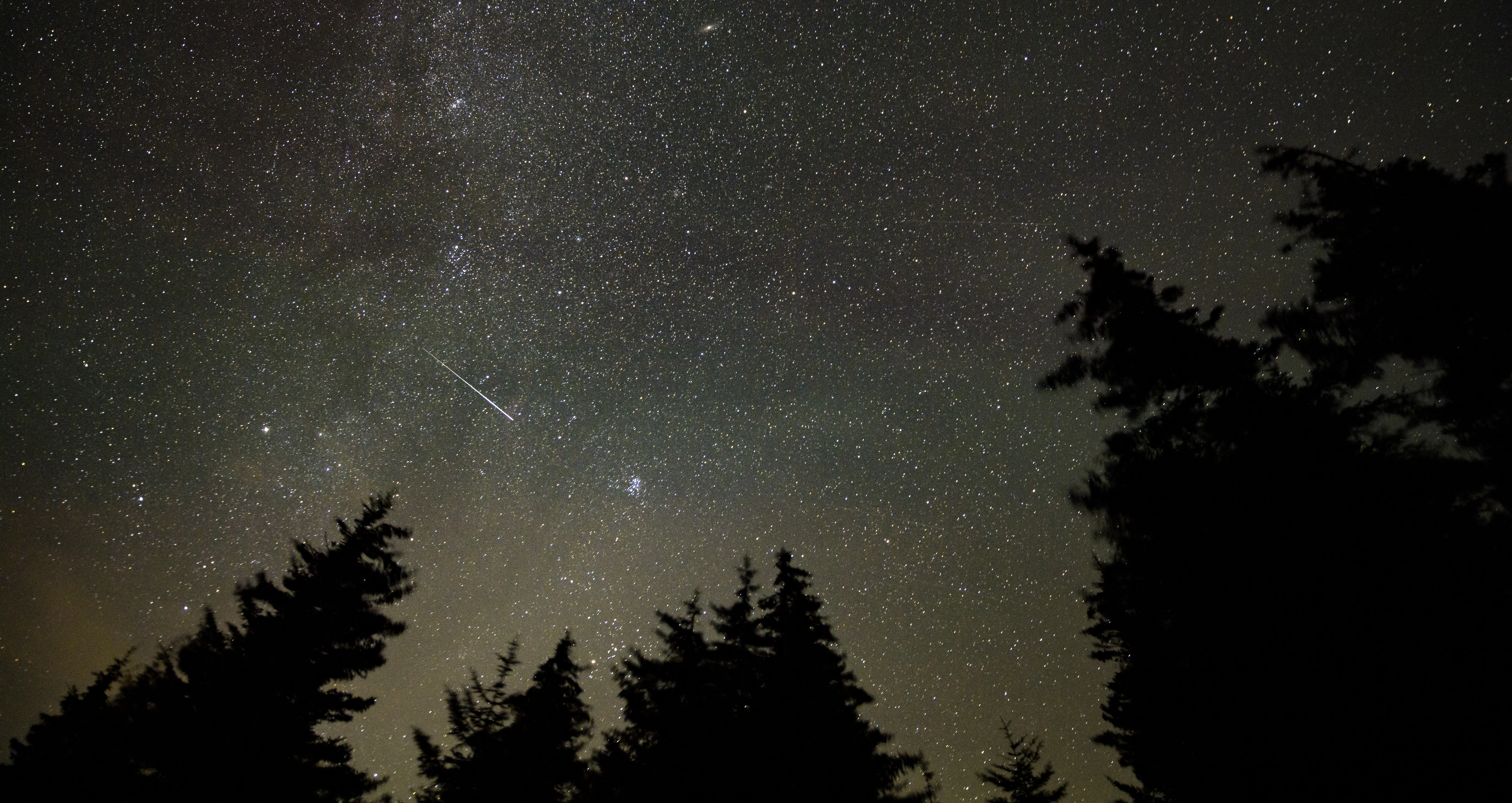
The 2026 Perseids peaked overnight on August 12–13 under a new moon, and I drove up to Troodos to catch the plateau’s rise before the sky brightened. The number first: in the darkest hour, with the radiant past 60° altitude, I counted just over 40 meteors. That’s not a storm, but it’s the most I’ve logged from a Perseid night since 2021, and the sky earned every one — no Moon, no haze, and a horizon dark enough to watch the Perseus radiant climb out of the northeast on its own.
If you read the preview I wrote two weeks ago, you know the pitch: a moonless maximum, the best background sky for this shower since 2021. That part delivered. One thing most previews glossed over, mine included: the numerical peak this year was timed for the Atlantic, not the eastern Mediterranean. First the night, then that catch.
The night, hour by hour
I set up near Mount Olympos, a little above 1,700 m, at a pull-off I’ve used before — Bortle 3–4, open to the north and east. Kit was deliberately minimal: a reclining chair, a red headlamp, and a camera on a fixed tripod running 15-second frames, the exact no-tracker setup I described on Tuesday. Meteor watching is still the one branch of astronomy where the best instrument is your own dark-adapted eyes.
- 22:30–23:30 local (EEST, UT+3). Radiant low in the northeast, maybe 25–30° up. Sparse: I counted 12 in the hour, but three were long, slow earthgrazers skimming almost parallel to the horizon, the kind you only get while the radiant sits low. Worth the early start on their own.
- 00:00–01:00. Radiant near 40°. The rate picked up to the low 20s. One fireball around 00:40 threw a brief green flash and left a train that hung for a second or two.
- 02:00–03:00. Radiant past 55°. Steady now, high 20s to low 30s, with a lull mid-hour that meteor watchers learn to expect. They arrive in clumps, not on a metronome.
- 03:15–04:15. The best hour. Radiant above 60°, sky at its darkest before astronomical twilight crept in around 04:35. I logged 41, several of them bright enough to read against the Milky Way.
I packed up as the eastern sky went from black to deep blue. And that’s the catch worth being straight about.
The peak was timed for the Atlantic
The International Meteor Organization placed the broad Perseid maximum across a long window — roughly August 12, 21:00 UT to August 13, 09:00 UT — with the richest hours near 02:00–04:00 UT on the 13th. Convert that to Cyprus time and the numerical peak lands at 05:00–07:00 local, which this far east is already twilight, then sunrise. The hours I could actually use, full darkness with the radiant climbing, sat on the rising side of that plateau. I caught the shower building, not cresting.
That’s geometry, not bad luck. Longitudes further west, the Atlantic and the Americas, had the dark peak hours land in their night instead. If you watched from the UK, Iceland, or North America and clocked higher numbers than I did, that’s why. Nothing was wrong with your sky or mine; we were standing at different clocks.
What “up to 100 per hour” actually meant this year
Every Perseid write-up quotes a ZHR — zenithal hourly rate — of up to 100. Two things bend that number down before it reaches your eyes.
The ZHR is a ceiling: it assumes the radiant is directly overhead and the sky is perfectly dark (limiting magnitude 6.5). Neither is ever quite true. A rough field estimate is
observed rate ≈ ZHR × sin(radiant altitude) × dark-sky factor
At 03:30, with the radiant near 62° and a Troodos dark-sky factor around 0.7, a nominal ZHR of 100 predicts about 100 × sin(62°) × 0.7 ≈ 62/hr. I saw closer to 40.
The gap isn’t a mistake on my part; it fits the second factor. Forecasters flagged 2026 as a leaner year for the stream. The headline “up to 100” is a good-year figure, and models had Earth crossing a thinner section of comet Swift-Tuttle’s debris, with the realistic nominal rate reported nearer 30–50 than 100. Run the same arithmetic with a ZHR of 45 and you get roughly 28/hr predicted, which brackets what I counted once you allow for a genuinely dark site nudging it up. The sky was excellent and the stream was ordinary. Both were true at once.
The Moon that did double duty
The reason the sky was that dark: the new moon fell at 17:37 UT on August 12, 0% illuminated and out of the sky all night. The same new moon, a few hours earlier and a third of the way around the planet, slid in front of the Sun to give Greenland, western Iceland, and northern Spain a total solar eclipse at sunset. One moon, two gifts on the same date: totality for the Atlantic edge of Europe by day, and a meteor sky with no lunar glare for the rest of us by night.
Moonless Perseid maxima aren’t common. The shower’s date and the Moon’s phase only line up like this on a roughly 19-year rhythm, so the next Perseid peak this free of moonlight won’t come round again until the mid-2040s. If you were clouded out, that’s the real cost, not next year’s return.
The physics, briefly
Perseids are debris from comet 109P/Swift-Tuttle, which loops the inner solar system about every 133 years: last through in 1992, back around 2126. Earth ploughs the same stretch of its trail every August. The grains, most no bigger than a sand grain, hit the top of the atmosphere at about 59 km/s and burn up near 100 km altitude. What you see is the glowing column of air they ionise, not the speck itself.
They stream from a radiant in Perseus, low in the northeast at nightfall and high by dawn, which is the whole reason the after-midnight hours beat the evening. Past midnight you’re on Earth’s leading side, sweeping head-on into the stream, and the radiant is higher, so more of the shower clears your horizon.
From a balcony in Nicosia
Not everyone drives two hours for a dark site, and you didn’t have to. Friends who watched from Nicosia balconies (Bortle 7, the sky I usually complain about) still caught a handful of the brightest per hour. The new moon helped them more than it helped me: in the city the Moon is often the only glare you can actually beat, and this year it was gone. If you used the no-gear plan from the beginner guide and saw six or eight good ones from a rooftop, that’s a normal city result. Nobody was getting 40 from inside the ring road.
What’s next
The calendar goes quiet on meteors for a couple of months. The Orionids, Halley’s other debris stream, peak around October 21 at a modest 20/hr. The one to circle is the Geminids on December 13–14, the richest annual shower at a nominal ZHR near 120, and unlike the Perseids they favour the whole night rather than only the pre-dawn hours. I’ll post moon conditions and a Troodos plan closer to the date.
For last night, the verdict is simple. The sky was the best this shower has offered since 2021, the rate was ordinary, and both of those can be true. I got just over 40 in a clean dark hour and a green fireball I’ll remember. From the eastern Med, on a leaner year, timed for someone else’s clock — I’ll take it.