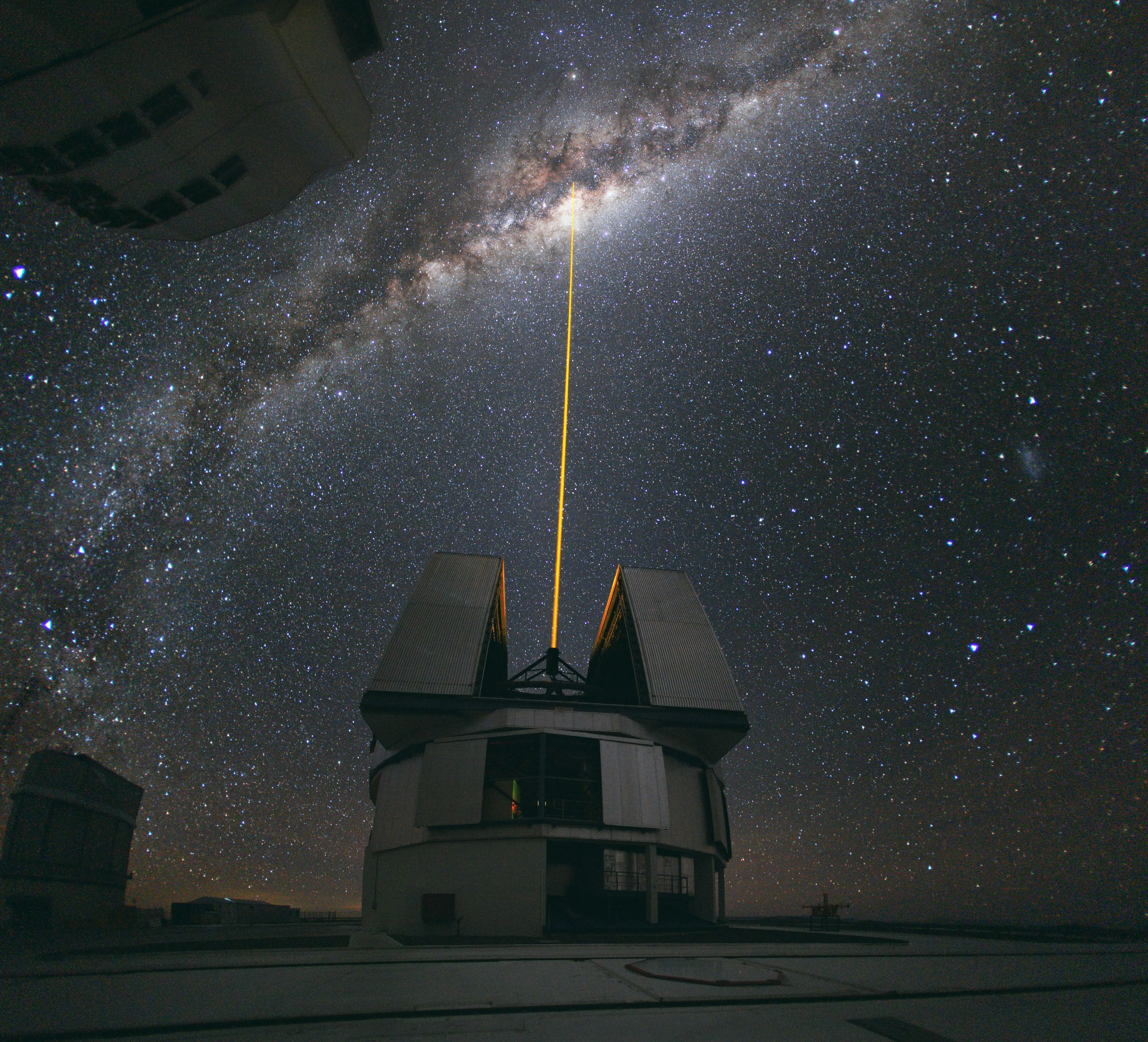
I observe from a balcony in Nicosia at 35° north, and there is an entire half of the sky I have never seen. Not “hard to see.” Never. The Southern Cross, the two Magellanic Clouds, Omega Centauri riding high instead of skimming the murk: from Cyprus these sit permanently below my horizon or crawl along it. The Atacama Desert in northern Chile is where I’d go to fix that, and if you observe from anywhere in Europe, it’s probably the single trip that would show you the most sky you’ve never had access to.
This is a practical guide: why the Atacama is the darkest place most amateurs can realistically reach, when to go, how to get to San Pedro, and which specific objects the trip buys a northern observer.
Why the Atacama and not somewhere closer
The town you base yourself in is San Pedro de Atacama, at about 2,400 m (2,408 m, to be exact) on the eastern edge of the driest desert on Earth. Three things stack up there in a way they don’t anywhere in Europe:
The darkness is Bortle 1 to 2, the black end of the scale, where the Milky Way casts a faint shadow and the sky background has no artificial glow at all. My home sky in Nicosia is Bortle 7. Even Troodos, my nearest real dark site, sits around Bortle 3–4 on a good night. The Atacama is a different category.
The air is dry. Humidity often sits below 20%, and the region gets more than 300 clear nights a year. Water vapour is what smears starlight and holds a town’s light pollution up as a glow; take it out and the transparency is something most of us only read about.
And the air is steady. The wind coming off the cold Pacific arrives smooth rather than turbulent, so the “seeing” (how much the atmosphere blurs a point of light) is among the best on the planet. That’s steadiness, separate from darkness, and it’s why planets and double stars hold detail through a telescope here that they never do from a rooftop.
You don’t have to take my word for the sky quality. The professionals voted with concrete. Northern Chile hosts the densest cluster of major observatories anywhere: the Very Large Telescope on Cerro Paranal, ALMA’s array on the Chajnantor plateau at 5,000 m, La Silla, Las Campanas, and, on Cerro Pachón, the Vera C. Rubin Observatory that just started churning out its first survey data. The Extremely Large Telescope is rising on Cerro Armazones next door to Paranal. When that many billion-dollar instruments pick the same strip of desert, the sky is telling you something.
A quick, honest caveat about the big observatories
If you’re picturing an evening at the eyepiece of the VLT, set that aside now. The professional observatories are working scientific sites, not night-tour venues. Paranal runs free guided visits on Saturdays, but only during the day. You tour the facility and the mirror, not the sky. ALMA does the same on weekends, with a bus leaving San Pedro around 09:00. Both are worth doing for the engineering. Neither is stargazing.
Actual night observing in the Atacama runs through commercial operators outside San Pedro, plus your own eyes from any dark spot past the edge of town. The best-known operator is SPACE (San Pedro de Atacama Celestial Explorations), set up in 2003 by Alain Maury, a French astronomer who spent years hunting asteroids and comets before moving south. It sits about 10 km out of town with a rack of telescopes, and runs English, French and Spanish tours on clear nights (they pause around full moon, for the obvious reason). Other operators list through platforms like GetYourGuide and Viator. Book one night guided to get oriented, then spend the rest with a chair, a blanket and no screen.
What 23° south actually buys you
Here’s the geometry that makes the trip worth a 14-hour flight. San Pedro sits near 23° south. From Nicosia at 35° north, any object south of about −55° declination never clears my horizon at all. The number is just 90 minus your latitude. Cross that line and the sky is off-limits from Cyprus, from Greece, from most of Europe, forever. The Atacama flips it: the whole southern cap swings up into view, and the objects clustered down there are some of the best in the sky.
The Magellanic Clouds. Two satellite galaxies of the Milky Way, naked-eye, hanging in the south like detached pieces of the band itself. The Large Magellanic Cloud is roughly 160,000 light-years away, the Small around 200,000. At declinations near −70° they’re circumpolar from the Atacama, up every clear night, all night. From my latitude they don’t exist. This alone is worth the airfare.
The Southern Cross and the Centaurus pointers. Crux sits near −60° declination and Alpha Centauri near −61°, so both fall below my −55° cutoff and never rise from Cyprus. Alpha Centauri isn’t just a bright star; it’s the nearest star system to the Sun, 4.4 light-years out, and it splits into a lovely gold pair in any small scope.
Omega Centauri. The largest and brightest globular cluster in the Milky Way, around 17,000 light-years away, packed with millions of stars. It has a declination near −47°, so technically it grazes about 7° above my southern horizon at best, a faint smudge fighting through two magnitudes of horizon haze. From the Atacama it climbs to 65° up, a grainy ball that starts resolving into individual stars in a 20 cm telescope. Same object, completely different experience.
The Eta Carinae Nebula. A star-forming region several times the size of the Orion Nebula on the sky, wrapped around one of the most unstable massive stars we know of. At around −60° declination it’s invisible from Cyprus too, and a genuine showpiece from the south.
The galactic center overhead. From Nicosia the core of the Milky Way in Sagittarius culminates around 26° up, low, always fighting the southern horizon. It’s the target I keep chasing every summer; I wrote a whole naked-eye guide to squeezing it out of a Mediterranean sky. At 23° south it passes nearly at the zenith, around 84° up. You lie back and the brightest, most detailed stretch of our galaxy is directly above you, dark rifts and star clouds and all. This is the view that people who make the trip talk about for years.
The only other place I’ve written about with a comparably open southern sky is NamibRand in Namibia, at 25° south: same hemisphere, same payoff, different continent. If you’re weighing the two, the Atacama wins on dryness and on the observatory infrastructure nearby; Namibia wins on lodges built for astronomers and, for many, on cost.
When to go
The Atacama is a dry-season target. Aim for roughly April through November, when the desert is at its driest and clearest. The sweet spot is the southern winter, June to September: coldest nights, lowest humidity, and the galactic center high in the evening rather than after midnight. “Coldest” is real: night temperatures at altitude can sit around −10 °C, so this is a down-jacket-and-gloves trip, not a t-shirt one.
The one window to avoid is the invierno altiplánico, the “Bolivian winter,” a summer monsoon that pushes moisture and cloud onto the high plateau, mostly across late December to February. It’s the wettest, least reliable stretch for the sky, exactly opposite to the northern-hemisphere intuition that summer means clear nights.
Then layer the Moon on top. Pick a week bracketing new moon and you get the Magellanic Clouds and the galactic center against a truly black background; land on a full moon and you’ve flown a very long way to see a washed-out sky. Mid-August 2026, as it happens, is a decent window: dry season, and the Moon is new around the 12th, which is also why the cover photo above was shot here in mid-August. Check a Moon-phase calendar before you book flights, not after.
Getting there and staying
You don’t fly to San Pedro. You fly to Calama (El Loa Airport, code CJC), which connects through Santiago, and then it’s about 100 km and a 75-minute drive southeast to San Pedro. Shared transfers and rental cars both work; the road is paved and straightforward.
San Pedro itself, at 2,400 m, is a mild altitude. Most people feel a little breathless the first day and are fine after that. The excursions are where altitude bites. The El Tatio geyser field sits around 4,300 m, and the ALMA plateau tops 5,000 m, so give yourself a day or two in town to acclimatise before anything high, and go easy on alcohol the first night. It’s a small adobe town built for tourism, so lodging runs from hostels to a few properly dark desert lodges outside the grid of streets; the further out you stay, the less town light you fight.
What to actually pack for the sky
Warm layers first. The cold is the thing people underestimate. A red headlamp to protect your dark adaptation, which takes a full 30 minutes to build and one white phone screen to destroy. Binoculars earn their place more here than anywhere: 10×50s on the Magellanic Clouds and the Sagittarius star clouds are, for my money, a better first night than any telescope. If you’re bringing a camera, a fixed tripod and a fast wide lens will pull the Milky Way core out easily at this darkness, no tracker needed for short exposures.
You don’t need to haul a telescope across the Pacific. Book one guided night for the big glass and local knowledge, then let your own eyes do the rest. A Bortle 1 sky doesn’t ask for equipment. It asks you to lie down, look up, and stay out long enough for your eyes to catch up to where you are. If you’ve spent your observing life at 35° north, that’s a genuinely new sky.