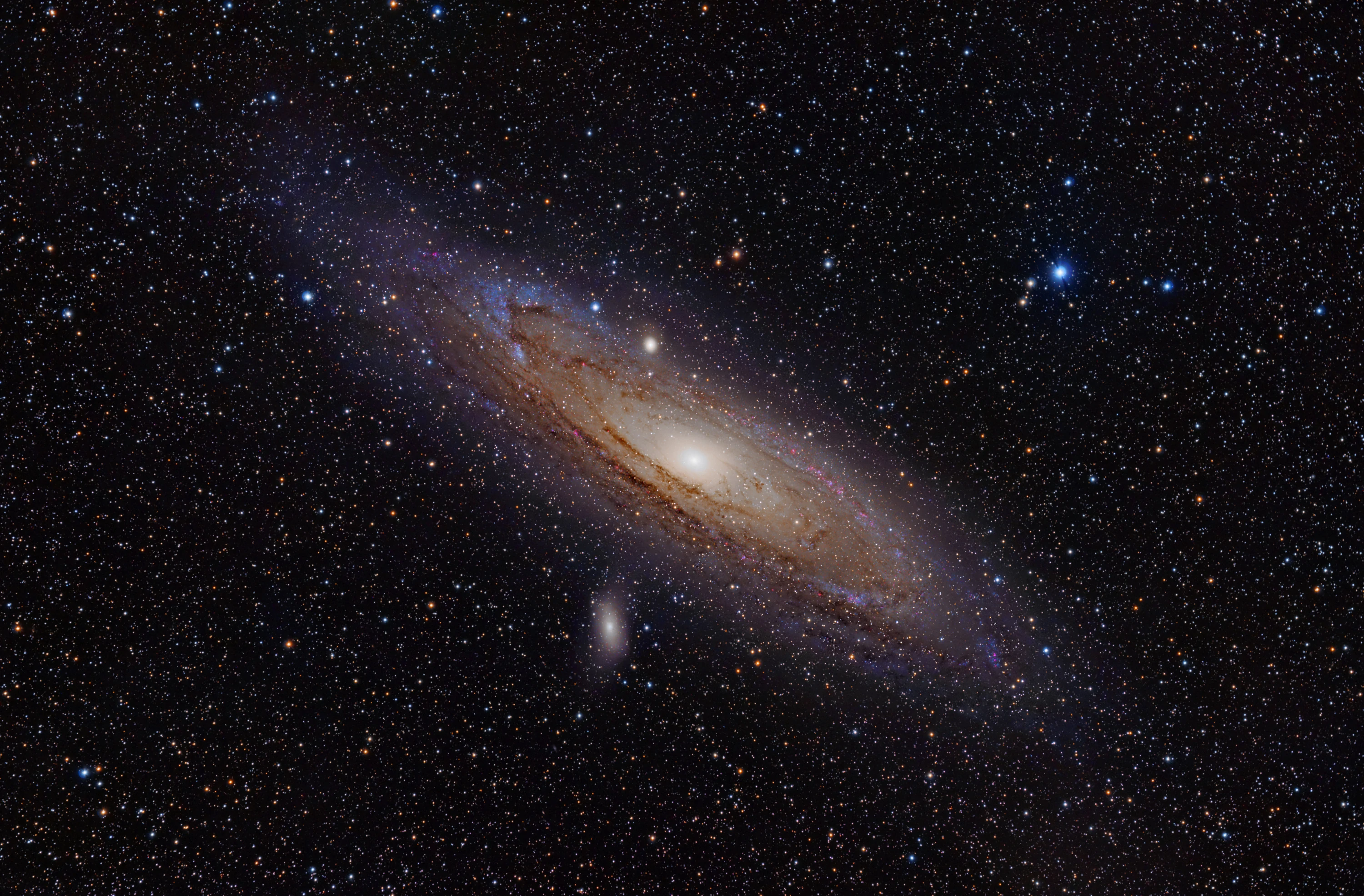
The most distant thing you can see without any equipment is a galaxy 2.5 million light-years away, and autumn is the season to find it. The Andromeda Galaxy (M31) climbs into the evening sky through September and October, and from a reasonably dark spot it looks like a small, elongated grey smudge in the constellation Andromeda. No telescope, no binoculars, no app subscription. Just your eyes, a little patience, and knowing where to point them.
I want to be honest about that smudge before you go out, because the gap between the photograph at the top of this page and what your eye actually registers is where most beginners give up. The cover image is a long exposure through a hydrogen-alpha filter. Your eye is not that. What you’ll see is a faint oval of grey light, brightest in the middle and fading at the edges — closer to a thumbprint on a dark window than to a swirl of spiral arms. Once you know that’s the target, it’s easy. If you’re waiting for the postcard, you’ll walk right past it.
What you’re actually looking at
M31 is the nearest large spiral galaxy to our own, at roughly 2.5 million light-years; the most-cited figure is about 2.537 million ly. Its integrated apparent magnitude is around 3.4, which on paper is brighter than plenty of stars you can see easily. The catch is that this brightness is smeared across a big patch of sky. The full galaxy spans about 3°, roughly six times the width of the full Moon, so its light is diluted over a wide area. That’s why a magnitude-3.4 point would be obvious while magnitude-3.4 spread this thin needs a dark sky and a bit of technique.
To the naked eye you don’t see the whole 3°. You see the bright central bulge, maybe a degree of it on a good night, as a soft elliptical glow. It contains something like a trillion stars, and the photons landing on your retina tonight left it about 2.5 million years ago, before our species existed. That’s the part I still find hard to sit with: you’re not looking at a picture of the past, you’re catching the actual ancient light.
When to look this autumn
Andromeda is a northern-sky object (declination about +41°), which makes it a treat from mid-northern latitudes. From Cyprus at 35°N it passes almost straight overhead, near 84° altitude, so it clears the worst of the horizon murk.
- Late August: M31 rises in the northeast in mid-evening and is well up by the small hours. If you’re out for the tail end of summer’s Milky Way, look northeast after midnight.
- September–October: it rises earlier and is high in the east by mid-evening. This is the sweet spot: dark by a civil hour, galaxy already well-placed.
- November onward: high overhead in the evening, the easiest it gets all year.
Pick a night when the Moon is out of the way. A bright Moon washes the contrast out of a diffuse object faster than it hurts stars. And get away from direct lights. You don’t need a mountain; you need to not be staring at a streetlight.
Two ways to star-hop to it
Andromeda has no bright star sitting on top of it, so you find it by hopping from a pattern you already know. Two routes work reliably. If you’ve done the Big Dipper star-hops, the method here is identical: anchor on a shape, measure with your hand, move.
Your hand is the ruler. At arm’s length, a closed fist covers about 10° of sky, three fingers about 5°, and the tip of your little finger about 1°.
Route 1: down from Cassiopeia. In the northeast, find Cassiopeia: five bright stars in a lopsided “W” (or “M”, depending on the hour). One of the two V’s in that zigzag is deeper and more pointed than the other. That sharper V works like a crude arrowhead. Follow the direction it points, about 15° (a fist and a half), and you’re in Andromeda’s neighbourhood. Cassiopeia is bright and unmistakable even from a city, which is why I reach for this one first from the balcony.
Route 2: the Mirach hop. This is the classic, and it’s the one I trust in a darker sky. Find the Great Square of Pegasus, a large near-empty box of four stars. The star at its northeast corner is Alpheratz, which technically belongs to Andromeda. From Alpheratz, two gentle chains of stars curve off toward Perseus. Follow the brighter chain to the second prominent star: that’s Mirach (β Andromedae, about magnitude 2). At Mirach, make a right-angle turn toward Cassiopeia and step to the next moderately bright star (μ And), then one more short step to a fainter one (ν And). The smudge sits just past ν And. Mirach → μ → ν → galaxy: once you’ve done it twice, your hand remembers it.
If you’re not sure which way is which up there, the Summer Triangle is still high overhead in early autumn and makes a good starting landmark to get your bearings before you swing northeast.
The technique that actually reveals it
Finding the right patch of sky is only half of it. The other half is your eyes.
Give yourself time in the dark. Full dark adaptation takes 20–30 minutes, and the difference is not subtle. A smudge that’s invisible when you step outside becomes plainly there once your rod cells wake up. Keep phones and headlamps off, or use dim red light.
Then use averted vision. Don’t stare straight at where the galaxy should be; look a little to the side of it. The centre of your retina is packed with cone cells that are lousy in the dark, while the rod cells that pick up faint grey light sit off-centre. Look slightly away and the smudge brightens in your peripheral vision; look right at it and it fades. It feels backwards the first few times. It works every time.
From my balcony in Nicosia (Bortle 7, city glow in three directions) M31 is a marginal naked-eye target: on the clearest, most transparent nights I can just hold it with averted vision, and on hazy ones it’s gone. Drive up to Troodos, though, and at Bortle 3–4 it’s an obvious elongated glow you can trace well past the core. Same galaxy, same eyes; the sky is the whole game.
If you want more than a smudge
A pair of 10×50 binoculars turns Andromeda from a faint patch into something with structure. The core brightens and the oval stretches noticeably, and on a good dark night you can pick out the two brightest companion galaxies, M32 and M110, as small separate glows flanking it. Binoculars are, honestly, the best value upgrade in all of stargazing; I make the binoculars-versus-first-telescope case at length elsewhere, and Andromeda is exhibit A.
A small smart telescope or a camera on a tripod is a different experience again: a 10-second exposure starts to pull the spiral arms and the reddish hydrogen regions out of the dark, the kind of detail in the cover image. That’s what a sensor stacks up over time. Your eye can’t integrate like that, and that’s fine. The naked-eye view is a different kind of thing: not detailed, but real-time and 2.5 million years deep.
The collision story, updated
You’ve probably heard that the Milky Way and Andromeda are on a collision course, destined to merge into one galaxy in a few billion years. That was the textbook line for over a decade. It’s now less certain than it sounds.
A 2025 study led by Till Sawala, published in Nature Astronomy (preprint here), reran the orbital calculation while properly accounting for the pull of other Local Group members, chiefly M33 and the Large Magellanic Cloud. Their result: only about a 50% chance the two galaxies merge within the next 10 billion years. A direct head-on collision comes out at under 2%. NASA and ESA summarised it as going “from near-certainty to a coin flip.” The old “our galaxies will collide” story isn’t wrong so much as overconfident — the honest version is that we don’t yet know.
None of that changes what you’ll see tonight. It’s still a grey oval near Mirach. But it’s a grey oval whose fate is an open question, which I think makes it more worth the walk outside, not less.
The short version
Wait for a dark, Moon-free night. Get clear of direct lights and give your eyes half an hour. Find Cassiopeia’s “W” in the northeast, or run the Mirach hop from the Great Square of Pegasus. Look slightly to the side of the target. When a faint elongated glow settles into your peripheral vision and holds, that’s it — the farthest thing a human can see unaided, and you found it with nothing but your own two eyes.