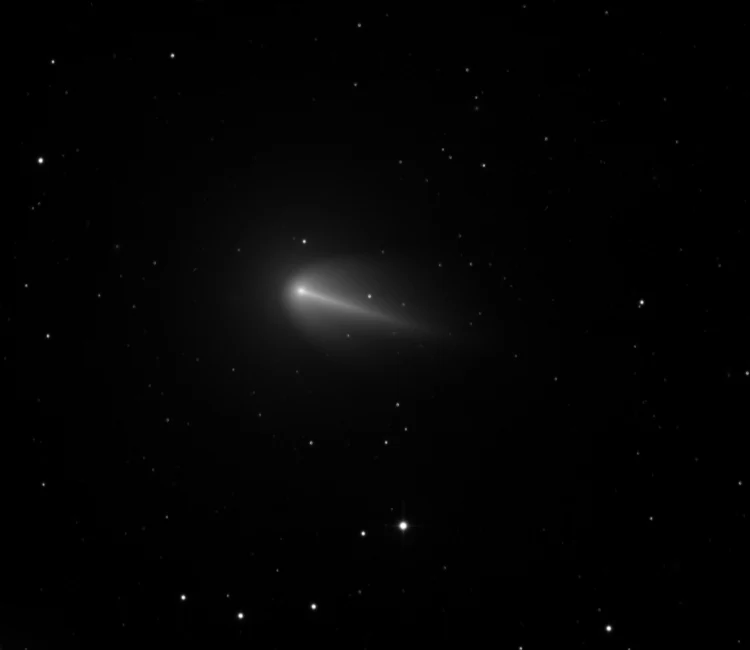
There’s a comet in the pre-dawn sky right now that most people will never hear about, because it isn’t the kind that makes the news. Comet 220P/McNaught is a small periodic visitor that has done something unusual twice this summer: it blew up. Two separate outbursts, in late May and again on August 5, dragged a 17th-magnitude speck up into binocular range. In mid-August it was sitting around 6th to 7th magnitude, low in the constellation Cetus before sunrise: a binocular object under a dark sky, and already fading. If you want it, this is the week to try.
I haven’t caught 220P myself yet; the last few mornings in Nicosia have been hazy down toward the horizon where it lives. So this is the plan I’m working from and the numbers behind it, not a field report. For that, here’s what I actually saw from an earlier comet that got more hype than it deserved.
Two outbursts, three months apart
Robert McNaught found this comet on 2004-05-20 from Siding Spring in Australia, as a roughly 17th-magnitude smudge on survey images. It was the first of 18 comets he’d go on to discover. It’s a Jupiter-family comet: a short, 5.51-year orbit shaped by Jupiter’s gravity, passing perihelion this time on 2026-06-14 at 1.56 AU from the Sun, just beyond the orbit of Mars. On a normal apparition it never gets anywhere near an amateur’s reach. You’d need a big telescope and a reason to look.
Then, around May 30–31, it flared. Reported visual estimates had it jumping from about magnitude 18 to magnitude 11, a 600-fold brightening, with some observers putting a peak near magnitude 8. It faded back over the following weeks, as outburst comets do, and that looked like the end of the story.
On August 5 it went off again. This time it climbed from roughly magnitude 13–14 back to the edge of naked-eye brightness. An observer in Yamaguchi, Japan reported it at magnitude 6.8 in 8×42 binoculars on August 5.78 UT, with a coma about 7 arcminutes across. Over the next few days the coma grew to around 7.5 arcminutes with a short tail near 21 arcminutes. Two outbursts in one apparition from a comet that’s usually invisible is genuinely rare. It’s the kind of thing that gets photometrists out of bed.
And the two eruptions weren’t the same. Astronomers at Bulgaria’s Rozhen Observatory reported that the August event was dust-dominated, chemically distinct from the gas-rich May outburst. The likeliest picture: a pocket of volatile ice under the crust heats up, flashes to vapour, and punches out a plume of dust that spreads and catches sunlight. More reflecting surface, more brightness — until the dust disperses and the comet settles back down.
A quick note on the numbers, because they run backwards: on the magnitude scale, smaller means brighter, and each step of 1.0 is about 2.5× in brightness. A good dark-sky naked-eye limit is around +6. Even at its August peak of +6.8, 220P stayed a binocular comet, too faint to trip over with your eyes alone.
Why the photos are green
If you look at recent images, including the one at the top of this post, you’ll see the coma glowing green in colour shots. That colour is diatomic carbon: C₂ molecules in the coma fluorescing in sunlight, the same Swan-band emission that tinted the well-known green comets of the last few years. Your eye won’t see it. At 7th magnitude the coma reads as a flat grey smudge in binoculars; the green only shows up on a camera sensor stacking many seconds of light. Worth knowing before you get to the eyepiece and wonder where the colour went.
How bright is it tonight? Check before you drive
Here’s the honest part. This is a fading outburst, and outbursts don’t hold. The May event dropped off within a couple of weeks, and the August one has been following the same downward track. A COBS observation was logged as recently as August 14, so it’s still being watched, but the trend is down. In mid-August it was still around 6th to 7th magnitude. By the time you read this it has almost certainly slipped fainter, which is exactly why a fixed number in a blog post is useless to you.
So do this: before you set a 03:30 alarm, pull a live magnitude estimate. The COBS Comet OBservation database collects visual estimates from observers worldwide, usually within a day or two. Search it for 220P. TheSkyLive’s 220P page gives a current position and brightness estimate. Seiichi Yoshida’s comet site is the other standard reference for what’s up and how faint it’s getting. If the latest visual estimates are down around magnitude 9, this becomes a small-telescope target and a binocular sweep from a light-polluted spot is a waste of a morning.
Finding it from 35°N
220P is tracking through Cetus, the sea monster (a big, dim autumn constellation), near the 4th-magnitude star Mu Ceti. Cetus rises in the east well after midnight in August, so this is firmly a pre-dawn hunt: the comet is best placed in the roughly four hours before sunrise, once it’s climbed clear of the horizon murk into the southeastern sky and before morning twilight washes it out. From Cyprus that means a window around 03:00 to 05:00 local.
A comet moves against the stars, and this one shifts a noticeable amount night to night, so don’t try to memorise a position. Generate a dated finder chart for your exact morning in Stellarium or on TheSkyLive. As a rough orientation: find the Great Square of Pegasus high in the south before dawn, then work down toward the horizon into the faint sprawl of Cetus below it. The comet sits in that region near Mu Ceti. In binoculars, sweep slowly. A comet looks like a small out-of-focus star that refuses to snap to a point no matter how you adjust. That fuzziness is the giveaway.
Gear-wise, 7×50 or 10×50 binoculars are the right tool: enough aperture to gather the light, a wide enough field to sweep the area without getting lost. A small telescope will show the shape of the coma and maybe some asymmetry from the expanding dust shell, but it narrows your field and makes the initial find harder. Skip anything smaller than 50 mm binoculars for a target this faint.
Two things are working in your favour this week. The Moon reaches first quarter around August 20 and sets near local midnight, so the pre-dawn hours stay dark, with no lunar glow to fight. And the sky itself: at 6th to 7th magnitude, this is a comet that needs a genuinely dark horizon. From my Bortle 7 balcony in Nicosia I’d rate my odds as poor. This is a drive-to-Troodos target, where the mountain sky gets dark enough for a faint smudge low in the southeast to actually register. Give your eyes the full 20 to 30 minutes to dark-adapt before you decide you can’t see it. A fresh-from-the-car retina will miss it every time.
Is it worth the alarm?
Set your expectations at the right level and it is. You’re not going to see a bright head and a sweeping tail hanging over the mountains. You’re going to see a faint grey blob, a little softer than the stars around it, that took a 5.5-year orbit and two ice explosions to put within reach of a pair of binoculars. That’s the appeal. A dead-looking periodic comet blew its lid twice in one summer, and for a couple more mornings you can go out and confirm it with your own eyes.
If you’ve never tracked a comet before, an outburst object near a findable star is a good first one, precisely because the challenge is real and the payoff is earned. Check COBS the night before. Point the car at Troodos. And if the estimates say it’s dropped below a comfortable binocular limit by the time you read this — that’s the deal you make with outburst comets. They give you a narrow window and then they close it.