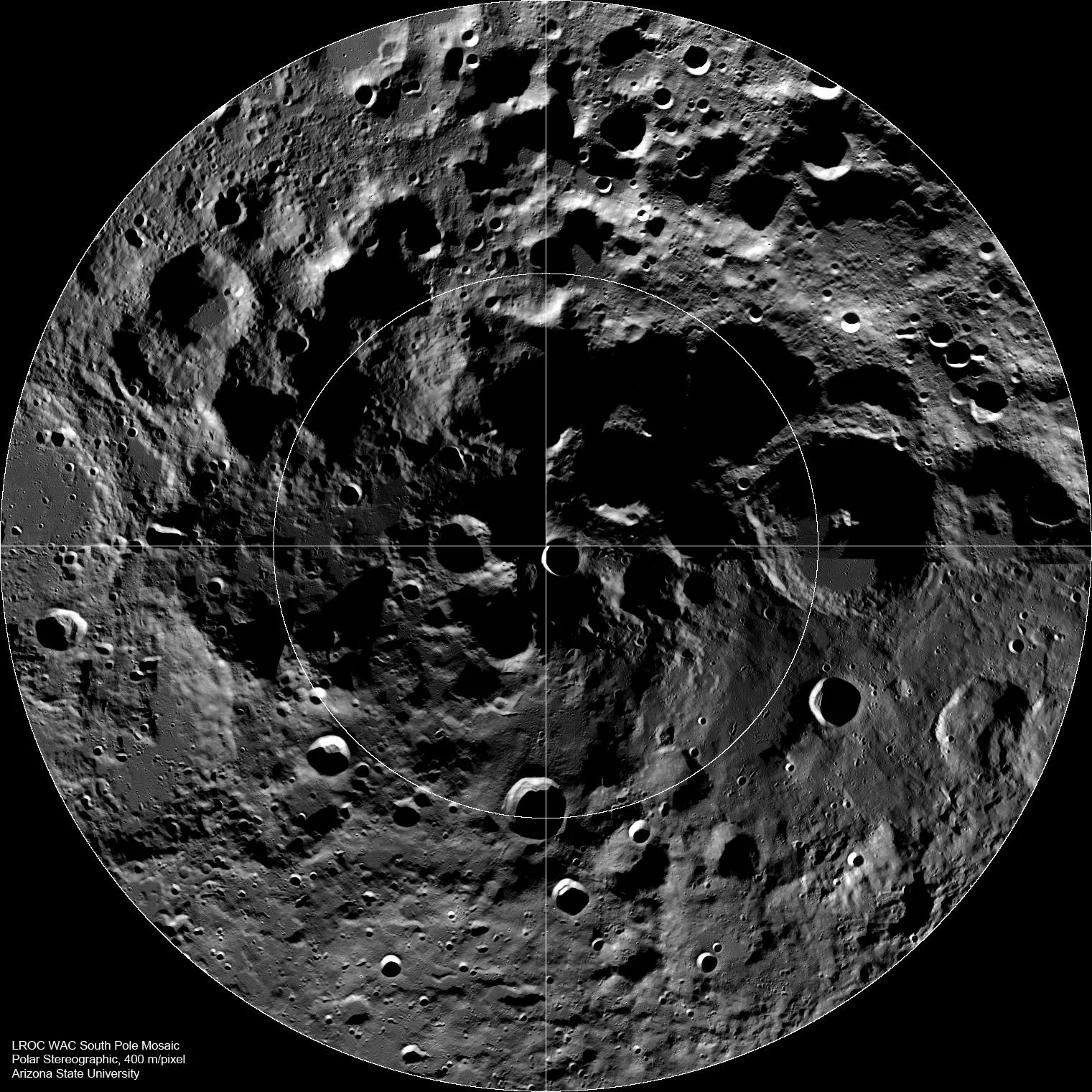
This weekend China sends its most complicated Moon mission yet toward the one patch of lunar ground everyone now wants. The launch window for Chang’e 7 opens on the morning of August 24 Beijing time (late Sunday, August 23, in the Americas) on a Long March 5 out of Wenchang. Sitting on top isn’t one spacecraft but four: an orbiter, a lander, a rover, and a six-legged robot built to jump into craters that haven’t seen sunlight in billions of years and drill for ice.
The launch itself is the least interesting part. Getting the stack to lunar orbit takes about six days, and the landing attempt isn’t until around November. That makes Sunday the opening move, with the science payoff months away. But it’s aimed at the most contested real estate off Earth, and the hardware going there does something no spacecraft has done before.
What’s actually launching
Chang’e 7 is a four-part system. The orbiter carries eight of the mission’s instruments and doubles as a remote-sensing platform once it arrives. It releases a lander that will attempt a touchdown near the lunar south pole, and the lander delivers both a rover (built on the same Yutu chassis lineage as the earlier Chang’e rovers, with a ground-penetrating radar to look under the regolith) and the piece that makes this mission worth writing about: a small hopping detector.
In all, the mission flies 21 scientific payloads, six of them contributed by other countries and organisations: a joint hyperspectral imager from Egypt and Bahrain, an Earth-radiation spectrometer from Switzerland’s Davos observatory, a space-weather sensor from Thailand, a laser retroreflector from Italy’s National Institute for Nuclear Physics, a dust and electric-field probe from Russia, and a small astronomical telescope from the International Lunar Observatory Association. Communications run through Queqiao-2, the relay satellite already parked in lunar orbit since 2024.
Why the south pole, and why ice is hard to confirm
The Moon’s spin axis tilts barely 1.5° from the plane of its orbit around the Sun. Near the poles that means the floors of some deep craters never catch a sunbeam. These are the permanently shadowed regions, or PSRs, and they work as cold traps. NASA’s Lunar Reconnaissance Orbiter has measured spots inside them at only a few tens of kelvin, among the coldest surfaces anywhere in the solar system. Any water molecule that wanders in, delivered over billions of years by comet and asteroid impacts or cooked out of the soil by the solar wind, freezes onto the floor and effectively never leaves.
That’s the theory, and the indirect evidence is strong. Orbital neutron spectrometers see a hydrogen signal at both poles. In 2009 NASA’s LCROSS mission slammed a spent rocket stage into Cabeus crater and found water in the debris plume. What nobody has ever done is land in one of these places and dig. “There has never been a landed mission to find water,” planetary scientist Norbert Schörghofer told Scientific American. Everything we think we know about polar ice, we know from orbit or from a single deliberate crash.
The closest anyone has landed is India’s Chandrayaan-3 in 2023, at about 69° south. That sounds polar, but it’s still roughly 640 km short of the pole itself. That’s the high-latitude equivalent of landing in Cyprus and claiming you’ve reached the Arctic. Chang’e 7 is aiming for 88.8° south.
The hopper is the new idea
A PSR is a miserable place to send a rover. No sunlight means no solar power, and the cryogenic cold kills batteries and electronics fast. Instead of driving into the dark, Chang’e 7’s detector flies in. It fires a small thruster, hops up to 15 kilometres across the surface, and sets down on six legs inside a shadowed crater. Once there it crawls a short distance to reach ground that its own landing plume didn’t disturb, drills into the regolith, and runs a mass spectrometer tuned to water molecules and hydrogen isotopes, looking for water ice, methane and other frozen volatiles.
Then, in principle, it hops back out into sunlight to recharge and try another crater. If it works, it’s the first craft to sample the inside of a permanently shadowed region directly, rather than inferring what’s there from a bright neutron count or an impact flash seen from above. The hydrogen-isotope part is the clever bit: the ratio of deuterium to ordinary hydrogen in the ice is a fingerprint that can point to where the water came from: comets, the solar wind, or the Moon’s own interior.
Power next door to the shadow
The lander won’t touch down in the dark. Its target is a sunlit ridge: a peak near the southeastern rim of Shackleton crater, a 21 km pit whose rim grazes the pole. That’s deliberate. On these polar ridges, near-continuous sunlight for solar panels sits only a short hop from floors of permanent shadow. Power on one side, ice on the other. The lander is built to put itself down inside an ellipse smaller than 100 metres, which is tight for a body arriving from lunar orbit.
This is the same logic driving NASA’s Artemis III site selection and the commercial CLPS landers: everyone wants the sunlit high ground beside the cold traps. Two programs are now converging on the same few kilometres of ridge, because the prize is the same. Water ice at the poles means drinking water, breathable oxygen split out of it, and hydrogen-oxygen propellant you don’t have to haul up out of Earth’s gravity well. Chang’e 7, together with Chang’e 8 around 2029, is China’s groundwork for a robotic research station near the pole and a crewed landing in the 2030s.
What you can and can’t see from here
None of this is observable from a backyard, and that’s the whole point. From Earth the Moon’s south pole sits right on the limb. Libration, the slight monthly rocking of the Moon’s face toward and away from us, tips the pole in our direction by at most six or seven degrees, and even at best you’re looking across the pole at foreshortened, overlapping crater rims, not down onto the floors. The PSRs are never lit — by definition there is no light coming out of them to catch, at any aperture, ever.
From my balcony in Nicosia the Moon’s southern edge is a jumble of rims stacked edge-on; the Seestar resolves the big craters fine but can’t tell you a thing about what’s on a shadowed floor 88° south. No telescope on Earth can, because the problem isn’t resolution — it’s that a shadow has no photons to give. That’s exactly why you send a lander. The one region we most want mapped for water is the one region our instruments down here physically cannot reach.
There’s a small twist I like. One of those 21 payloads, the observatory association’s telescope, is an actual astronomical instrument that will observe the sky from the lunar surface once it’s down. Astronomy from the Moon, not of it — a preview of what a permanent south-pole base might eventually do for the rest of us.
What to watch
If you enjoy a good rocket climb-out, the Long March 5 lifting off Sunday is worth catching on a stream. But the date to circle is November, when Chang’e 7 tries to set a lander, a rover and a hopping robot down within 100 metres of a ridge at 88.8° south. That’s when the real question, whether there’s ice you can actually dig and where it came from, starts getting answered from the ground instead of from orbit. For the full instrument list and mission design, China’s own payload paper in National Science Review is the primary source; I’ll post a follow-up if the landing sticks.