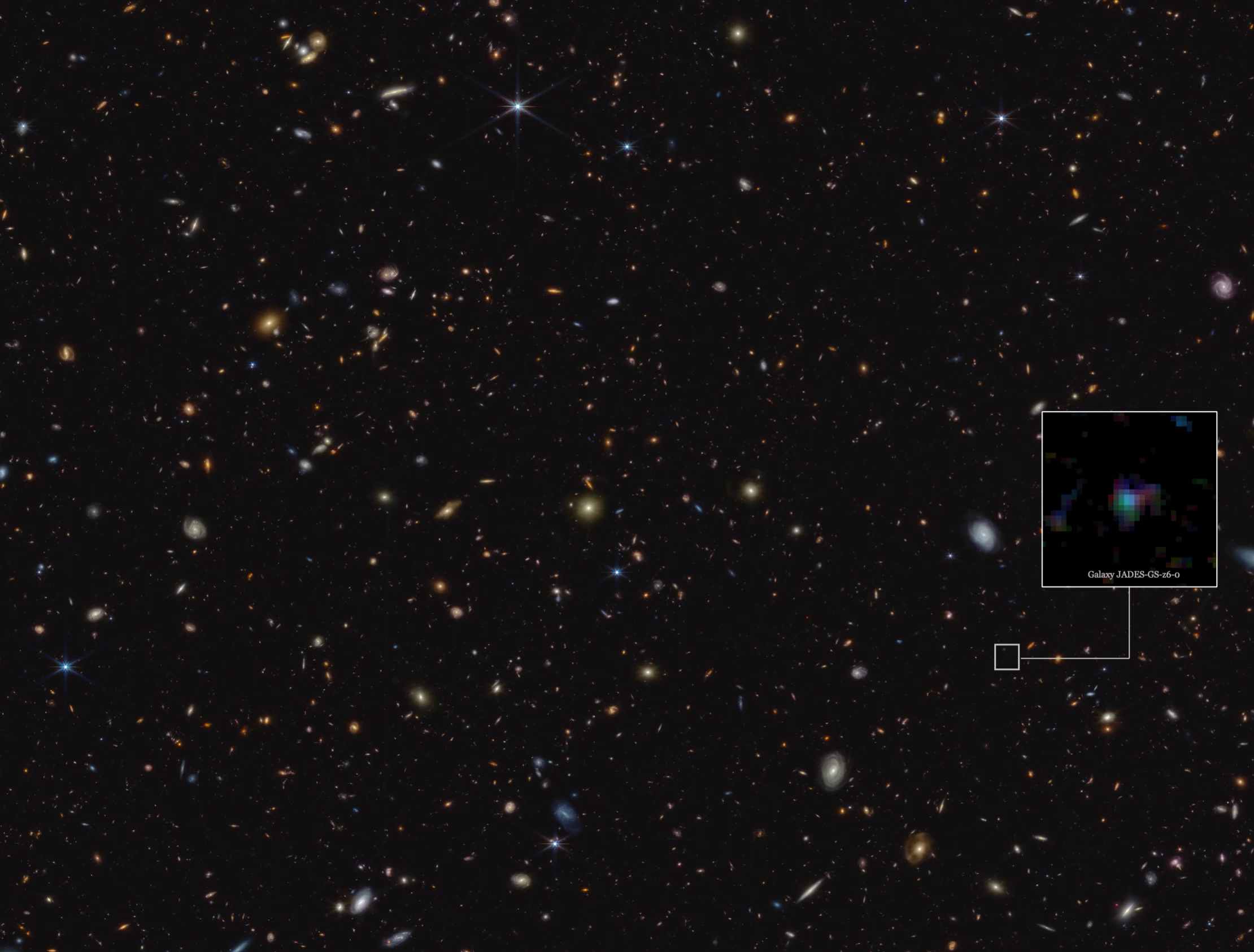
When you weigh a galaxy, you’re really weighing its light. Point a telescope at an elliptical galaxy a few billion light-years away and you record a smear of photons, and most of that light comes from a small number of bright, heavy stars. The faint red dwarfs, the ones that make up the overwhelming majority of any galaxy’s star count, are individually invisible at that distance. You never see them one by one. You infer how many there are, and you do that by assuming a galaxy far away is built from the same mix of stars as the ones nearby.
A paper published in Nature Astronomy on 18 August 2026 says that assumption has been quietly costing us mass. A team led by Chloe Cheng at Leiden University measured the hidden dwarf-star population inside nine massive galaxies and found far more small stars than the Milky Way’s recipe predicts. For the oldest galaxy in the sample, one whose stars formed less than 1.5 billion years after the Big Bang, the correction is big: it may be as much as four times more massive than earlier estimates suggested.
How you weigh a galaxy you can’t touch
There’s no scale for this. What you actually measure is a galaxy’s brightness at various wavelengths, then convert that light into a mass using a mass-to-light ratio. A stellar population model tells you: for this much light of this colour, you need roughly this much stellar mass. The whole thing hinges on knowing what kinds of stars are producing the light.
That’s the catch. A single 10-solar-mass star can outshine ten thousand red dwarfs, but it carries a tiny fraction of the combined mass. So the light you collect is dominated by the rare heavyweights, while the mass is locked up in the faint crowd you can’t resolve. To go from light to mass you have to guess the ratio of heavyweights to lightweights — and that ratio is the initial mass function, or IMF: the distribution of stellar masses a burst of star formation produces.
For decades the standard move has been to assume the IMF is universal. Measure it carefully in the solar neighbourhood, where you can count individual stars, then apply the same distribution to a galaxy 8 billion light-years away because you have no better option. The commonly used forms (Kroupa, Chabrier) are all essentially “Milky Way” recipes. If that assumption is wrong for distant galaxies, every stellar mass built on it is wrong too.
Reading dwarf stars in a spectrum
Here’s the part that still surprises me: you can actually test the assumption, without resolving a single dwarf star. The trick is that low-mass dwarfs and high-mass giants leave different fingerprints in a galaxy’s combined spectrum, even when their light is blended together.
Cool dwarf stars have high surface gravity because they’re small and dense, and that gravity changes the strength of certain absorption lines. A few features in the red and near-infrared are especially sensitive: the sodium doublet near 8200 Å, the Wing–Ford band of iron hydride around 9900 Å, and the calcium triplet near 8600 Å. In a population dominated by giants, some of these lines are weak; in a dwarf-rich population, they deepen. Add up enough of these gravity-sensitive features and you can back out how bottom-heavy the star mix is.
Pieter van Dokkum and Charlie Conroy demonstrated this on nearby giant elliptical galaxies back in 2010 (in Nature), finding those systems held far more dwarfs than a Milky-Way IMF allows. What Cheng’s team did was push the same idea much further out in time and distance, using spectra deep enough to pull those subtle features out of galaxies that stopped forming stars long ago.
Nine dead galaxies, and a lot of missing stars
The sample is nine massive, quiescent galaxies — systems that finished their main star-forming era and have been coasting ever since. They come from the VLT’s LEGA-C survey, which took long ground-based spectra of galaxies around redshift z ≈ 0.7, roughly 6 to 7 billion years ago. On top of that, the team layered ultra-deep spectra from JWST’s NIRSpec, whose sensitivity in the near-infrared is what makes the faint dwarf signatures readable at all.
The result was consistent across the sample: these galaxies carry a larger fraction of low-mass stars than the Milky Way does, and the effect is strongest in the most massive, oldest systems. “Our models show that behind the brightest stars there is a much larger population of small stars, like houses among the skyscrapers,” Cheng said in the Leiden University announcement. For the oldest galaxy in the set, folding in that hidden population raises the stellar mass by up to a factor of four.
Note what’s actually being measured and where. These are evolved galaxies at z ≈ 0.7, where the team can get signal-to-noise that you simply can’t get on a galaxy at z = 10. But their stars were forged very early, the oldest of them within about the first billion and a half years of cosmic history. So the measurement is a window onto how star formation worked in the young universe, read off the fossil populations those galaxies are still carrying today.
Why a heavier galaxy is a harder problem
More mass sounds like good news. It isn’t.
Ever since JWST turned on, it has been finding big galaxies uncomfortably early — systems that look too massive and too mature for how little time had passed since the Big Bang. I wrote about one flavour of that tension when JWST’s little red dots turned out to be black holes wrapped in gas rather than impossibly dense starbursts, which actually eased the problem by removing stellar mass that was never there. This new result pushes the other way. If the earliest massive galaxies really did make stars with a bottom-heavy IMF, then some of them weigh several times more than catalogued, and the question of how you assemble that much stellar mass that fast gets sharper, not softer.
It also has knock-on effects. Stellar mass feeds into how we map the growth of structure across cosmic time, the same large-scale scaffolding JWST has been tracing across 13 billion years. Change the conversion from light to mass in the early universe and you nudge a lot of downstream numbers at once.
The honest caveats
This is one measurement of nine galaxies, and IMF work is genuinely hard. The gravity-sensitive lines that flag dwarfs also shift with a galaxy’s age, its metal content, and the abundance of specific elements like sodium, so disentangling “more dwarfs” from “more sodium” takes careful modelling. Different groups analysing similar data have not always agreed on how bottom-heavy massive galaxies are. A factor-of-four mass revision for the extreme galaxy in the sample is a headline number, not a blanket correction you apply to every galaxy in every catalogue.
What’s solid is the direction: at least in these massive systems, the universal-IMF assumption is leaking, and it’s leaking in a way that hides mass. The team frames it as evidence that the first galaxies produced low-mass stars faster and more abundantly than the standard recipe assumes. Confirming how far that generalises will take more deep NIRSpec spectra of more galaxies, which is exactly the kind of slow, unglamorous follow-up that turns a striking single result into an accepted correction.
What this changes for the rest of us
Nothing you can point a telescope at. You will never resolve these dwarfs, and neither will any instrument we’re likely to build this century. But the idea reframes what a galaxy image actually is. The light I pulled out of an elliptical like M87 on the Seestar last spring was, in a real sense, a headcount of its brightest few percent of stars — the visible skyscrapers standing over a city of faint houses I could only estimate.
For years that estimate leaned on the assumption that every galaxy’s population of small stars looks like the Milky Way’s. Cheng’s team has shown, at least for the most massive galaxies in the young universe, that it doesn’t, and that the difference is heavy enough to change how we think the first big galaxies were built. The next time a survey quotes a stellar mass for a galaxy at cosmic dawn, remember that most of what’s being weighed was never actually seen.