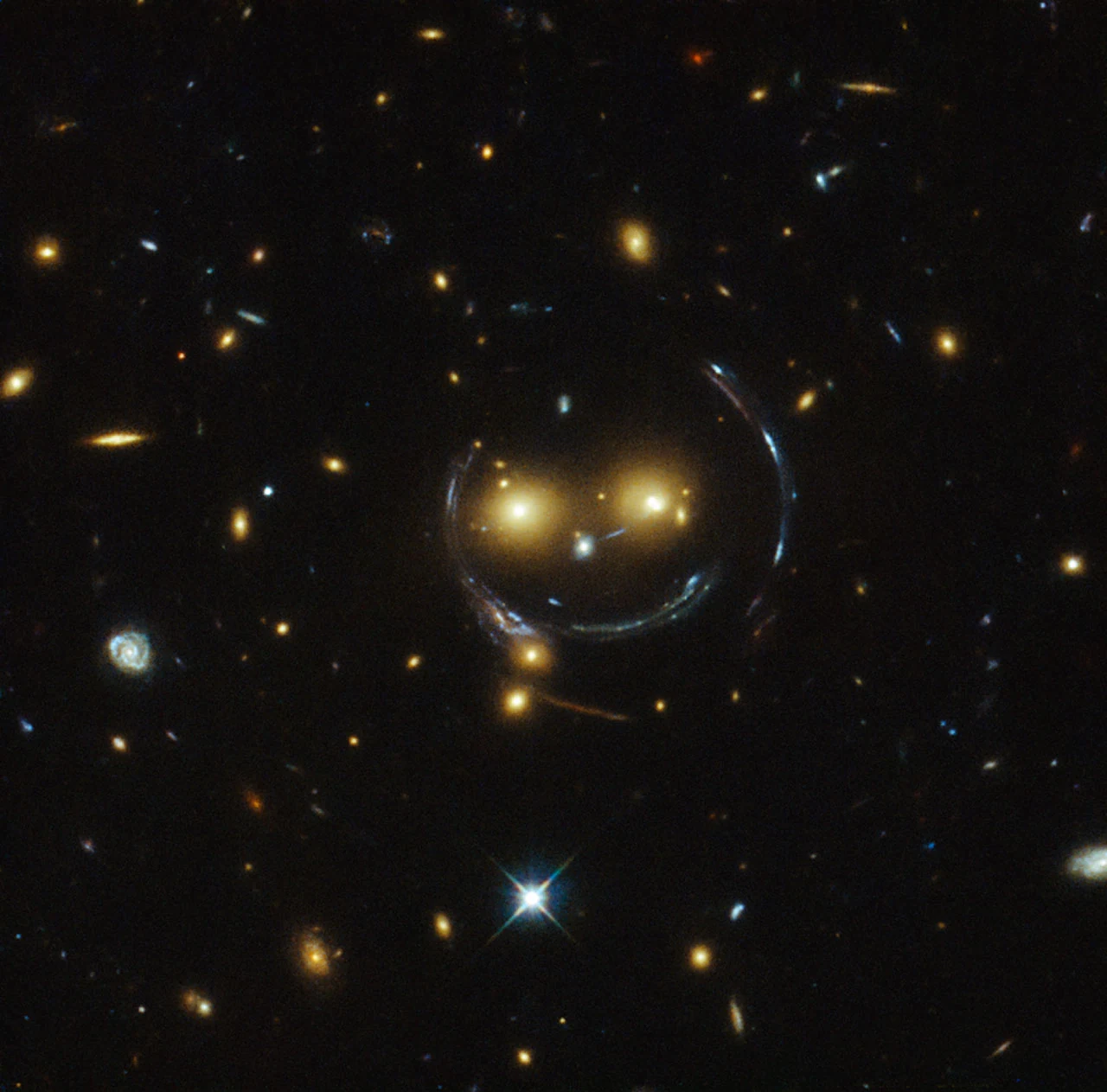
Euclid’s first quick data release covered 63 square degrees, about 0.45% of the sky the mission will eventually map, and in that sliver it turned up 497 galaxy-galaxy strong gravitational lenses. Of those, 250 are grade A candidates, and 243 had never been published before. In one fraction of one percent of the survey, the team doubled the number of strong lens candidates ever found with space-based imaging.
That’s the headline. The part I keep coming back to, as someone who spent years training image classifiers before I spent my evenings pointing a Seestar off a Nicosia balcony, is how they did it. It wasn’t one clever network. It was five different neural networks feeding a funnel of human eyes, and the honest lessons about which models worked, where they failed, and why you still can’t cut the humans out are more interesting than the pretty arcs.
What a strong lens actually is
Gravity bends light. Put enough mass between you and a distant galaxy (a massive foreground galaxy, or a whole cluster of them) and that mass acts like a warped lens, smearing the background galaxy into arcs, multiple images, or a full ring. When the alignment of source, lens, and observer is close to perfect, you get an Einstein ring: a circle of stretched light wrapped around the lensing galaxy.
The cover image is the well-known “Smiling Lens,” the galaxy cluster SDSS J1038+4849, where the lensing arcs happen to curve into something like a face. Most real lenses are far less photogenic: a faint blue smudge or a partial arc a couple of arcseconds across, sitting right on top of a bright elliptical galaxy.
They’re worth the hunt because a lens does three jobs at once. The shape of the arcs traces the total mass of the foreground galaxy, including its dark matter, down to small subhalos you can’t measure any other way. The lens magnifies whatever sits behind it, so a strong lens is a free zoom onto galaxies in the early universe that would otherwise be too faint to study. And if the background source is a quasar or supernova that flickers, the light paths have slightly different lengths, so the flicker arrives at different times. That delay is something you can turn into an independent measurement of the Hubble constant that sidesteps the usual distance ladder.
The catch has always been supply. Before Euclid, the entire literature held only a few thousand strong lens candidates, most from ground-based surveys and many never confirmed. Lenses are rare (of order one in ten thousand galaxies is a clean galaxy-galaxy lens), so finding them means sorting through a haystack no team of humans can inspect by hand.
Why this is a machine-learning problem
Euclid’s Q1 fields contain roughly a million galaxies bright and resolved enough to bother checking. The full six-year Wide Survey will image on the order of a billion. You cannot put a billion postage stamps in front of graduate students. This is exactly the shape of problem deep learning is good at: a rare, visually distinctive pattern buried in an enormous, mostly-boring background.
The Euclid Strong Lensing Discovery Engine, the collaboration’s name for the whole pipeline and spread across a run of papers in Astronomy & Astrophysics, works in stages. Neural networks do the first brutal cut, ranking every galaxy by how lens-like it looks. Citizen scientists inspect the top of that ranking. Experts vet what survives. Then a smaller team models the best systems one by one. Each stage is narrower and more expensive per object than the last, and the machines exist to make the human stages tractable.
The five models
The lens-finding paper is refreshingly blunt: it ran five different models against the same million galaxies and reported how each did, rather than cherry-picking a winner. The five:
- A plain 4-layer convolutional neural network, the simple baseline.
- OU-100, a network from the Euclid organisation’s own lens-finding unit.
- IncNet, built on Inception-style modules.
- Zoobot, the best performer.
- Lens Vision, a vision-transformer model.
Zoobot is worth dwelling on because it shows how much reuse is now baked into astronomy ML. It started life classifying galaxy morphologies (spiral, elliptical, barred) for Galaxy Zoo, trained across a mix of survey imaging. For lens finding the team fine-tuned its ConvNeXt-Nano backbone, a 15.6-million-parameter network. ConvNeXt is essentially a ResNet-50 that’s been modernised with tricks borrowed from vision transformers, so it keeps the efficiency of a convolutional net while picking up some of the newer architecture’s strengths. The point isn’t the acronym soup. It’s that the winning lens finder wasn’t built from scratch; it was a morphology classifier taught a new trick, the same transfer-learning move I wrote about when foundation models arrived in astronomy.
Lens Vision comes at it from the other direction. It uses a vision-transformer backbone with 14×14 image patches, pre-trained with self-supervised contrastive learning (no labels, just learning what Euclid galaxies look like) before being taught the lens/non-lens distinction on 80,000 simulated lens images and 80,000 non-lenses. Those non-lenses were chosen deliberately: ring galaxies, mergers, and face-on spirals are exactly the objects that fool a lazy classifier into shouting “ring.”
Best-performing meant Zoobot recovered 143 of the confirmed lenses inside its top 1,000 ranked candidates out of a million galaxies. That’s a hit rate you can actually work with. But here’s the finding I’d underline for anyone building these systems: no single model found every lens the others found. Each network had blind spots, and the union of five models was meaningfully better than the best one alone. Ensembling isn’t elegant, but on a rare-object search it buys real recall.
The humans didn’t leave
After the networks rank everything, the top candidates go to Space Warps, a citizen-science project where volunteers scroll through image cutouts and flag the ones that look lensed. Reported turnout for this round was more than 8,000 volunteers working through tens of thousands of cutouts. Crowds are good at this: a human eye rejects an edge-on spiral masquerading as an arc almost instantly, and thousands of independent votes smooth out any one person’s mistakes.
What survives the crowd goes to a handful of strong-lensing experts, who grade each candidate A, B, or C, and then the best systems get modelled individually, fitting an actual mass distribution that reproduces the arcs. Only after all of that does a candidate become a “lens” in the catalogue.
You might ask why, if the networks are so good, you need three layers of people behind them. The answer is false positives. At the scale of a billion galaxies, even a very accurate classifier produces a flood of wrong guesses in raw numbers, and the wrong guesses are the visually tricky ones: rings, mergers, tidal tails. There’s also a subtler problem the collaboration is candid about. The models are trained largely on simulated lenses, and simulations never quite match the real sky. A companion paper is specifically about closing that simulation-to-reality gap using confirmed lenses from the real Euclid data. Until that gap is closed, the humans are the calibration.
The number that’s coming
Q1 was the trailer. Scaling the same pipeline, the team projects roughly 7,000 grade A or B lenses by the first full data release (DR1, due from ESA in late 2026), and north of 100,000 by the end of the six-year mission. That’s two orders of magnitude above every strong lens found in the history of the field before Euclid switched on.
A hundred thousand lenses changes what the questions are. With a handful of systems you study each one lovingly. With a hundred thousand you do statistics: population-level constraints on how dark matter is distributed inside galaxies, thousands of magnified windows into the early universe, and enough time-delay systems to make lensing a serious, independent handle on the Hubble constant. It’s the same shift I’ve watched in every corner of survey astronomy this year, from Rubin’s alert brokers on down: the bottleneck moves from finding things to trusting the models that find them.
You won’t see any of these lenses from a backyard; they need space-based resolution, and most are fainter than magnitude 20. But you can still get your hands on the pipeline. Space Warps is open to anyone, and clicking through Euclid cutouts is a genuinely useful way to spend twenty minutes; the volunteers in that 8,000 weren’t decoration, they were a stage in a published discovery. And when DR1 lands later this year, the imaging goes public. The machines will have done the first pass. The interesting part, deciding which faint blue arc is actually real, is still a job for a careful pair of eyes.