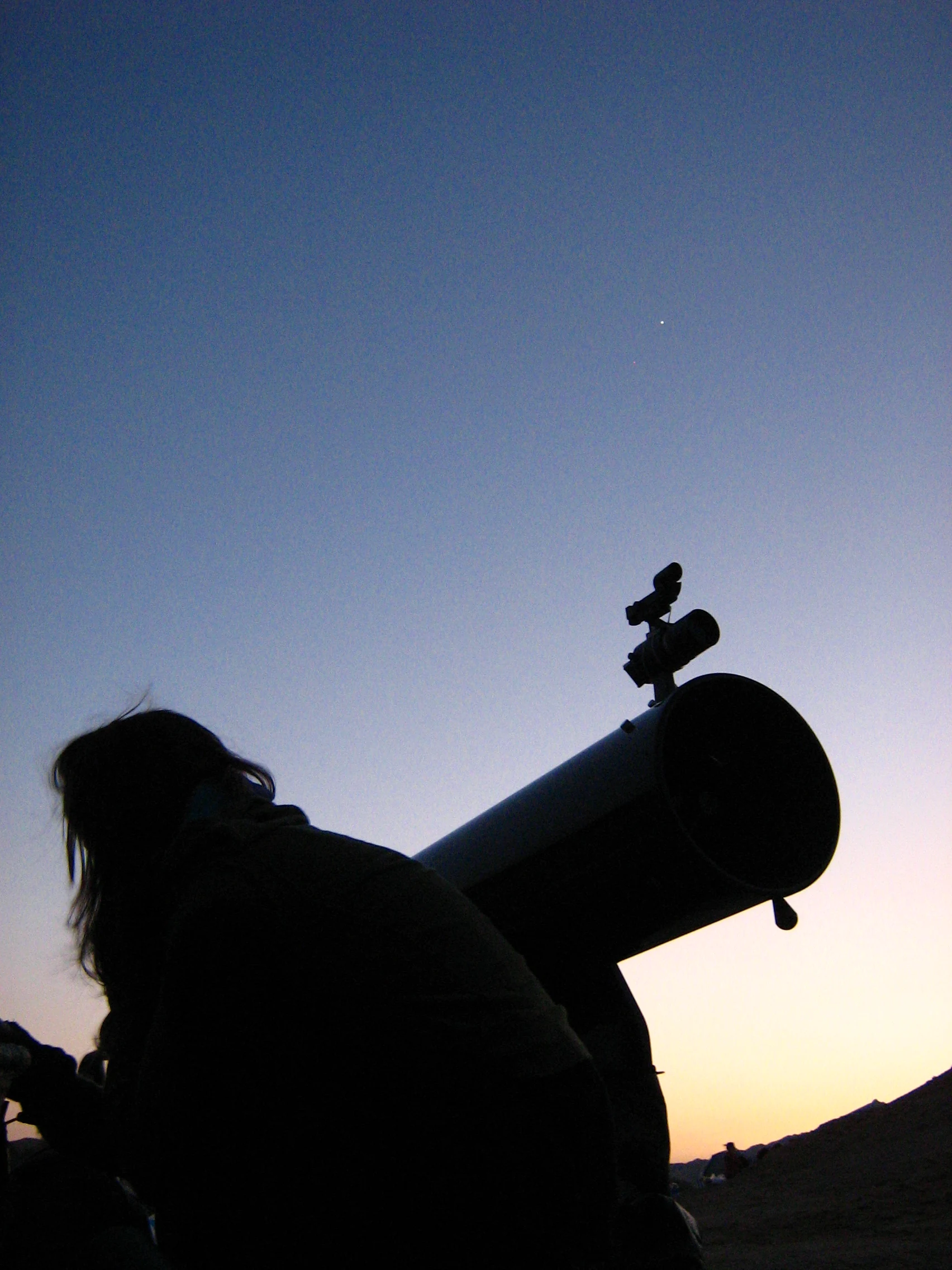
Somewhere in the next few weeks the first properly damp night of autumn will cut an observing session short, and it won’t be cloud that does it. A film of water forms on the front of the telescope, the stars go soft, then milky, then gone, and you spend twenty minutes with a battery hairdryer wondering where the sky went. That’s dew, and it’s the most avoidable way to lose a clear night. Here’s what forms it, what stops it, and where you can stop spending — because the cheapest fix is often enough, and some of you don’t need to buy anything at all.
Why glass dews when the air is still dry
The reflex explanation is “humidity,” and it’s only half the story. Your objective lens doesn’t cool down to the air temperature and stop there. It goes colder than the air around it.
Point any surface at a clear night sky and it radiates heat away as infrared, out through the atmospheric window (roughly 8–13 µm), toward a sky whose effective temperature can sit 15–30°C below the air at ground level. Glass is a good radiator. The still air a few centimetres in front of it barely conducts heat back. So the front element drifts a couple of degrees below ambient.
Now bring in the dew point: the temperature at which the air, at its current humidity, becomes saturated and starts giving up its water. On a dry desert night the dew point sits far below the air temperature, and radiative cooling never catches it. On a humid Mediterranean night in October, with the air at 16°C and the dew point at 14°C, a two-degree radiative drop is all it takes. The glass reaches 14°C, water condenses straight out of the air onto it, and you’re finished for the night.
This is why dew shows up on the clearest, stillest, most transparent nights: the ones with no cloud layer overhead to radiate warmth back down, which are usually the exact nights you most wanted to be out.
Two things follow from that. Dew is a surface-temperature problem more than a humidity problem, which is why the fix is to keep the glass warm rather than to dry out the whole sky. And the surfaces most exposed to open sky get hit first.
What dews first, and what gets off lightly
Where the optic points decides everything. A flat front element aimed near the zenith sees the most open sky and cools fastest:
- Refractor objectives, and the corrector plates on Schmidt-Cassegrains and Maksutovs. Big exposed front glass, sitting flush with the mouth of the tube. SCTs and Maks are the classic offenders because nothing shades that corrector.
- Camera lenses shooting wide-field Milky Way or meteors. A 14–24 mm lens pointed straight up is a small, fast disc of glass with no tube in front of it, and it’s often the first thing to fog on a landscape-astro shoot.
- Finderscopes and Telrad windows, which nobody thinks to heat and everybody curses at 01:00.
- Eyepieces, though those fog as much from your own breath and cheek as from the sky.
Newtonian reflectors get off lightly, which is worth knowing if you own one. The primary mirror sits deep in the tube, shaded from the sky, and the secondary is the usual casualty instead — and it dews far more slowly than a naked corrector plate would. If you observe with a refractor, an SCT, a Mak, or a camera lens, dew is more your problem than most.
Start with a dew shield (free to cheap)
Before any electronics, reach for a dew shield. It’s just a tube that extends out past the front element, and it works by cutting down the patch of open sky the glass can “see.” Less sky in view means less net radiative loss, which buys you time. Sometimes that’s the whole session; sometimes it’s one extra hour before the strap has to come on.
Refractors often ship with a retractable shield built in. Use it, fully extended, every time. SCTs and Maks usually don’t, and a flexible wrap-around shield is the best-value dew accessory you can buy: a few tens of euros, no power, nothing to break. You can also cut one from a camping mat and a strip of velcro. It looks agricultural and performs exactly as well as the bought version.
A shield has a ceiling, though. On a night when the dew point is sitting right up against the air temperature, it only delays the inevitable, because you’re slowing the heat loss rather than putting the heat back. That’s the point where you add power.
Heater straps: put back the heat the sky steals
A dew heater is a resistive strip you wrap around the tube at the objective. It draws a little current and pushes a few watts of warmth into the glass. The aim is narrow: hold the front element a couple of degrees above the dew point. Not warm, not “defogged,” just above the line where water condenses.
The temptation is to crank it up, and you should resist. Overheat the objective and you set up a plume of warm, rising air right in the light path, which softens every image the scope delivers. You’d be trading dew for bad seeing, and on a genuinely good night that’s the worse deal. The correct amount of heat is the least that keeps the glass dry, and on marginal nights that can be surprisingly little.
There are two flavours. USB straps plug straight into a power bank and run at a fixed output — the simplest possible setup, and what I use for camera-lens work because a power bank is already in the bag. RCA-style straps run off a controller instead: a Kendrick, a Thousand Oaks unit with four independent channels (tube plus finder plus guide scope), a DewBuster, or a Pegasus Pocket Powerbox that reads temperature and humidity and sets the output for you. A controller is overkill for one refractor and exactly right for a mount carrying a main scope, a guide scope, and a finder all at once.
On brands, don’t overthink it. Astrozap and Kendrick straps are the long-standing defaults; ZWO now sells its own plain Anti-dew Heater Strip aimed at the smart-telescope crowd. These are commodities. Match the strap to your tube diameter, match the connector to your power source, done. If you want model-by-model detail, AstroBackyard’s roundup goes deeper than I will here.
The power budget, worked out
Field observers care about this far more than balcony observers do, and it’s just arithmetic. Say a strap draws 5 W, a typical figure for a small-refractor or camera-lens strap on USB. A 10,000 mAh power bank stores about 37 Wh at the cell, so call it roughly 30 Wh out of the USB port once you allow for boost-conversion losses. 30 Wh ÷ 5 W ≈ 6 hours. That covers most of a night on one small bank; a 20,000 mAh unit doubles it, and a 12 V field battery driving an RCA controller will outlast both you and the clouds.
The number that actually bites is running heaters and a cooled camera and a mount and a dew-heated guide scope off a single battery. Budget each load on its own and carry more capacity than you think you need. A battery that dies at 02:00, with the sky finally steady and the target finally high, is its own particular heartbreak. If you already run a cooled camera in the field you’ve met this arithmetic before; I went through the summer heat version of it in imaging at 35°C.
Smart telescopes: the Seestar case
Smart telescopes complicate the picture, because some of them handle dew for you. The Seestar S50 I’ve run from my balcony for over a year has a built-in dew heater you toggle in the app, and for most Nicosia nights that’s the end of the conversation. (The rest of living with it is over here.)
But “built-in” isn’t “immune.” On the worst nights up at Troodos, when the car roof is soaked by midnight, I still slip a wrap-around dew shield over the front. Several third-party ones exist for the S50 (Buckeye Stargazer, TS-Optics, Cloud Break Optics), and the shield plus the internal heater together hold on longer than either does alone. The shield earns its place a second way from a balcony, blocking stray light from the neighbours’ windows.
If your smart scope has no heater at all, treat its front lens like any other refractor objective: shield first, small USB strap if the shield can’t keep up.
When it’s already fogged
If you catch it early, gentle warm air from a battery hairdryer held well back will clear the glass in a minute, and a dew shield or strap keeps it clear afterwards. What you never do is wipe the objective with a cloth. The condensation is pure water and will evaporate on its own; a cloth just drags dust across the coatings and risks a scratch to fix a problem that fixes itself. If dew has already soaked through to the point where warming won’t hold it, that’s the night telling you to cap the scope and pack up. No shame in it.
Who can skip all of this
Not everyone needs to spend money here.
- Observe from a genuinely dry site — high desert, a cold clear inland night with the dew point far below the air — and you may go whole sessions untouched. The Atacama is a dew-free luxury for exactly this reason.
- Keep your sessions short, a 30-minute balcony look before bed, and you might pack up before the glass ever reaches the dew point.
- Use a Newtonian, and the shaded primary buys you a lot of grace. Watch the secondary, not the tube mouth.
For everyone else, spend in this order: extend or add a dew shield first (cheap, no power, do this before anything else); add a single USB heater strap on the objective once the shield alone starts losing; move up to a controller only when you’re heating three things at the same time. You don’t need a four-channel controller to keep one refractor dry, whatever the shop suggests at checkout.
Bottom line
Dew is radiative cooling meeting a high dew point, and it comes for the best nights first. Shade the glass from the open sky with a shield, and if that isn’t enough, put back the few watts of heat the sky is stealing — no more than that, or you’ll wreck the seeing you were trying to protect. Start cheap and add power only when a real night tells you to. Mine, this time of year: shield always on, a USB strap on the camera lens up at Troodos, and the Seestar’s own heater doing its quiet work on the balcony rail.