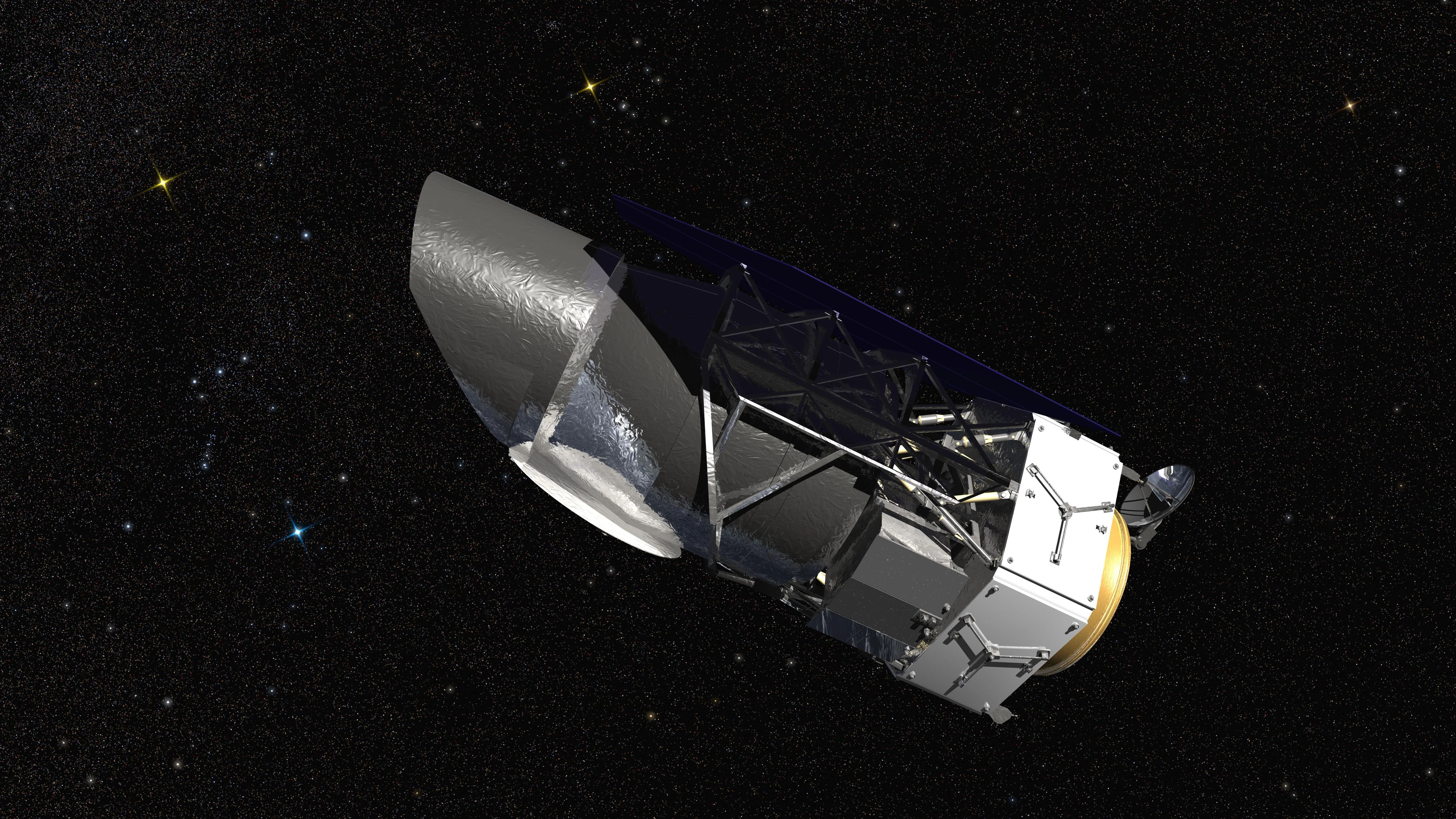
As I write this, NASA’s Nancy Grace Roman Space Telescope is bolted to the top of a SpaceX Falcon Heavy at Launch Complex 39A in Florida, and the countdown is running. Liftoff is set for 07:26 EDT: 11:26 UTC, or 14:26 here in Nicosia. NASA’s live coverage starts at 10:20 UTC on NASA+ and YouTube. If weather or a last-minute hold gets in the way, the backup window opens tomorrow morning at 11:22 UTC.
I’ll have the stream open with a coffee at half past two. This is the launch I’ve been most curious about all year, and not for the spectacle. A Falcon Heavy is a known quantity by now. What rides on top of it isn’t: Roman is NASA’s next flagship astrophysics mission after JWST, and it observes the sky in a way neither Hubble nor Webb can.
I wrote a full preview in July, when Roman arrived at Kennedy by barge, so here’s the short version. Roman carries a 2.4-metre primary mirror, the same diameter as Hubble’s, handed to NASA already figured by the National Reconnaissance Office. Behind it sits a 300-megapixel near-infrared camera with a field of view about 100 times Hubble’s. One Roman exposure covers as much sky as roughly a hundred Hubble frames, at comparable sharpness, in the near-infrared. Its destination is the second Sun–Earth Lagrange point (L2), about 1.5 million km out, where JWST and Gaia already orbit.
What happens after the rocket
The launch is the loud part, and the easy part. Falcon Heavy will put Roman on a trajectory toward L2; cruise and orbit insertion take weeks, and then come months of commissioning: cooling the instrument, focusing the optics, calibrating detectors against known stars. L2 is worth the trip out because it parks the Sun, Earth, and Moon all on the same side of the spacecraft, so a single sunshield keeps the near-infrared detectors cold while the sky in front of them stays dark and unobstructed. Nobody should expect science images this year. NASA’s plan puts routine survey operations in 2027. If you followed JWST, which launched in December 2021 and returned its first images the next July, Roman will feel similar. A dramatic morning, then a long quiet stretch before the data that actually matters shows up.
Two instruments are aboard. The Wide Field Instrument is the survey workhorse I described in the preview. The second, the Coronagraph Instrument, is a technology demonstration: it masks a star’s light to image the much fainter planets beside it. If it performs the way the team hopes, it’s a rehearsal for the direct-imaging observatories meant to photograph Earth-like worlds decades from now.
What it changes for the rest of us
I observe mostly from a Bortle 7 balcony, with drives up to Troodos when the Moon cooperates. From that seat, the thing that matters about Roman isn’t the hardware. It’s that nobody points it, not me and not a professor with a great idea, and yet all of its data becomes public.
Roman’s images and catalogs will land in the same public archive as Hubble and JWST (MAST), and its transient alerts will feed the same citizen-science pipelines that already let volunteers hunt asteroids and sort galaxies. If you’ve watched what Rubin’s alert brokers do on the ground, Roman is the space-based counterpart: fewer, deeper, near-infrared looks at chosen fields instead of an all-sky sweep every few nights. I pulled Rubin’s first public data earlier this month for exactly this reason, and Roman’s releases will be worth the same kind of afternoon. Unlike a single team’s Hubble program, the core Roman surveys carry no long proprietary period; getting the data into public hands quickly is most of the point of building a survey machine in the first place.
The bigger change is in the exoplanet census we all read about. Nearly every planet you’ve seen announced, from the TESS candidates to the JWST atmospheres, comes from the transit method: a planet crossing its star and dimming it by a fraction of a percent. Transits are blind to planets on wide orbits, and blind entirely to worlds drifting between the stars with no sun of their own. Roman’s Galactic Bulge survey uses gravitational microlensing instead, catching the brief brightening when one star drifts almost exactly in front of a more distant one and its gravity focuses the light. Microlensing doesn’t care how far a planet orbits from its star, so Roman is predicted to find thousands of cold, wide-orbit, and free-floating planets that transit surveys simply can’t reach. When those catalogs arrive, the running tally of known exoplanets is going to jump, and questions like whether free-floating planets outnumber stars will finally have measurements behind them.
The other half of Roman’s job is cosmology. Its wide survey will measure the shapes and distances of billions of galaxies to trace how dark energy has stretched space over cosmic time, and its time-domain fields will pin down thousands of Type Ia supernovae as standard candles. That’s the same measurement sitting at the heart of the Hubble-constant disagreement, the stubborn few-percent gap between the value from the early universe and the value from the local distance ladder. Roman won’t settle that argument on its own, but it’s built to shrink the error bars that keep it alive.
For the next few years, three machines will define the deep sky between them. JWST looks narrow and deep in the infrared. Rubin sweeps the southern sky every few nights in optical light. Roman fills the space between: wide and deep at once, near-infrared, above the atmosphere. Everything the three of them find lands, eventually, in archives any of us can open with a browser and a little Python.
Today, though
None of that is today. Today is the rocket, and a few tense minutes while a mirror that spent years in a government warehouse clears the tower and starts the long fall out to L2. If Roman flies on schedule, it’ll be well on its way by the weekend and mostly out of the news until commissioning wraps next year. I think it’s worth watching anyway. You don’t often get to see the exact moment a decade of data begins. I’ll have the stream open at 14:26, Nicosia time.