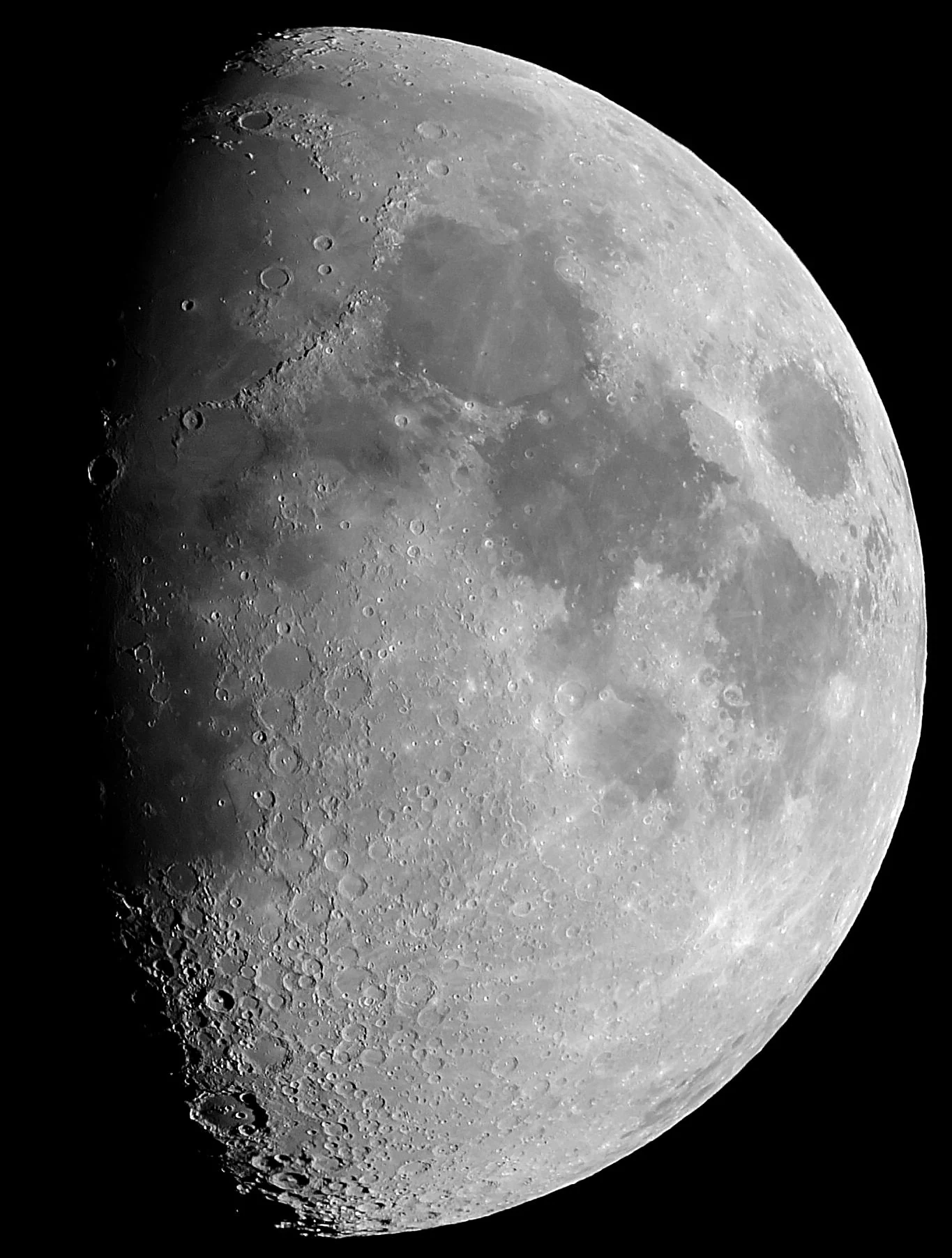
The single biggest thing standing between you and a good night under the stars isn’t your gear, your location, or even the weather. It’s the Moon. A full Moon can raise the brightness of the whole sky enough to erase the Milky Way, wash out every meteor fainter than a fireball, and flatten a galaxy into a grey smudge. A week later the same sky, from the same spot, with the same eyes, shows all of it. Nothing changed but the phase.
Once you can read the Moon’s phase, and predict it a week out, you stop wasting clear nights and start spending them on the right targets. Here’s how the lunar cycle actually works, why it takes 29.5 days and not the 27 you might expect, and how I use it to decide whether tonight is a Milky Way night from Troodos or a crater night from my balcony in Nicosia.
The eight phases, in order
The Moon runs through the same eight-step sequence every month, always in the same order: new, waxing crescent, first quarter, waxing gibbous, full, waning gibbous, last quarter (also called third quarter), waning crescent, and back to new. “Waxing” means the lit part is growing; “waning” means it’s shrinking. “Gibbous” just means more than half lit but not yet full.
That whole loop is one lunar cycle. The shape you see on any given night is a snapshot of where the Moon is in it.
Why the Moon has phases
Here’s the part most people get slightly wrong: the phases have nothing to do with Earth’s shadow. The Sun lights up exactly one half of the Moon at all times, the same way it lights half of Earth. What changes is how much of that lit half we can see from where we’re standing.
At new moon, the Moon sits roughly between us and the Sun, so its illuminated half faces away and the side toward us is dark. At full moon, the Moon is on the far side of Earth from the Sun, and we see the entire lit face. In between, we catch the lit hemisphere at an angle, so it reads as a crescent, a half, or a gibbous disc.
Earth’s shadow only touches the Moon during a lunar eclipse, which is why eclipses are occasional events rather than a monthly thing. The Moon’s orbit is tilted about 5° to Earth’s, so in most months the full Moon passes above or below the shadow and misses it. The full Moon on August 28 this year was one of the exceptions: it slid through the shadow for a 96% partial lunar eclipse. Most months, nothing.
29.5 days, not 27
The lunar cycle you experience, new moon to new moon, takes 29.5 days. This is the synodic month: 29 days, 12 hours, 44 minutes, to be exact. But the Moon completes one actual orbit of Earth in 27.3 days, the sidereal month, measured against the background stars.
The nearly two-day gap comes from the fact that Earth doesn’t sit still. While the Moon goes once around us, Earth travels about 27° along its own orbit around the Sun. After 27.3 days the Moon has returned to the same spot against the stars, but the Sun–Earth–Moon alignment that defines the phase hasn’t caught up. The Moon needs roughly two extra days to swing back into line. That’s why “a month” and “a Moon” are close but not identical, and why the calendar and the lunar cycle drift against each other all year.
What each phase does to your night
Phase matters for observing because each one rises and sets at a different time, so the Moon spends different parts of the night above the horizon. Roughly:
- New moon is up during the day and absent from the night sky. The darkest skies of the month, and when I plan anything faint.
- First quarter rises around local noon and sets around midnight, so it owns the evening: bright early, dark after midnight.
- Full moon rises at sunset and sets at sunrise. It’s up all night at an apparent magnitude of about −12.7, bright enough to cast shadows and drown everything faint.
- Last quarter rises around midnight and sets around noon, leaving the evening dark and handing the Moon to the small hours.
- The crescents cling to the Sun in the sky: a waxing crescent hangs low in the west after sunset, a waning crescent low in the east before dawn.
The Moon also rises, on average, about 50 minutes later each night as it slides roughly 13° eastward against the stars every day. That steady slippage is why the dark evening window walks through the month instead of staying put.
The dark window
Put those rise and set times together and a pattern falls out. For most of us who observe in the evening, the good dark nights cluster around new moon: roughly the ten nights from last quarter, through new, to the thin waxing crescent, when the Moon is either out of the evening sky or a sliver that sets early. Deep-sky observers and astrophotographers live by this window.
It’s why a meteor shower peaking near new moon, like the 2026 Perseids, is worth a drive, while one peaking under a full Moon, like this year’s Delta Aquariids, barely repays the effort. It’s the same reason every Milky Way photo worth keeping is shot in that moonless stretch, and why I only bother driving up to Troodos for the galactic core when the Moon is out of the way.
When the Moon is the target
The flip side is nice: the week around full moon, when deep-sky is hopeless, is when the Moon itself is worst to look at. A full Moon is lit head-on, so there are no shadows and no relief, just a flat, glaring disc that’s genuinely uncomfortable in a telescope without a filter.
The best time to actually observe the Moon is near the quarters, along the terminator, the line dividing the lit and dark halves. There the Sun sits low over the lunar surface, and every crater rim and mountain throws a long black shadow, the same way a landscape looks most dramatic near sunrise. Crater walls stand up in relief, and features that vanish at full moon jump out. The terminator creeps a little each night, so the same region looks different from one evening to the next. From my balcony a first-quarter Moon through the Seestar shows the crater Copernicus and the Apennine mountains in hard shadow; four nights later, near full, that same ground is a washed-out grey.
How to find tonight’s phase
You don’t have to track any of this in your head. Any planetarium app shows tonight’s phase and the Moon’s rise and set times, and lets you scrub forward a week to plan — I went through the good ones here. For longer-range planning, timeanddate and NASA’s Moon phase page both keep clean, accurate tables you can bookmark and pick nights from months out.
One more thing if you’re chasing faint targets: even a crescent Moon, once it clears the horizon, is bright enough to start undoing your dark adaptation. A thin waxing crescent low in the west isn’t a problem, since it sets within an hour or two. A gibbous Moon that’s up all evening is.
As I write this at the end of August, the Moon is a fat waning gibbous a few days past the full Moon of the 28th, bleaching the sky from mid-evening until dawn — a poor stretch for anything faint. The next new moon lands on September 11. That’s the night I’m already planning around: no Moon, a genuinely dark sky, and whatever the weather over the Troodos ridge decides to give me. Learn to read the phase, and you’ll start doing the same, saving your clear nights for the targets that actually reward them.