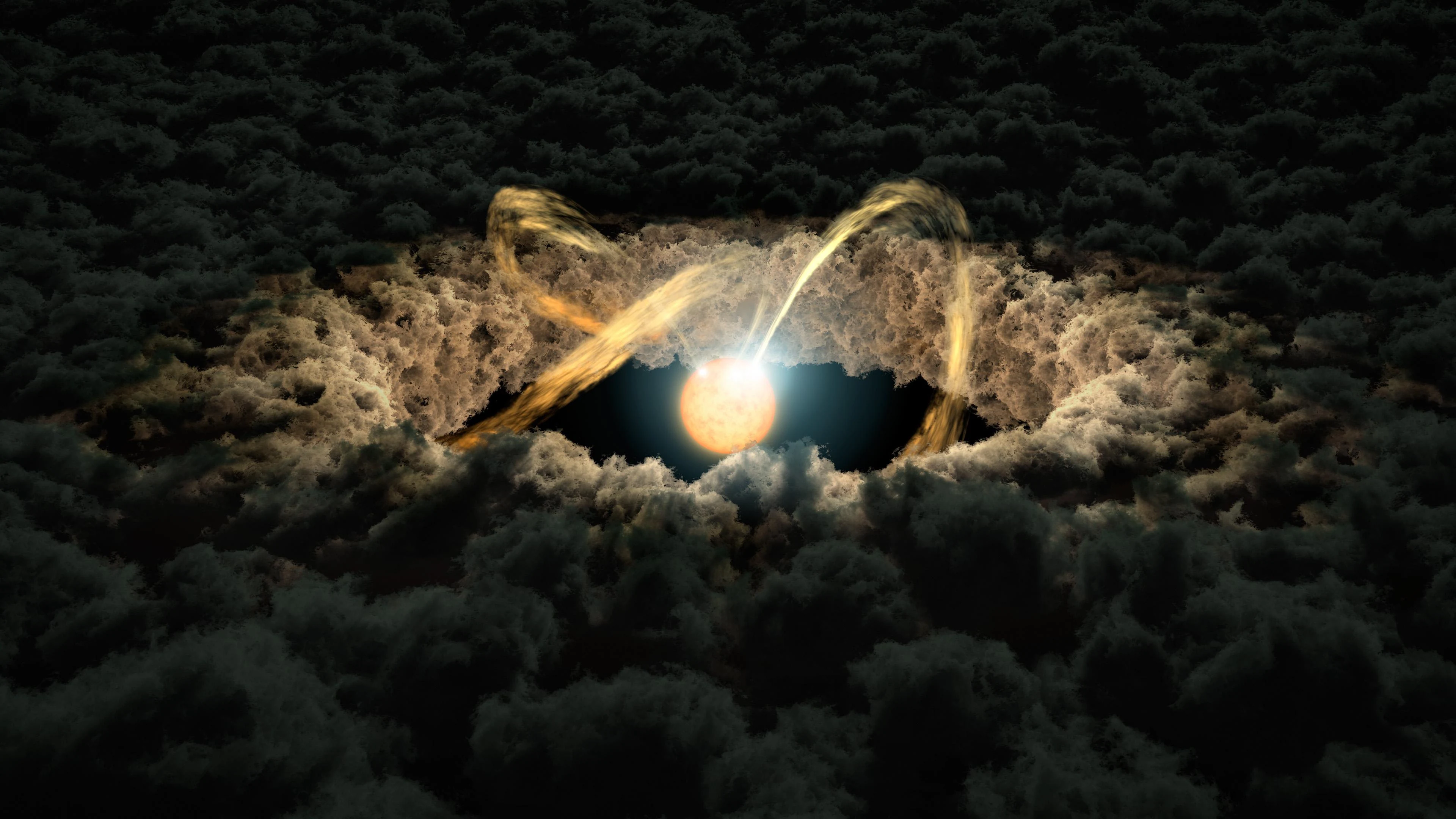
Every planet, ours included, assembled inside a flat disk of gas and dust that has since vanished. That disk is the raw material and the deadline at once: it survives only a few million years around a young star before the gas is gone, and any world that wants a thick hydrogen-helium atmosphere has to grab it before the tank runs dry. A new study led by Naman Bajaj at the University of Arizona used JWST to watch that gas actually leaving, mapping the jets and winds carrying it off in 72 young disks and showing how the escape route changes as a disk ages. The paper, “JWST/MIRI Reveals the Evolution from Molecular to Atomic Disk Winds”, is one of the largest JWST disk-wind surveys to date.
The disk is a countdown clock
A protoplanetary disk is what’s left over after a star finishes forming: a rotating pancake of gas and dust, with roughly 100 times more gas (mostly molecular hydrogen and helium) than solid dust by mass in its first few million years. Planets are built inside it. Rocky cores grow from the dust; gas giants like Jupiter then have to pull in an envelope of that hydrogen and helium while it’s still around.
The trouble is that the gas doesn’t stick around. Surveys of young star clusters have shown for decades that disks disappear on timescales of a few million years, a spread of roughly 2 to 8 Myr depending on the star. After that you have whatever planets you managed to build and nothing more to work with. That’s the “race against time” framing the authors use, and it isn’t hyperbole: whether a system ends up with a gas giant like the methane-rich worlds JWST keeps finding or just a few bare rocks can come down to how fast its disk emptied. Even an atmosphere that does form can leak back into space later.
That leaves an obvious question: how does the gas actually get out?
Two ways to drain a disk
Gas leaves a disk in a few competing ways, and telling them apart is the whole game.
Some of it simply falls inward and accretes onto the star. But a lot is thrown outward, and there are two broad families of mechanism for that:
- Magnetically driven winds and jets. Magnetic field lines thread the disk and, as it rotates, fling material off the surface: a slower, wide wind plus a narrow, fast jet shot perpendicular to the disk along its rotation axis. These are strongest while the star is still actively feeding, pulling gas inward at a high rate.
- Photoevaporation. The star’s own high-energy light (ultraviolet and X-rays) heats the disk’s upper skin until the gas is moving fast enough to escape the star’s gravity, boiling off as a slow wind. This one doesn’t care how much the star is accreting; it keeps working, and it’s thought to take over late, once the disk is already thinning.
The two leave different fingerprints, and that’s what makes them separable with the right instrument.
Reading the fingerprints with neon and hydrogen
Bajaj and 12 co-authors went back through archival data from JWST’s Mid-Infrared Instrument (MIRI), specifically its integral field unit — a mode that records a full spectrum at every pixel, so you can see where on the sky a given wavelength is coming from, not just that it’s there. They pulled 72 disks that happen to be tilted toward us by more than 40°, because an inclined disk lets you see a jet or wind standing up off the surface instead of buried in the disk’s own glare.
Two tracers did most of the work.
Ionized neon ([Ne II] at 12.81 microns) only glows once something strips an electron from it, and that takes a fairly energetic photon, over 21 electron-volts, exactly the kind of ultraviolet and X-ray radiation involved in these winds. A high-velocity [Ne II] signal off the disk axis is the signature of a jet; a slow, marginally resolved one is the signature of a photoevaporative wind. Earlier high-resolution spectroscopy pegged that slow neon wind at only about 5–10 km/s.
Molecular hydrogen shows up in a ladder of mid-infrared lines: the S(1), S(3), S(5) and S(7) rotational transitions. These trace warm molecular gas carried out in a wider, cone-shaped wind, and because the higher rungs of the ladder come from hotter gas, the set of lines works like a thermometer.
What the survey found
Out of 72 disks, 66 showed extended emission: gas reaching beyond the star in molecular hydrogen, neon, or both. Within that, the team built a framework to pick out two structures cleanly: cone-shaped molecular-hydrogen winds, detected toward 46 disks, and high-velocity neon jets punched perpendicular to the disk, toward 40. Every source with a neon jet also showed a matching wind, traced in molecular hydrogen 85% of the time and in atomic oxygen the rest. Jets and winds travel together; you don’t get one without the other.
The pattern that ties it into a story is how these detections track the star’s accretion rate, how fast it’s still swallowing disk gas. The neon jets and the warm molecular winds appear preferentially around the high accretors, and their frequency drops as accretion falls off. It doesn’t depend on how tilted the disk is or how massive the star is; it tracks accretion specifically. Meanwhile the slow, low-velocity neon winds (the photoevaporation signature) turn up preferentially around the low accretors. And among the disks that do have molecular winds, the hottest component (the S(7) and S(5) lines) fades faster than the cool S(1) gas as accretion drops.
Put together, that’s an evolutionary sequence caught as a single snapshot. While a young disk is feeding its star hard, magnetically launched jets and warm molecular winds do the heavy lifting of carrying gas away. As the star’s appetite fades, below roughly 10⁻⁸·⁵ solar masses per year, the jets weaken, the molecular wind cools and thins, and slow atomic photoevaporation becomes the dominant way the last of the gas escapes.
The honest caveats
This is a demographic argument, not a time-lapse. Nobody watched a single disk evolve; the team uses many disks at different accretion rates as stand-ins for different ages, the astronomer’s standard “space for time” trick. It’s a strong argument because the correlations are clean and the sample is large, but it’s still an inference. The data are also archival and skewed toward inclined, mostly mature (Class II) disks, which is a sensible choice for seeing winds edge-on but isn’t a random census. And “race against time” is the interpretation; what’s measured is which winds appear at which accretion rates.
None of that undercuts the result. It means the headline, planets racing a disappearing gas supply, is the frame, and the survey’s real contribution is nailing down which draining mechanism runs when.
What this has to do with a backyard scope
You are never going to see a disk wind from a balcony. This is 12-micron light gathered above the atmosphere; my Seestar S50 in Nicosia isn’t remotely in that game. But you can point a telescope straight at the nurseries where these disks live. Right now, in early September, Orion is climbing back into the pre-dawn sky here at 35° north, and the fuzzy patch below its belt, the Orion Nebula (M42), is the nearest big stellar maternity ward. Hubble famously imaged dark little teardrops silhouetted inside it: proplyds, protoplanetary disks being blasted by the ultraviolet of the massive Trapezium stars nearby. That’s photoevaporation too, just driven from the outside by other stars rather than from within.
When you look at M42 through an eyepiece (even as a grey smudge from a light-polluted garden), you’re looking at the stage this JWST study is dissecting: hundreds of young stars, each wrapped in a disk that’s already leaking, each running its own countdown. Some of those disks will build planets in time. Some won’t. The Bajaj survey is our clearest look yet at the machinery deciding which.
The full paper is on arXiv and published in The Astronomical Journal (DOI 10.3847/1538-3881/ae9089); the SETI Institute, whose scientist Uma Gorti co-authored it, has a plain-language write-up.