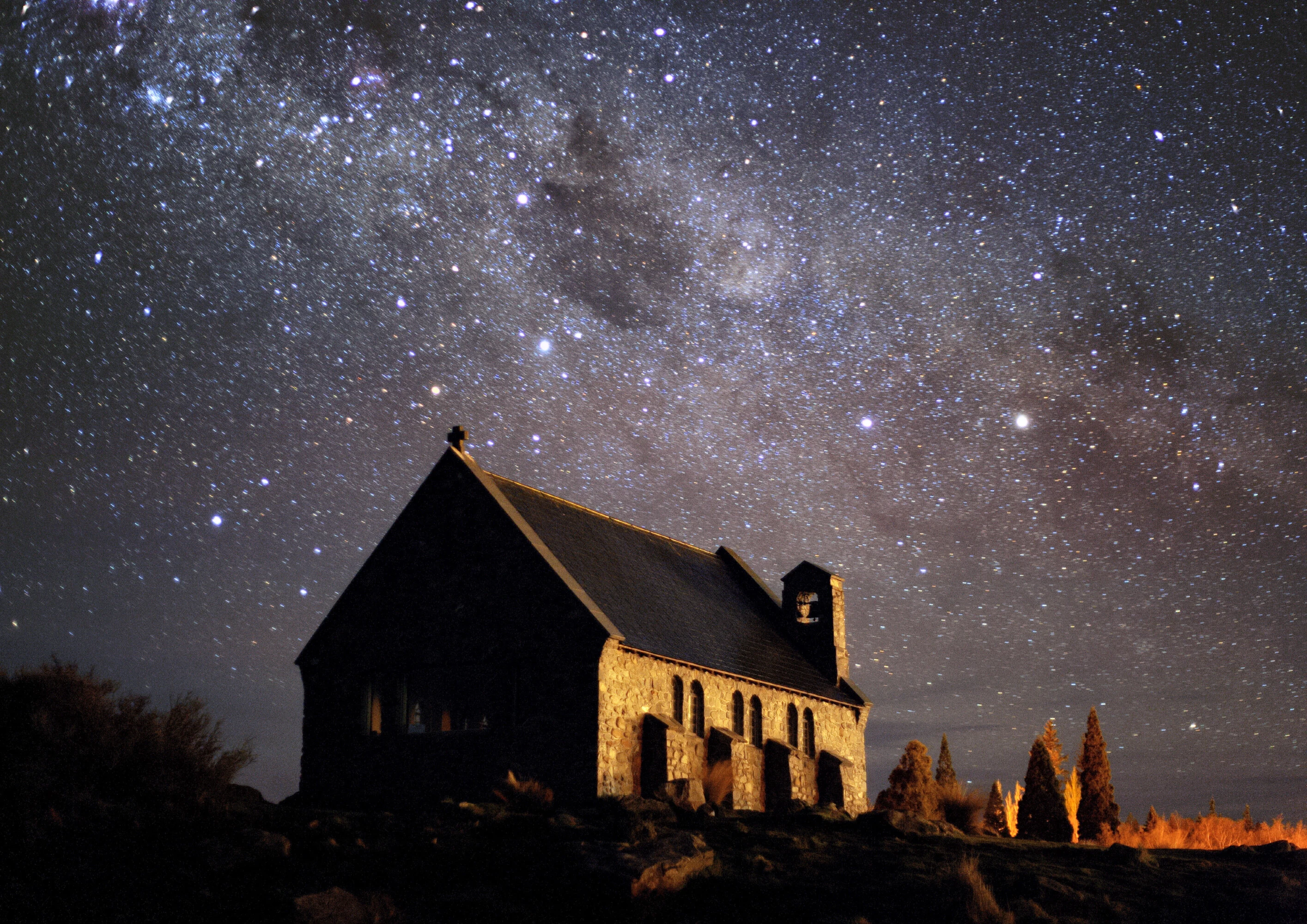
From my balcony in Nicosia, at 35° north, there’s a whole half of the galaxy I’ll never see. The Southern Cross never clears my horizon. The two Magellanic Clouds, the nearest galaxies bright enough to catch with the naked eye, sit permanently below it. To see them I have to get on a plane and fly south, and the most organised place on Earth to do that is a high, dry basin on New Zealand’s South Island: the Aoraki Mackenzie International Dark Sky Reserve.
Call this a destination guide rather than a field report; I haven’t stood under the Tekapo sky myself yet. But it’s near the top of my list, and after working through the reserve’s paperwork, the observatory’s setup and a decade of visitor logistics, here’s what a northern-hemisphere observer actually gains by going, and how to plan it so the weather doesn’t wreck the trip.
What the reserve actually is
DarkSky International (the body that certifies dark-sky places) named Aoraki Mackenzie an International Dark Sky Reserve in June 2012. It was the first reserve in the Southern Hemisphere and one of the largest anywhere, about 4,300 km² covering the Mackenzie Basin, Lake Tekapo, Lake Pukaki and Aoraki/Mount Cook National Park. Its core zone carries a gold-tier rating, the top rung of the scale, which means the sky over it is about as dark as an inhabited, reachable place gets: Bortle 1–2, where the Milky Way is bright enough to cast a faint shadow and the zodiacal light stands up as an obvious cone after dusk.
That rating isn’t an accident of geography alone. The Mackenzie District enforces outdoor-lighting rules that predate the reserve: shielded fixtures that throw light down instead of sideways, warm low-sodium lamps, and limits on brightness. The result is a town, Takapō/Tekapo, where you can walk a few minutes off the main street and already be dark-adapting.
At the centre sits Mount John, a 1,029 m hill above the lake that hosts the University of Canterbury’s observatory, New Zealand’s main optical research site. Its largest instrument is a 1.8 m telescope used for gravitational-microlensing surveys, the technique that finds planets by watching a foreground star briefly magnify a background one. A sealed road runs to the summit, but after dark it’s closed to casual traffic to keep stray headlights off the domes; you go up on a guided tour.
The sky you can’t get at 35° north
Here’s the payoff. Declination is the sky’s version of latitude, and from 35° N everything south of about −55° stays under the horizon all year. That line cuts off the best of the southern sky.
Crux, the Southern Cross, sits near −60°. The two bright Pointers beside it, Alpha and Beta Centauri, are just as far south. Alpha Centauri is the closest star system to the Sun, 4.3 light-years away, a naked-eye star I’ve never once seen. The Large and Small Magellanic Clouds ride at roughly −70°; from Tekapo they’re plain naked-eye smudges, satellite galaxies of our own, and a pair of binoculars turns them into fields of clusters and nebulae. Tucked against the Small Cloud is 47 Tucanae, one of the finest globular clusters in the sky. Over in Centaurus is Omega Centauri, the brightest globular of all: a fuzzy star to the eye, a ball of hundreds of thousands of suns in a telescope.
Then there’s the Carina Nebula, a star-forming region several times larger and brighter than Orion’s, invisible from Europe. And the Milky Way runs the wrong way up: the galactic centre in Sagittarius, which barely scrapes my southern horizon in Cyprus, passes nearly overhead from the Mackenzie in the southern winter. The dark dust lanes, including the Coalsack (the black notch beside the Cross), stand out because the sky behind them is genuinely black. If you’ve read my write-up of the Atacama southern sky, it’s the same catalogue of targets; Aoraki just hands it to you with paved roads and a research observatory attached.
Where to stand
Most photos you’ve seen of Tekapo are of the Church of the Good Shepherd, a small 1935 stone church right on the lake. It’s a fine foreground, and it’s on the cover of this piece. But it’s floodlit at night and pulls in crowds and car headlights, so it’s the worst spot to actually dark-adapt. Walk the lakeshore paths away from it, toward Mount John, and the sky opens up within a few minutes. Give your eyes the full 20–30 minutes it takes the rods to reach sensitivity, the same dark-adaptation that matters anywhere; here the reward is just steeper.
For the serious view, book the Mount John summit. The main operator, Dark Sky Project (formerly Earth & Sky), runs after-dark tours to the observatory where guides work the southern sky with green lasers and put you on telescopes. They also run an in-town experience built around tātai aroraki (Māori astronomy), worth doing on a cloudy night, because the sky here isn’t only a scientific object. For Ngāi Tahu, the South Island iwi, the stars are navigation and calendar; Matariki, the reappearance of the Pleiades cluster in midwinter, marks the Māori new year and is now a national public holiday. I’d rather learn a sky’s older names than pretend the physics is the only story.
If you have a car, the shores of Lake Pukaki and the road up to Aoraki/Mount Cook Village give you the same dark sky with the mountain on the skyline. The Mount Cook end trades a little convenience for foreground drama.
When to go
New Zealand’s seasons are flipped: autumn and winter run March to August, and that’s the window I’d aim for. Nights are longest, the air is coldest and driest, and the galactic centre climbs high after dark. If you want the core of the Milky Way straight overhead, roughly May to August on a moonless night is the target.
I’m publishing this in early September — the New Zealand spring. It’s a softer season: milder, fewer crowds, still-long nights, but the galactic core is sinking into the west after dusk while the Magellanic Clouds climb the south-eastern evening sky. You lose the overhead-Milky-Way spectacle and keep the southern galaxies. For a first trip I’d still choose late autumn or winter and pack for real cold at altitude. One bonus of being this far south, at around 44° S, is that a strong geomagnetic storm can put the aurora australis on the southern horizon. It’s not reliable, but it’s not impossible either.
Whatever the season, plan around the Moon (aim for the week bracketing new moon) and around cloud. This is the part people underplan. Weather cancels a large share of summit tours here (operators quote roughly 40–60%, depending on season), so build at least two clear-night chances into your itinerary rather than one. Tour companies will rebook or refund a clouded-out night, but they can’t rebook your flight home.
Getting there, and where to sleep
Tekapo sits on State Highway 8. From Christchurch it’s about a three-hour drive; from Queenstown, around two and a half to three. There’s no dark-sky-grade public transport, so this is a rental-car trip. That’s fine: a car is what lets you drive out to Pukaki or up toward Mount Cook on the clear night when it finally comes.
For lodging, Tekapo and nearby Twizel have the most options, and there are a handful of stays inside the park near Aoraki/Mount Cook Village if you want the mountain on your doorstep. (I don’t run affiliate links to any of these yet; book direct, or through whatever platform you already use.) Whatever you pick, prioritise being able to step outside into darkness over being in the middle of town.
The gear question
You need nothing. The Magellanic Clouds, the Cross, the Milky Way’s dust lanes: all naked-eye, once your eyes have adapted. A pair of 10×50 binoculars is the highest-value thing you can pack: enough to resolve 47 Tucanae and Omega Centauri and to sweep the Carina region. If you image, a smart telescope like a Seestar works fine on southern targets (the plate-solving doesn’t care which hemisphere it’s in), and the object list you’d never bother with from Europe suddenly gets interesting.
That’s the real reason to make the trip. From Cyprus I can chase the northern sky I already know well. Aoraki Mackenzie is one of the few places dark enough, and organised enough, to hand a northern observer the other half of the galaxy: a certified sky, a working research telescope, and someone to teach you the constellations’ first names.