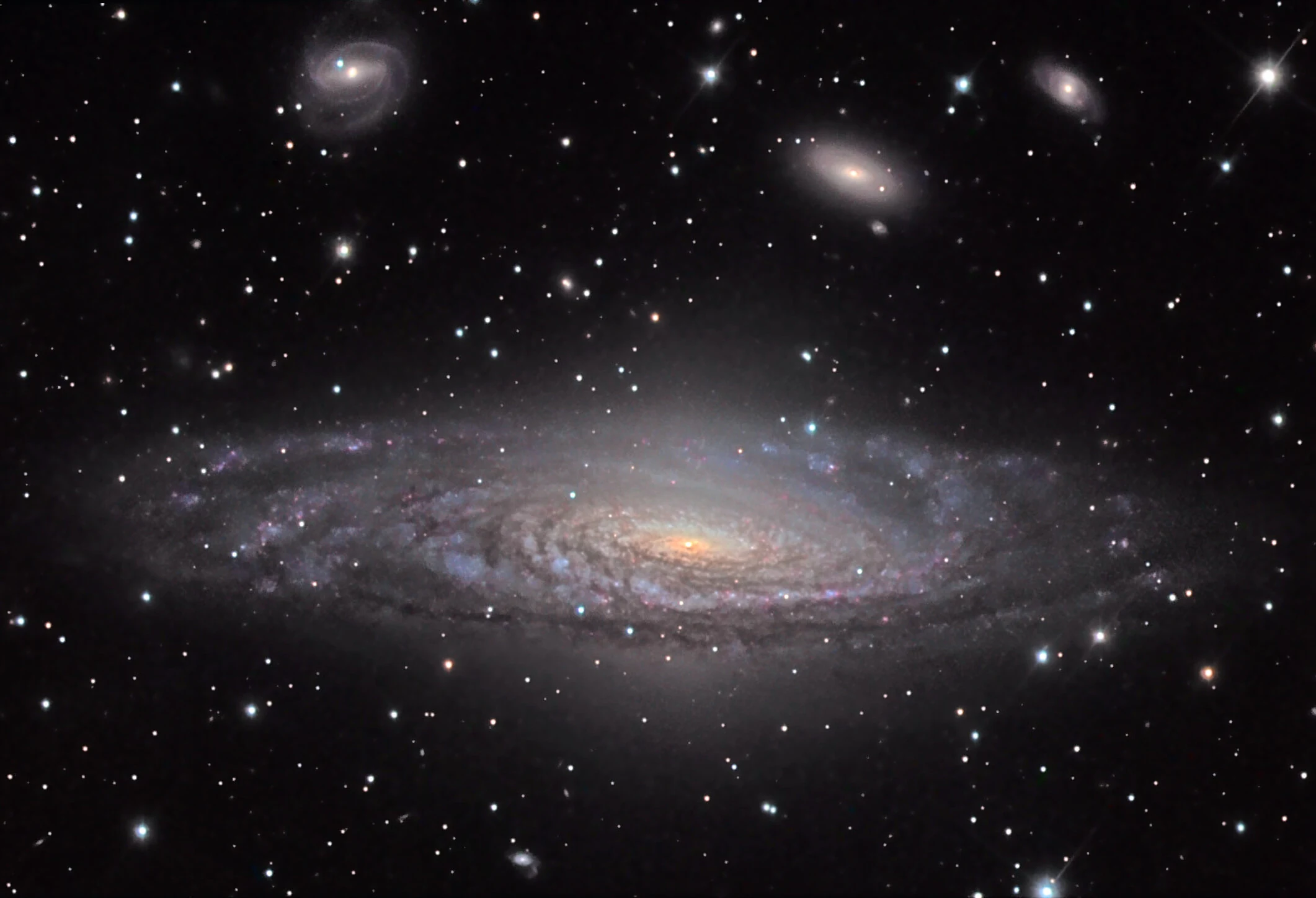
A white dwarf in the galaxy NGC 7331 tore itself apart in a thermonuclear explosion, and the light is only now reaching us, bright enough to catch in a backyard telescope. SN 2026aaiv is a Type Ia supernova in a spiral galaxy in Pegasus, about 44 million light-years away, and it’s still brightening. The ATLAS survey flagged it on September 1; by September 11 it had climbed to roughly magnitude 13.8, and observers expect a peak near 11th to 12th magnitude within a week or two. Pegasus rides almost overhead from 35°N around midnight this month, so from Cyprus the timing and the geometry both line up. If you own a telescope or a smart scope, the next couple of weeks are the window.
I haven’t pulled it out yet. The last few nights in Nicosia have been hazy, and at 14th magnitude this is not a naked-eye or a quick-glance object. So what follows is the plan I’m working from and the numbers behind it, plus why a Type Ia in a nearby galaxy is worth the effort even when it never gets bright enough to see without glass.
What ATLAS caught on September 1
The Asteroid Terrestrial-impact Last Alert System is a network of survey telescopes built to spot incoming asteroids, and it sweeps the whole sky every night or two. On September 1 it picked up a new point of light sitting on NGC 7331 that hadn’t been there before. Spectra taken soon after tagged it as a Type Ia: the thermonuclear detonation of a white dwarf, not the core collapse of a massive star.
Since then it’s done what young Type Ia supernovae do, which is brighten fast. The Transient Name Server record and the running log on David Bishop’s bright-supernova page collect the estimates as they come in; the most recent I’ve seen puts it around magnitude 13.8 on September 11 (a visual estimate by Tom Eby). A Type Ia typically takes two to three weeks to go from discovery to peak, so it should still be on the way up as you read this.
Why a Type Ia has a brightness you can predict
What makes this one more than a faint smudge to tick off a list is the physics behind that brightness. A Type Ia supernova happens when a white dwarf, the dead core of a Sun-like star, pulls enough matter off a companion (or merges with a second white dwarf) to approach the Chandrasekhar limit of about 1.4 solar masses. At that point the carbon and oxygen inside ignite in a runaway thermonuclear burn, and the whole star is destroyed in seconds. Because the trigger mass is nearly the same every time, the peak luminosity is nearly the same every time: an absolute magnitude close to −19.3, a few billion times the Sun’s output.
That uniformity is why Type Ia supernovae are the rung of the cosmic distance ladder that reaches deepest into the universe, and why they revealed the accelerating expansion of the cosmos, and dark energy, back in 1998. They aren’t perfectly identical; the Phillips relation ties how fast a Type Ia fades to how bright it was, which lets astronomers calibrate out most of the scatter and treat them as standardized candles.
You can run that logic yourself for SN 2026aaiv. NGC 7331 sits somewhere around 13 Mpc, call it 13.4 Mpc, which is about 44 million light-years (Cepheid-based estimates push it closer to 49, so there’s real spread in the number). A distance of 13.4 Mpc gives a distance modulus of about 30.6, the number of magnitudes the galaxy’s distance dims everything inside it. Subtract a peak absolute magnitude of −19.3 and you get an expected peak around magnitude 11.3. Dust in NGC 7331’s spiral arms, plus a little in our own Galaxy, will pull that down a few tenths toward 12. That’s the same range experienced observers are calling, and it’s a satisfying check that nobody is guessing: the arithmetic and the eyepiece agree.
NGC 7331, a galaxy that keeps blowing up stars
The host is worth knowing on its own. NGC 7331 (also catalogued as Caldwell 30) is an unbarred spiral of type SA(s)b, about magnitude 10 as a whole and well over 100,000 light-years across, a little larger than the Milky Way. For years it was called “the Milky Way’s twin,” a label that’s fallen out of favour now that we’re fairly confident our Galaxy is barred and this one isn’t. Through an eyepiece it’s an elongated glow with a bright core, noticeably brighter along one edge where a dust lane cuts across the near side.
It also has a habit of producing supernovae. SN 2026aaiv is the fifth recorded in NGC 7331, after SN 1959D, SN 2013bu, SN 2014C, and last year’s SN 2025rbs, and it’s the second Type Ia there in about fourteen months. That’s less the galaxy being special than it being big, nearby, and heavily watched. But two Type Ia in a row from one 10th-magnitude spiral is a fun coincidence for anyone who imaged the last one.
The 1959 and 2014 events were core-collapse supernovae, the death of a single massive star, which is a different animal from a Type Ia: messier, more varied in brightness, and the kind whose first X-ray flash the Einstein Probe caught as a shock breakout earlier this year. A Type Ia gives you the cleaner, more standardized light curve.
One bonus if you’re imaging: about half a degree south-southwest of NGC 7331 sits Stephan’s Quintet, the tight knot of interacting galaxies JWST used for one of its first public images in 2022. A wide-field smart scope can frame the supernova’s host and the Quintet in nearly the same shot. The little galaxies scattered around NGC 7331 in photos, the so-called fleas (NGC 7335, 7337, and 7340), are background objects five to eight times farther away, not real companions.
Finding it from 35°N
NGC 7331 lies in the northwest corner of Pegasus, near the border with Lacerta, at RA 22h 37m, Dec +34° 24′. The easy signpost is Eta Pegasi (Matar), a magnitude-2.9 star at the base of the horse’s neck; the galaxy is just over 4° north of it and slightly to the west. At declination +34° it transits within a degree of the zenith from 35°N, which for Cyprus means it passes essentially overhead around local midnight in mid-September, as high and through as little air as a deep-sky object ever gets from here. It’s already well up in the east by the end of twilight.
You can star-hop to it, but this is exactly the target where a GoTo mount or a plate-solving smart scope earns its keep: enter NGC 7331, let the scope slew and solve, and the supernova is the extra “star” sitting just off the galaxy’s core. Compare the field against a dated finder chart from the Rochester page or an AAVSO comparison chart to be sure which point is the supernova and not a foreground star.
What you’ll actually see, and what you need
Be realistic about the scale. The galaxy itself is magnitude 10 and spread out, so from my Bortle 7 balcony in Nicosia it’s faint and washed; NGC 7331 wants a genuinely dark sky and some aperture to show structure. The supernova is a magnitude 13 to 14 point right now. Catching it visually means an 8-inch or larger telescope from somewhere like Troodos, real dark adaptation, and a chart so you know exactly where to look. Near peak, at 11th to 12th magnitude, a 4- to 6-inch scope under a dark sky brings it within reach.
For most people, including me, the practical route is imaging. A Seestar S50 or any small smart telescope, stacking a few minutes of exposure, reaches magnitude 15 to 16 even from a light-polluted balcony, which puts both the galaxy and the supernova comfortably on the frame. That’s my plan: point the Seestar at NGC 7331 over two or three nights, stack ten to twenty minutes each time, and watch the extra star brighten and then fade against the galaxy’s arms. You won’t see colour or drama. You’ll see a single point of light that, for a couple of weeks, is shining with billions of times the Sun’s luminosity from a spot near the edge of a galaxy’s spiral arms.
Check the magnitude before you set up
One warning, the same one I give for any brightening object: the magnitude in this post is already going stale. Type Ia supernovae rise over a couple of weeks and then fade over a couple of months, so a fixed number is close to useless by the time you read it. Before you set up, pull a current estimate from the Rochester bright-supernova page or the TNS record; the AAVSO carries comparison charts too if you want to make your own estimate. If it’s already sliding back down past 14th magnitude, plan on imaging rather than an eyepiece.
Type Ia supernovae are the reason we can put numbers on the size and expansion of the universe, and most of the ones that anchor that measurement are faint specks in galaxies nobody can name. This one is bright enough, and well enough placed, that you can go outside this week and record the same kind of explosion for yourself. A white dwarf finished burning 44 million years ago, the photons have been traveling since before the first apes existed on Earth, and they land on your sensor on an ordinary night over Nicosia. That’s worth ten minutes of stacking.